


Magazine Archive
Home -> Magazines -> Issues -> Articles in this issue -> View
Leader | |
Article from Recording Musician, October 1992 | |

Using recording equipment is not particularly difficult, and anyone wishing to get involved shouldn't get too worried about the technicalities because, like photography, it is a subject that can be approached at a number of levels. Using even the most basic equipment, it is possible to explore many basic recording techniques, and at the same time, come up with a pretty good end result. However, it must be appreciated at the outset that the role of technology in music goes far beyond being able to use a tape recorder.
Over the last decade, we have been presented with countless ways of processing and mixing recorded sound — we now have to contend with MIDI synthesisers, sound samplers, MIDI sequencers, drum machines, automated mixing consoles and so on: the list seems endless. Then there are peripheral gadgets that help us link it all together, such as synchronisers, remote controllers, interface boxes and patchbays, which makes the subject as a whole potentially very complex.
Any one area can be tackled in isolation without too much of a problem — I am fortunate in that my interest in recording started many years ago, and as a consequence, I have been able to assimilate most of the technology as it emerged. But today, it is less easy for someone to start right from scratch because technology permeates so many areas of music creation, recording, production, and even composition.
This techno barrier faces all musicians who want to branch out into recording, and it also faces music teachers, who are required to come to terms with the new technology with a minimum of training. In truth, many teachers are lucky if they get a whole day's specialist training and, as anyone who's already familiar with the subject will tell you, this would be laughable if it wasn't so serious.
Music Technology is every bit as complex as any other academic subject — if it was ever suggested that a music teacher could learn to teach A-Level physics in a day, I'm sure that the nonsense of the situation would be appreciated without further discussion. Likewise, the typical musician can't expect to buy a state-of-the-art studio package complete with MIDI sequencer and start making professional recordings from day one.
Recording Musician can help anyone wishing to start recording by going through basic areas, one at a time, but there is no quick fix — this is a potentially complicated area which is becoming ever more so as more and more new technology emerges. The only sane path is to tackle it a section at a time and learn to walk before you can run. By all means think about your ultimate recording system, but you're likely to get more out of it if you build up your system slowly and familiarise yourself with each new piece of equipment as it is added.
Publisher: Recording Musician - SOS Publications Ltd.
The contents of this magazine are re-published here with the kind permission of SOS Publications Ltd.
The current copyright owner/s of this content may differ from the originally published copyright notice.
More details on copyright ownership...
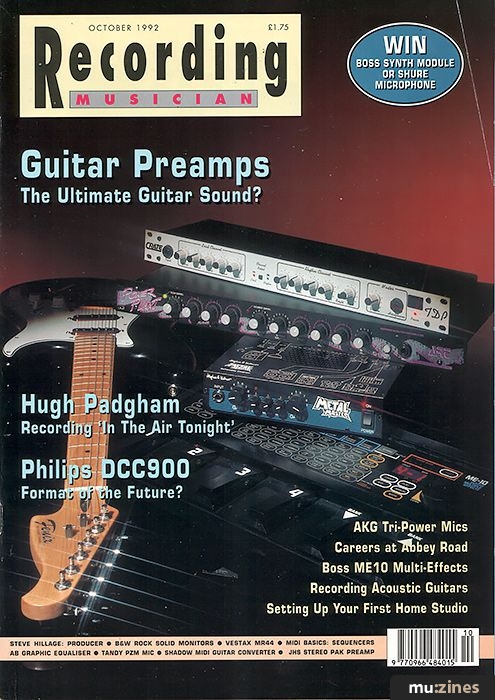
Recording Musician - Oct 1992
Editorial by Paul White
Next article in this issue:
Help Support The Things You Love
mu:zines is the result of thousands of hours of effort, and will require many thousands more going forward to reach our goals of getting all this content online.
If you value this resource, you can support this project - it really helps!
Donations for November 2026
Issues donated this month: 0
New issues that have been donated or scanned for us this month.
Funds donated this month: £0.00
All donations and support are gratefully appreciated - thank you.
Magazines Needed - Can You Help?
Do you have any of these magazine issues?
If so, and you can donate, lend or scan them to help complete our archive, please get in touch via the Contribute page - thanks!
If you're enjoying the site, please consider supporting me to help build this archive...
...with a one time Donation, or a recurring Donation of just £2 a month. It really helps - thank you!

 @mu_zines
 RSS Feed
 Blog