


Magazine Archive
Home -> Magazines -> Issues -> Articles in this issue -> View
Article Group: | |
Rock hoppers | |
Ortofon/Stanton cartridgesArticle from The Mix, May 1995 | |
Scratching and backtracking without tears
Two of the biggest names in styli, Stanton and Ortofon have always been the first choices for the DJ trickster. In true tradition, the two brands are again battling it out... This time with a new style of heavy-duty cartridge. Robin Green puts two 'Concordes' through their paces in a demanding test flight.

It isn't really doing these designs justice to refer to them as cartridges. In fact, they're all-in-one integrated heads which totally eliminate any inconvenient wiring, and (in theory) provide superior balance and tracking to the old style of cartridge you had to wire up yourself. I decided to pull on my anorak, and throw both designs in at the deep end, with a series of tests in both the home and club environment.
First of all, I should say that I have been using both the Trackmaster and the Night Club for a couple of months, and now feel qualified to judge the two products without prejudice. In this field, build quality and other practical matters are at least as important as sound quality. An absolute must, however, is tracking. That's one area where there's no room for compromise.
Ortofon Concorde Night Club E
Each of these cartridges comes in an impressive presentation box. Inside a plush, miniature coffin covered in red velour, the sleek Concorde is tucked up in satin sheets with two spare styli, and a cleaning brush. It seems like the perfect DJ's tool: A top quality cartridge that simply screws onto the end of your record deck arm, with a fluorescent stylus tip to assist cueing up in the dark. So how would it fare in my gruelling test?
As soon as the needle hit the groove, I noticed the improvement in sound quality. It was quite clear and bright, with the bass coming through tight and punchy. I found the mid-range very prominent and definitely the clearer frequency band — arguably of benefit in the muddy acoustics of a club, but not a sound that I'm not particularly keen on personally. The next stage in the test was the back tracking and scratching.
A tough test indeed for a stylus; 'make or break' in the harsh world of vinyl abuse. I began scratching lightly, and slowly sped up to a more vigorous action. (Have you seen a doctor? — Ed). But although the Concorde feels fairly delicate, it held its own quite well under pressure. I eventually managed to make it skip, but it took some doing.
After using the cartridges for several months now, I can't understand why they've started to skip at points in the record that other styli would ride over. Admittedly, this usually happened when there was a lot of bass in the room, which can set off turntable rumble. But to change styli every few weeks can work out expensive. I don't expect my styli to jump at all, even after weeks of hard use. It's reasonable to expect a certain diminution of sound quality after a month or two, but if it is damaged by constant scratching and back-tracking, then you face a problem.

You could be forgiven for thinking that the Ortofon was lighter, but in fact both cartridges weigh in at 17-18 grams. The extra weight isn't necessarily better for scratching. It depends not only on tracking weight, but also the balance of the cartridge, and its centre of gravity. On the Concorde, the weight seems to be centered around the steel rear area, where the cartridge connects to the tonearm socket. And the body itself is light and thin, which may account for some of my difficulties during scratching and backtracking.
All things considered, the Concorde isn't a bad stylus. It's competitively priced at £59.95 for the E (elliptical) and £54.95 for the S (spherical) range. This represents pretty good value for money, so long as you don't go in for my style of vinyl abuse!
"It was make or break, in the harsh world of vinyl abuse"
Stanton Trackmaster AL
In design terms, the Trackmaster and Ortofon are very alike, right down to the velour case, this time in 'sophisticated black'! On this cartridge, the entire plug area is gold plated to provide a better connection, and the body is also more substantial. Fashioned in tough, black plastic, you know the Trackmaster means business, even if the stylus casing looks a bit rougher around the edges than the Ortofon. But what of the sound quality?
I used the Trackmaster at home, as well as live, one Friday night where I'd previously used the old Stanton Mk 2 cartridges. When I changed to the Trackmaster, the improvement in bass response was immediately apparent. In fact, the top end was also boosted, producing a louder, crisper sound. I am rather partial to the sound of the Trackmaster, as the sub-bass reproduction is good, and the tinny mid-range less prominent.
As far as tracking goes, the Trackmaster cuts the mustard. Even when the bass was too loud and the rumbling effects came into play, the Trackmasters held their own. They're not perfect, but they certainly stuck to the vinyl when I needed it most. And after a couple of month's use both at home and live, the deterioration in sound quality was hardly noticeable, even over a large PA system.
One particularly good design feature is the Trackmaster's V-Guard stylus system which comes in two versions — AL (spherical) and EL (elliptical). I was using the AL, which I believe is designed to be moderately more resilient for scratching than the EL, while the EL apparently sinks into the grooves slightly better, perhaps giving a slightly clearer sound.
The Trackmaster seems to have a well thought-out, even weight distribution. I think this, combined with its high-precision stylus tip makes for a quality product that will last and stand up to the rigours of scratching and backtracking.

When comparing the two cartridges, it is only fair to say that the Ortofon had an elliptical stylus, whereas the Stanton had a spherical one. Although the difference between the two formats is fairly minimal, I had to consider this in my judgement. Although the Stanton came out best in most areas, it is considerably more expensive than its rival. About £38 more expensive in fact, and if you want the Trackmaster EL, you're looking at paying around £58 extra.
Stanton obviously have a lot of faith in their product, and personally I wouldn't be too worried about spending the extra money for a cartridge that has great sound and will stand the test of time. Ultimately, the choice is yours...
Spec check
| Stanton Trackmaster AL | Ortofon Concorde Night Club S | |
| Weight | 17g | 18g |
| Stylus type | Spherical High Polish | Spherical |
| Tracking Force | 2-5g | 2-5g |
| Frequency response | 20Hz - 20kHz | 20Hz-25kHz |
| Output voltage | 5.2mV | 6mV |
| Channel separation | >30dB | >23dB |
| Tracking ability @ 300Hz | 90μm | 80μm |
| Stanton Trackmaster EL | Ortofon Concorde Night Club E | |
| Weight | 17g | 18g |
| Stylus type | Spherical High Polish | Spherical |
| Tracking Force | 2-5g | 2-5g |
| Frequency response | 20Hz - 20kHz | 20Hz-25kHz |
| Output voltage | 5.2mV | 6mV |
| Channel separation | >30dB | >23dB |
| Tracking ability @ 300Hz | 80μm | 80μm |
The essentials...
More from: Lamba Plc, (Contact Details)
The essentials...
More from: Ortofon UK, (Contact Details)
Publisher: The Mix - Music Maker Publications (UK), Future Publishing.
The current copyright owner/s of this content may differ from the originally published copyright notice.
More details on copyright ownership...
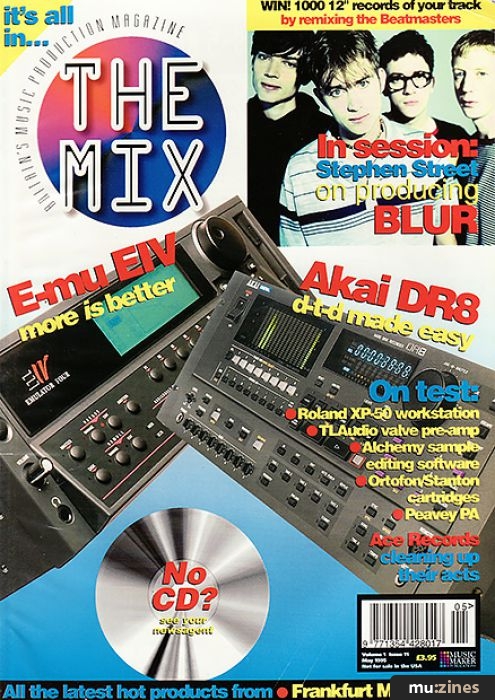
The Mix - May 1995
Donated by: Colin Potter
Coverdisc: Nathan Ramsden
Control Room
Review by Rob Green
Help Support The Things You Love
mu:zines is the result of thousands of hours of effort, and will require many thousands more going forward to reach our goals of getting all this content online.
If you value this resource, you can support this project - it really helps!
Donations for May 2026
Issues donated this month: 0
New issues that have been donated or scanned for us this month.
Funds donated this month: £0.00
All donations and support are gratefully appreciated - thank you.
Magazines Needed - Can You Help?
Do you have any of these magazine issues?
If so, and you can donate, lend or scan them to help complete our archive, please get in touch via the Contribute page - thanks!
Please Contribute to mu:zines by supplying magazines, scanning or donating funds. Thanks!
Monetary donations go towards site running costs, and the occasional coffee for me if there's anything left over!

 @mu_zines
 RSS Feed
 Blog
Blog