
Magazine Archive
Home -> Magazines -> Issues -> Articles in this issue -> View
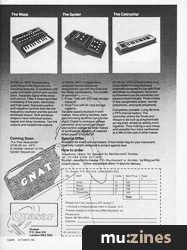
Wasp Synth | |
KeyboardsArticle from Sound International, December 1978 | |
Soundintpix presents 'Swarm (Isn't it)', starring Dave Crombie as Henry Fonda and a yellow and black object that goes Buzz and strikes terror into the hearts of more expensive synthesiser manufacturers.
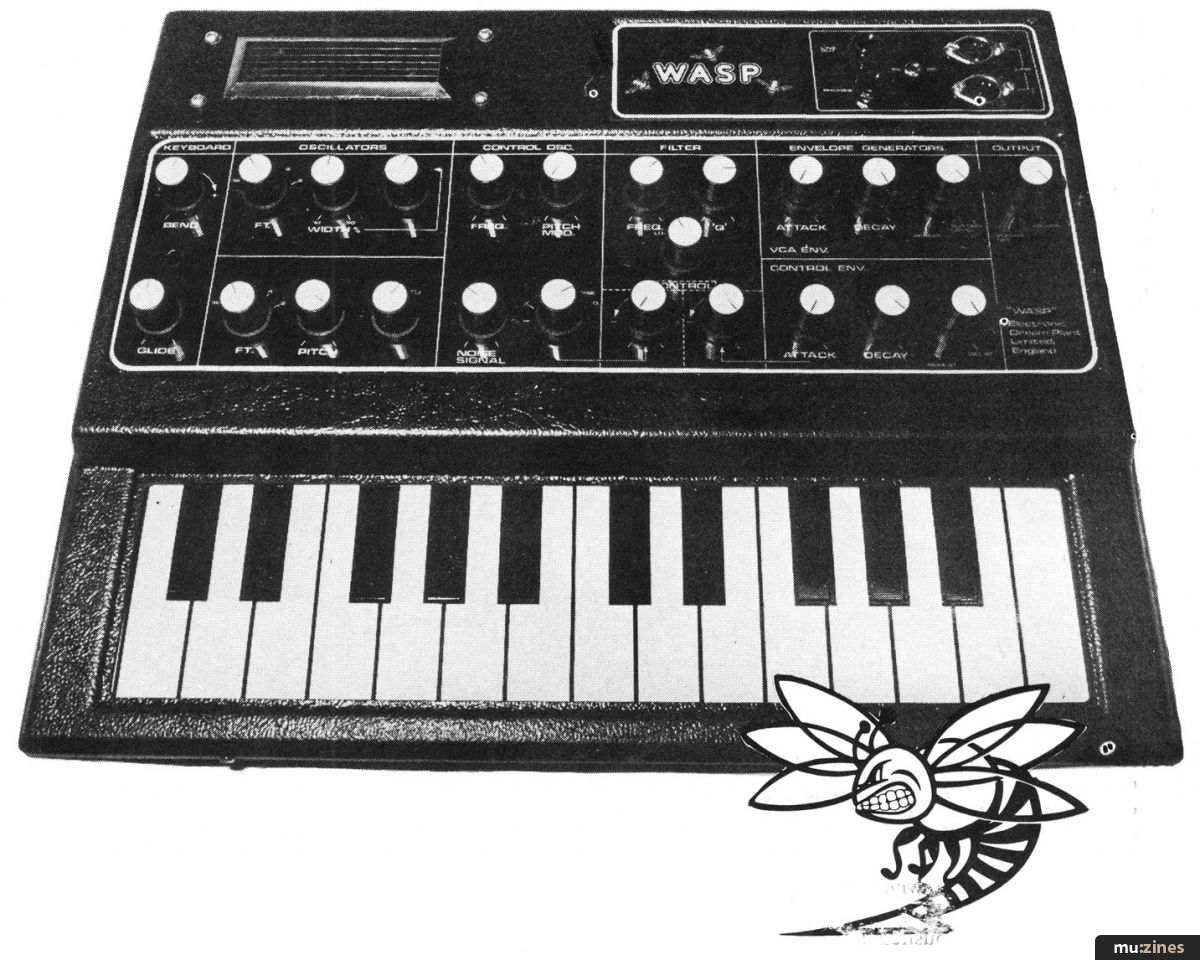
Having played the Wasp for only a couple of minutes I came to the conclusion that this instrument represents probably the most important keyboard development for many years. It will enable almost anyone to get into the world of electronic music.
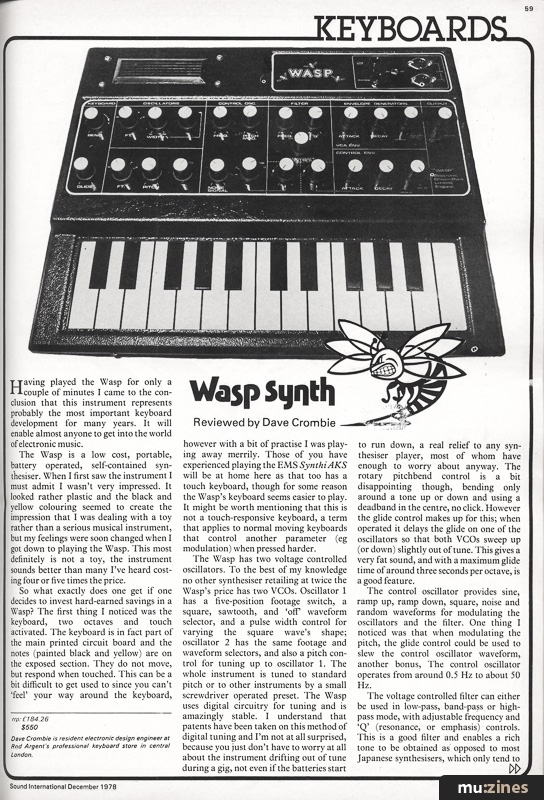
The Wasp is a low cost, portable, battery operated, self-contained synthesiser. When I first saw the instrument I must admit I wasn't very impressed. It looked rather plastic and the black and yellow colouring seemed to create the impression that I was dealing with a toy rather than a serious musical instrument, but my feelings were soon changed when I got down to playing the Wasp. This most definitely is not a toy, the instrument sounds better than many I've heard costing four or five times the price.
So what exactly does one get if one decides to invest hard-earned savings in a Wasp? The first thing I noticed was the keyboard, two octaves and touch activated. The keyboard is in fact part of the main printed circuit board and the notes (painted black and yellow) are on the exposed section. They do not move, but respond when touched. This can be a bit difficult to get used to since you can't 'feel' your way around the keyboard, however with a bit of practise I was playing away merrily. Those of you have experienced playing the EMS Synthi AKS will be at home here as that too has a touch keyboard, though for some reason the Wasp's keyboard seems easier to play. It might be worth mentioning that this is not a touch-responsive keyboard, a term that applies to normal moving keyboards that control another parameter (eg modulation) when pressed harder.
The Wasp has two voltage controlled oscillators. To the best of my knowledge no other synthesiser retailing at twice the Wasp's price has two VCOs. Oscillator 1 has a five-position footage switch, a square, sawtooth, and 'off' waveform selector, and a pulse width control for varying the square wave's shape; oscillator 2 has the same footage and waveform selectors, and also a pitch control for tuning up to oscillator 1. The whole instrument is tuned to standard pitch or to other instruments by a small screwdriver operated preset. The Wasp uses digital circuitry for tuning and is amazingly stable. I understand that patents have been taken on this method of digital tuning and I'm not at all surprised, because you just don't have to worry at all about the instrument drifting out of tune during a gig, not even if the batteries start to run down, a real relief to any synthesiser player, most of whom have enough to worry about anyway. The rotary pitchbend control is a bit disappointing though, bending only around a tone up or down and using a deadband in the centre, no click. However the glide control makes up for this; when operated it delays the glide on one of the oscillators so that both VCOs sweep up (or down) slightly out of tune. This gives a very fat sound, and with a maximum glide time of around three seconds per octave, is a good feature.
The control oscillator provides sine, ramp up, ramp down, square, noise and random waveforms for modulating the oscillators and the filter. One thing I noticed was that when modulating the pitch, the glide control could be used to slew the control oscillator waveform, another bonus, The control oscillator operates from around 0.5 Hz to about 50 Hz.
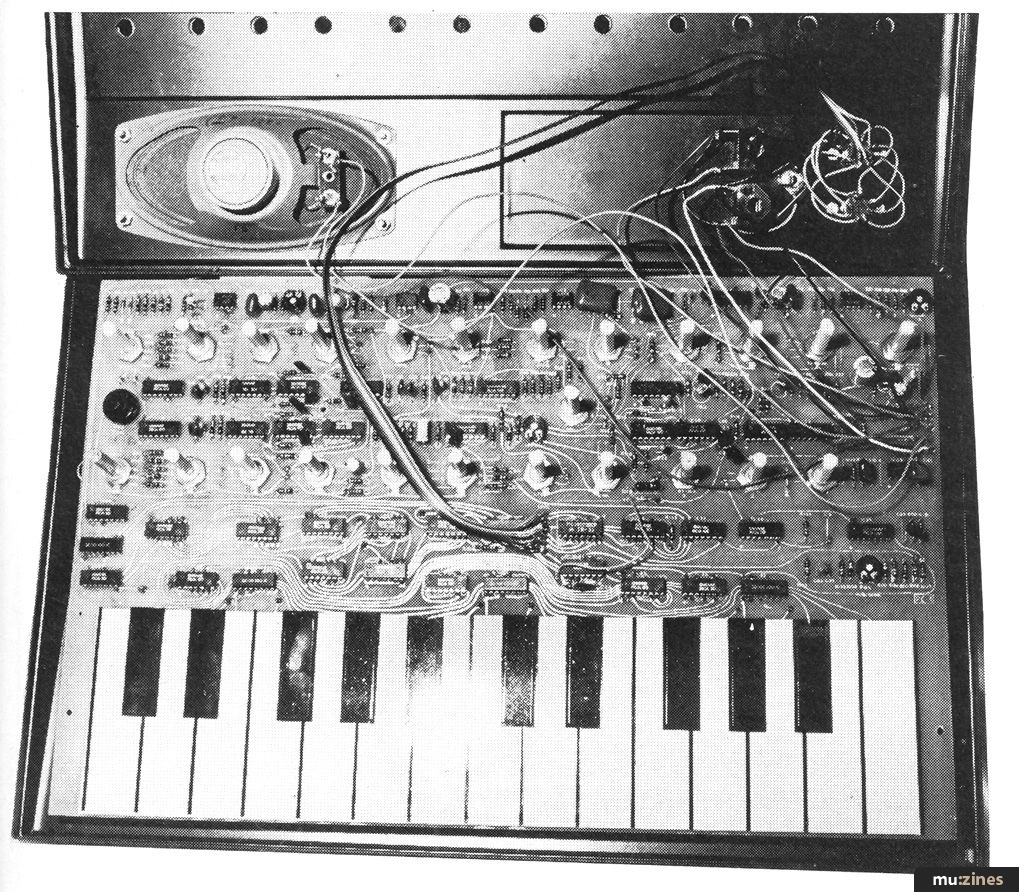
The voltage controlled filter can either be used in low-pass, band-pass or high-pass mode, with adjustable frequency and 'Q' (resonance, or emphasis) controls. This is a good filter and enables a rich tone to be obtained as opposed to most Japanese synthesisers, which only tend to give that 'nasal' sound. The filter has its own attack/decay envelope that can be used to provide either positive or negative modulation (another useful feature often not found even on expensive instruments). This envelope can also be delayed up to one second or repeated at various speeds. The voltage controlled amplifier has an attack/decay/sustain envelope, which can also be repeated at various rates, totally independent of the control envelope. Interesting effects can be obtained by using both envelopes in repeat mode, but at different rates.
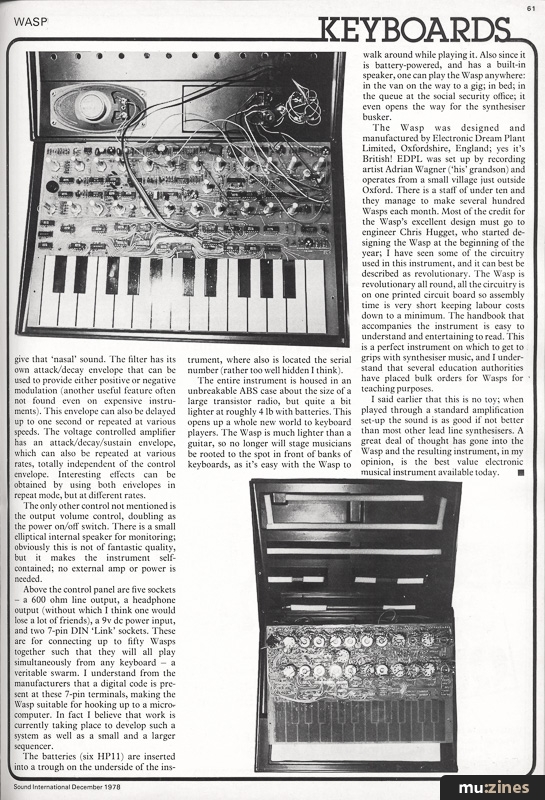
The only other control not mentioned is the output volume control, doubling as the power on/off switch. There is a small elliptical internal speaker for monitoring; obviously this is not of fantastic quality, but it makes the instrument self-contained; no external amp or power is needed.
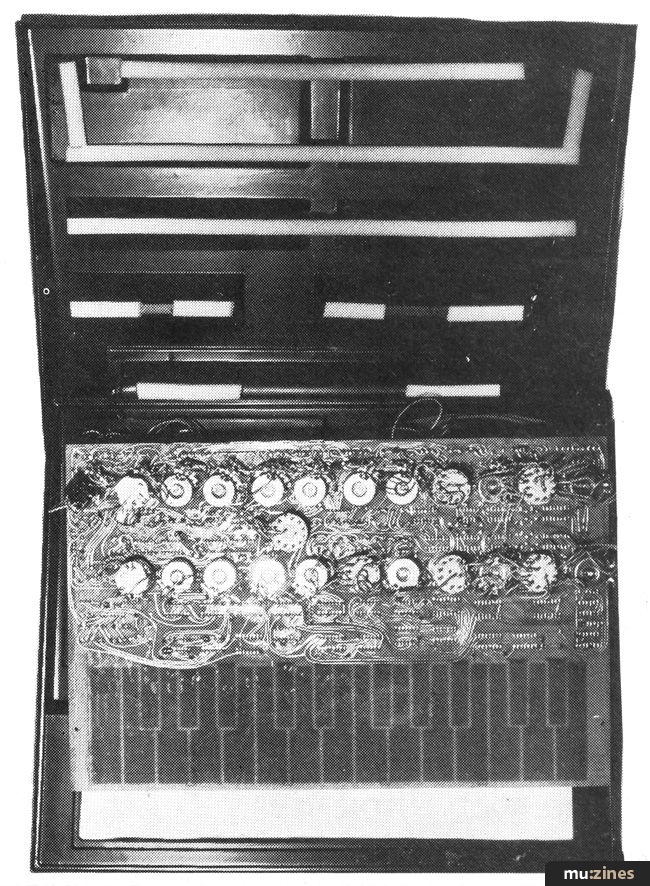
Above the control panel are five sockets - a 600 ohm line output, a headphone output (without which I think one would lose a lot of friends), a 9v dc power input, and two 7-pin DIN 'Link' sockets. These are for connecting up to fifty Wasps together such that they will all play simultaneously from any keyboard — a veritable swarm. I understand from the manufacturers that a digital code is present at these 7-pin terminals, making the Wasp suitable for hooking up to a micro computer. In fact I believe that work is currently taking place to develop such a system as well as a small and a larger sequencer.
The batteries (six HP11) are inserted into a trough on the underside of the instrument, where also is located the serial number (rather too well hidden I think).
The entire instrument is housed in an unbreakable ABS case about the size of a large transistor radio, but quite a bit lighter at roughly 4lb with batteries. This opens up a whole new world to keyboard players. The Wasp is much lighter than a guitar, so no longer will stage musicians be rooted to the spot in front of banks of keyboards, as it's easy with the Wasp to walk around while playing it. Also since it is battery-powered, and has a built-in speaker, one can play the Wasp anywhere: in the van on the way to a gig; in bed; in the queue at the social security office; it even opens the way for the synthesiser busker.
The Wasp was designed and manufactured by Electronic Dream Plant Limited, Oxfordshire, England; yes it's British! EDPL was set up by recording artist Adrian Wagner ('his' grandson) and operates from a small village just outside Oxford. There is a staff of under ten and they manage to make several hundred Wasps each month. Most of the credit for the Wasp's excellent design must go to engineer Chris Hugget, who started designing the Wasp at the beginning of the year; I have seen some of the circuitry used in this instrument, and it can best be described as revolutionary. The Wasp is revolutionary all round, all the circuitry is on one printed circuit board so assembly time is very short keeping labour costs down to a minimum. The handbook that accompanies the instrument is easy to understand and entertaining to read. This is a perfect instrument on which to get to grips with synthesiser music, and I understand that several education authorities have placed bulk orders for Wasps for teaching purposes.
I said earlier that this is no toy; when played through a standard amplification set-up the sound is as good if not better than most other lead line synthesisers. A great deal of thought has gone into the Wasp and the resulting instrument, in my opinion, is the best value electronic musical instrument available today.
rrp: £184.26 $550
Dave Crombie is resident electronic design engineer at Rod Argent's professional keyboard store in central London.
Also featuring gear in this article

Browse category: Synthesizer > Electronic Dream Plant
Publisher: Sound International - Link House Publications
The current copyright owner/s of this content may differ from the originally published copyright notice.
More details on copyright ownership...

Sound International - Dec 1978
Donated & scanned by: Mike Gorman
Review by Dave Crombie
Ads for Gear in this article:
Help Support The Things You Love
mu:zines is the result of thousands of hours of effort, and will require many thousands more going forward to reach our goals of getting all this content online.
If you value this resource, you can support this project - it really helps!
Donations for February 2026
Issues donated this month: 0
New issues that have been donated or scanned for us this month.
Funds donated this month: £0.00
All donations and support are gratefully appreciated - thank you.
Magazines Needed - Can You Help?
Do you have any of these magazine issues?
If so, and you can donate, lend or scan them to help complete our archive, please get in touch via the Contribute page - thanks!
If you're enjoying the site, please consider supporting me to help build this archive...
...with a one time Donation, or a recurring Donation of just £2 a month. It really helps - thank you!

 @mu_zines
 RSS Feed
 Blog
Blog