


Magazine Archive
Home -> Magazines -> Issues -> Articles in this issue -> View
Academic Qualification | |
The Dream AcademyArticle from One Two Testing, November 1985 | |
mixing classical with digital
Orchestrating The Dream Academy. Paul Colbert watches the baton.
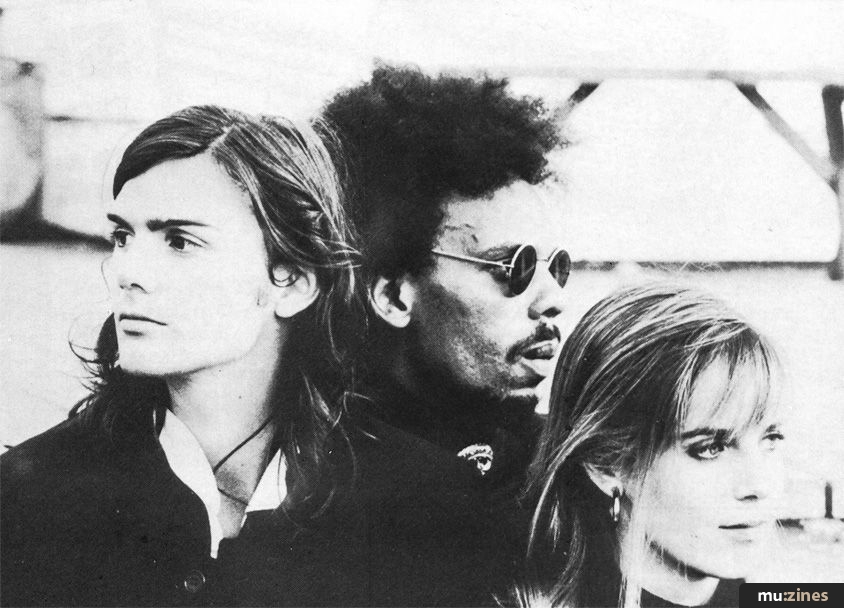
IN THE PINK and mildly psychedelic corner is Mr David Gilmour of the Floyd.
In the black and starkly technical corner is Mr Gary Langan, out of ZTT and the Horn (ahem).
In the middle is the band, who, after taking tracks to both somewhat disparate experts have to decide which one will make the best tutor for... The Dream Academy.
In the WEA interview room, eminently gentlemanly keyboardist, Gilbert Gabriel admits that, with all due respect, it wasn't that difficult a choice. Nick Laird-Clowes, Academy guitarist and vocalist, had met Gilmour on a Greek beach in '81, Gilbert had played with Gilmour's brother Mark in a band dubbed The Act, and they all seemed to share an affinity for what The Dream Academy sound must be — "slightly psychedelic, ethereal, floating".
Their's was the task of blending hi-tech keyboards (including Dave Gilmour's Emulator II) with third bandmember Kate St John's brass and woodwind collection, plus countless guest musicians on anything from timpani through cellos to fretless bass.
Gilmour takes a lot of credit (Gilbert's words) for the fabulous, lilting, haunting result (our words) of the excellent debut album (general opinion).
And what of Mr Langan? "We got involved with ZTT and Gary Langan for two tracks that were eventually remixed by Dave Gilmour. It took a long while for us to understand that though Fairlights are wonderful, it's the warmth you get off those small, analogue synths that seems more compatible with the acoustic guitars and oboes we use. It's a delicate fusion. When you're building big sounds, it seems you have to keep building, until you hit a cloud... with acoustic instruments you know the size of your bubble."
Gilbert's own synth gallery includes the ubiquitous DX7, a Roland JX3P, an ancient Solina string ensemble, an old Fender Rhodes "which I hardly ever play but can't get rid of, it's company", a Casio CZ-1000 and a UMI sequencing software package for the BBC B. The UMI came when the album had been completed but has already made yet another fan.
"The advantage is in structuring songs, there are so many alternatives, everyone who has a UMI could do a miniature 'Tubular Bells' album. There are so many ways to edit, cut in, modulate through all the keys." There's also, he warns, a danger that with so many easily attained alternatives, the UMI can take over and mask the original personality of the song. And that could have particular dangers for the Academy.
"The whole thing of The Dream Academy is bringing classical instruments into the songs. When I was at Darlington (two years studying piano and clarinet) I was very aware of using ethnic instruments and classical instruments. There should be no boundaries. You produce as much as you can and make it as interesting as possible."
Darlington also instilled in him, and therefore the Academy, a fascination for orchestration — admiration for the elder achievers such as Sibelius, and recognition of the sweat and thought that should go into adding today's synths to the sound recipe.
So, any other pop bands you think show a knack for orchestration? "Well... um... I know this is old hat, but Genesis, I think, were good at the start and... no I shan't say anything else, I don't like slagging people off... but they were great in the early days, and the Pink Floyd had lots of colour to their orchestration. That's what I felt was lacking in punk. It was all grey.
"It's amazing that certain synths have their own identity, like the PPG Wave for example. And when I first got the DX7 I was frightened... it was very clean, very clinical and all the same 'colour'. I was really pleased when I started MIDIing it to the JX3P and warming it up."
So how about some examples of synth orchestration on the album? "Right. Well, 'Life In A Northern Town' was the Solina strings mostly on the chorus, and a JX3P on the bass. Originally we used a Jupiter 8 for the demo, but the record company didn't like it so we had to start all over again.
"There were a few sound effects on tapes and a couple of friends of mine from college playing cello. But in the end we ended up sampling them on Dave's Emulator II and playing them in, they were slightly out of tune."
You seem very fussy about your string sound. Is that anything to do with the college training — having experience with real stringed instruments whereas most bands have experience with their imitators?
"Yes, maybe, but I think even my views have changed... I've had the JX3P for so long. Sometimes I find the string sounds you get from samplers are a bit cold. With Gary Langan, I wanted the warmth in the strings sounds, but the engineer was worried about the 'mush' and wanted to harden my sounds up... sometimes they weren't me.
"If you listen to 'Life In A Northern Town', it's quite revolutionary, I suppose. There aren't really any drums on that track, just a little drum machine, some congas, and there's a timp player called Ben Hoffnung who's in the London Symphony Orchestra. He's a really vital link with The Dream Academy; one of our friends. When we were at Livingstone Studio we had to take one of the doors off to get his timpani in.
"Sorry if I'm hopping about from subject to subject, but when I was in New York making the video, I conned a little marimba from someone. Now, I realise this is common sense and the marimba is a keyboard percussion instrument, but it was a lovely connection playing it and being involved with synths. You get a real feeling of what a marimba is all about, and then you can translate that to the marimba sound on your DX7." So there's a case for trying to play the real instrument before you play its sample? "Definitely." Another track?
"'Places On The Run' started when I was writing a ballet piece for my girl-friend in the Steve Reich/Philip Glass tradition — I'm fascinated by Systems music. Nick had the tape, I think he'd been to the pub and when he came back he started writing about markets and things. When we went into the studio we wanted to recreate the idea of the demo, but we had a constant battle. I wanted sequencers going through it and Nick wanted no sequencers at all — completely timeless. So the acoustic guitar went down, and I added a tapestry with the, then, newly acquired DX7. Kate blew some wild Moroccan oboe.
"Our arrangements always change frantically when we record. We usually start with Nick's acoustic guitar and a rough guide vocal. On this album I was quite naive... came up with thousands of ideas, put them all down, and threw almost everything out.
"Recently we've done a Smiths track 'Please Please Please...' and that's just organ, guitar, vocals then some strings, sampled vocals and oboe... that's really simple for us.
"Also Nick and I are writing the next set of songs just on piano and guitar.
"I've been playing a lot of acoustic piano lately... first time I've had my own for four years. I spend a lot of time just improvising. The piano is good at taking music out of you directly, whereas with the UMI it becomes an intellectual game and you have to play along."
As a producer, Dave Gilmour, from Academy descriptions, is the piano rather than the UMI — more interested in creating an immediate emotional response than a set of data to be perfected at a later date. The album features wispy vocals harnessed to tracked-up guitars and a confident feeling of space. Talking to Nick Laird-Clowes later, on the phone, revealed one Gilmour trick guaranteed to placate any vocalist: "He records with all the effects on — Dimension D, harmoniser and so on — instead of adding them later. It sounds brilliant as you're singing, everything's swirling around you, and that's really inspiring. I've had so many producers say 'get that vocal down dry'.
"Most of the vocals we did in the control room with a Neumann U87 or one of those 12in long 'tube' mikes that they all used on Live Aid... they seem to give a low breathy sound really easily. Dave's studio is an old barn that used to belong to Alvin Lee. It's got an old MCI desk... a cheap studio really but stacked with tons of effects because that's the way Dave Gilmour likes to work."
And the guitars? "A Gibson J200 acoustic, a Martin D28 borrowed from Dave Gilmour and an Ovation on 'Northern Town', plus a 12-string electric Fender I bought in a pawn shop in Alabama which is incredible because it never goes out of tune. It's still in tune from when we did the album. Oh, and a Fender Strat and old Les Paul occasionally."
Back at the original interview, Gilbert Gabriel has reached a few calm moments in the midst of video making, album promotion and songwriting to finally reflect on what comes next. "I was talking to the bass player from Imagination whose opinion was, mortgage everything you've got to get an Emulator II. I suppose if you really wanted to go the whole way, you could get a Synclavier. The people who've got Synclaviers seem to have the monopoly over film music, and that's something I'd like to do one day. But I'd be worried about what goes around a Synclavier — a big house, and a lovely studio, just to make sure you're getting the best from it.
"No, I think it will be one of those Akai Samplers with the disc drive. There's something about them in One Two isn't there? Can I have a look at your copy..."
Publisher: One Two Testing - IPC Magazines Ltd, Northern & Shell Ltd.
The current copyright owner/s of this content may differ from the originally published copyright notice.
More details on copyright ownership...

One Two Testing - Nov 1985
Interview by Paul Colbert
Help Support The Things You Love
mu:zines is the result of thousands of hours of effort, and will require many thousands more going forward to reach our goals of getting all this content online.
If you value this resource, you can support this project - it really helps!
Donations for September 2026
Issues donated this month: 0
New issues that have been donated or scanned for us this month.
Funds donated this month: £0.00
All donations and support are gratefully appreciated - thank you.
Magazines Needed - Can You Help?
Do you have any of these magazine issues?
If so, and you can donate, lend or scan them to help complete our archive, please get in touch via the Contribute page - thanks!
Please Contribute to mu:zines by supplying magazines, scanning or donating funds. Thanks!
Monetary donations go towards site running costs, and the occasional coffee for me if there's anything left over!

 @mu_zines
 RSS Feed
 Blog
Blog