Understanding the DX7 (Part 1)
Synthesis & Sound Design
(EMM Apr 84)


Magazine Archive
Home -> Magazines -> Issues -> Articles in this issue -> View
Advanced Music Synthesis | |
Voltage Controlled Filters Part 1Article from Electronics & Music Maker, August 1983 | |
This month we're going to have a look at harmonic manipulation or, in other words, filters. Whilst voltage controlled oscillators offer a great deal in terms of tonal variation, the ability to modify and manipulate the basic waveforms they generate allows us to create an even wider range of sounds. Let us first look at the most common type of filter which is available on nearly every synthesiser — the voltage controlled lowpass filter (VCLPF).
As its name implies, this is a device that filters out the higher harmonics, but allows the lower ones to pass through unaffected. For those of you who aren't that familiar with what harmonics are, it might be a good idea to briefly explain.

Figure 1a. A simple sawtooth wave is made by adding two harmonics to the fundamental. Adding more harmonics creates a sharper waveform.

Figure 1b. A simple square wave is created by adding two odd harmonics to the fundamental. By adding more harmonics (7th, 9th, 11th, etc.) a symmetrical square wave will be created.
Nearly every sound, whether it's electronic or acoustic, consists of harmonics to a greater or lesser degree. These harmonics are merely multiples of the fundamental frequency (the fundamental being the note you are playing). The sound is, therefore, a collection of pure sine waves which add themselves together to provide a basic waveform. Figures 1a and 1b show how the two most common waveforms available on a synthesiser are made up whilst Figures 2a and 2b show graphically the relative levels of those harmonics in relation to the fundamental.

Figure 2b. Harmonic spectra of a simple square wave.

Figure 2a. Harmonic spectra of a simple sawtooth wave.
Because the harmonics are multiples of the fundamental the number of a particular harmonic is simply the amount of times the fundamental frequency has been multiplied. In other words, the 3rd harmonic of a fundamental frequency of, say, 500Hz will be 1500Hz or 1.5kHz (500Hz x 3 = 1500 Hz). This applies to all harmonics, be they the 3rd, 4th, 7th, 13th or whatever.
It is the amount and the balance of these harmonics that enable us to differentiate between the various waveforms. Generally speaking, the more harmonics a sound has the more 'trebley' and 'bright' the sound will appear to be which is why a sawtooth wave sounds brighter than a square because, as I hope you can see, it has more harmonics.

Figure 3a. Effect of a low pass filter (with the cut-off frequency set at 3kHz) on a sawtooth waveform of 500Hz.
With that out of the way let us see what action a filter will have on these waveforms. Figure 3a shows the effect of a VCLPF on a sawtooth waveform. As you can see the higher harmonics are cut off above 3kHz. On the control panel of your synthesiser what you have done here is to set the cutoff frequency control at 3kHz — this allows all the harmonics up to that point to pass through unaffected. At 3kHz, however, they are quickly attenuated. By moving the cutoff frequency control down, more and more of the harmonics will also be attenuated and the sound will become more muted and 'softer'. If you take the cutoff below 500Hz (the fundamental) you will have filtered out the entire sound completely so you won't hear anything. (Incidentally, if you are trying this exercise out at home on your own synth make sure that the other controls associated with the filter such as modulation amount, keyboard track etc. are at minimum and that you are patched up as in Figure 4). The filter is, therefore, acting as an elaborate and very efficient tone control.

Figure 4. Basic patch for demonstration of the effect of a low pass filter on an oscillator's waveform.
Now then, if we increase the resonance control (or emphasis, or 'Q', dependant on what the manufacturer of your synth has decided to call it) the sound will become thinner and as you move the cutoff frequency control the 'WAA' effect you had will now become a 'WEEOW' type of sound (don't you love all these technical terms!!!). By referring to Figure 3b you should be able to see why. When you increase the amount of resonance what you are actually doing is boosting the harmonic(s) at the cutoff point so that it (they) are louder than the other harmonics. As you move the cutoff control what will happen is that each harmonic will be temporarily boosted and then attenuated whereupon the next harmonic will be boosted and soon — it is this that gives rise to the characteristic 'WEEOW' sound. By carefully setting the resonance control you should be able to pick out the harmonic independently as you move the cutoff frequency control.

Figure 3b. Effect of a low pass filter (with the cut-off frequency set at 3kHz) with increased resonance on a sawtooth waveform. Note how the sixth harmonic is boosted while other harmonics are attenuated either side of the cut-off frequency. The shaded area represents the proportion of the sound that will actually be heard.
Note: These graphs are not exact but are intended to demonstrate the effect of a low pass filter.
These effects, of course, apply to any sound fed into the filter be it a different waveform, a noise generator, an acoustic instrument or whatever — the operating principles apply to every type of sound and every lowpass filter (allowing, of course, for component tolerances) will have roughly the same effect, whether it's made by Moog, Roland, ARP or whoever.
Those, then, are the basic operating principles of VCLPFs. There are, however, many different types of filters which are found on synthesisers. These are: Highpass filters. These do exactly the opposite of LPFs in that they cut the lower harmonics but allow the higher ones to pass through. The result is a 'fizzy', 'buzzy' sound. HPFs are useful for creating thin and delicate sounds such as oboe, spinet etc. and can be useful for some vocal sounds. The Bandpass filter allows a band of harmonics to pass through but cuts off either or both the high and low harmonics. Personally, I don't find a great deal of use for these two types of filter though they are handy to have around for certain sounds and indeed some manufacturers provide multi-mode filters that can be low, high or bandpass types, but generally the VCLPF is probably the most musically useful type of filter to have which is why most, if not all synths have one. Sometimes a manufacturer will make their high and/or band pass filters voltage controllable like the VCLPF, but sometimes they can only be set manually — the Juno 6 and 60 have a highpass filter in addition to the VCLPF, but this can only be set to one position at any given time and so acts merely as an overall tone control. Nevertheless, it's useful to have the option.

Figures 5a-5f. Frequency responses of different types of filter.
Other types of filters are band-reject, notch and comb filters but these are not generally available as a synthesiser module and are outside the scope of this particular article but I have included their frequency response graphs in Figures 5a-5f for those who may be interested.
Filters are exceptionally versatile devices that can be used for a great number of musical applications, from the simple and cliched to the very advanced. The fact that they are voltage controllable expands their versatility even further and so next I'll be talking (or rather, writing) about some of the possibilities offered by modulation of the filter.
More with this topic
 |
 Back to Basics (Part 1) |
 Loony Toons |
 Customise (Part 1) |
 Modular Synthesis - Producing String Sounds (Part 1) |
 Synthesizer Design (Part 1) |
 Total recall - Cosmology |
 Constructing A Trigger Delay |
 Sample + Synthesis - Programming Clinic |
 The Sensuous Envelope Follower |
 It's Cee Zee! (Part 1) |
 The Synth Is Dead: Long Live The Synth |
Browse by Topic:
Synthesis & Sound Design
Publisher: Electronics & Music Maker - Music Maker Publications (UK), Future Publishing.
The current copyright owner/s of this content may differ from the originally published copyright notice.
More details on copyright ownership...
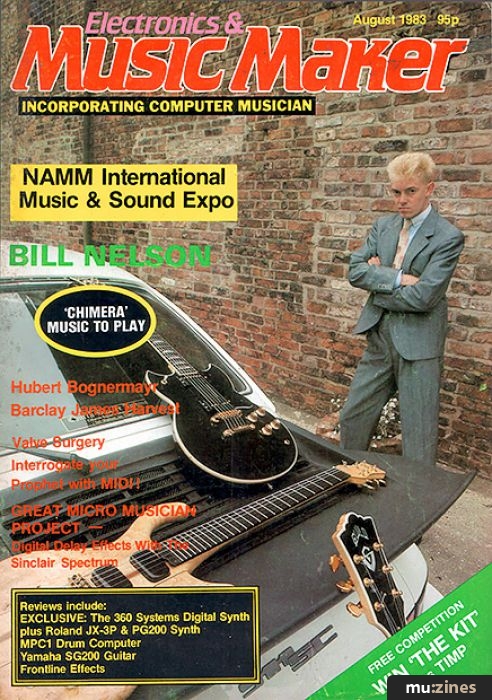
Electronics & Music Maker - Aug 1983
Feature by Steve Howell
Previous article in this issue:
Next article in this issue:
Help Support The Things You Love
mu:zines is the result of thousands of hours of effort, and will require many thousands more going forward to reach our goals of getting all this content online.
If you value this resource, you can support this project - it really helps!
Donations for October 2026
Issues donated this month: 0
New issues that have been donated or scanned for us this month.
Funds donated this month: £0.00
All donations and support are gratefully appreciated - thank you.
Magazines Needed - Can You Help?
Do you have any of these magazine issues?
If so, and you can donate, lend or scan them to help complete our archive, please get in touch via the Contribute page - thanks!
Please Contribute to mu:zines by supplying magazines, scanning or donating funds. Thanks!
Monetary donations go towards site running costs, and the occasional coffee for me if there's anything left over!

 @mu_zines
 RSS Feed
 Blog
Blog