Bill Nelson (Bill Nelson)
(EMM Nov 82)


Magazine Archive
Home -> Magazines -> Issues -> Articles in this issue -> View
Bill Nelson | |
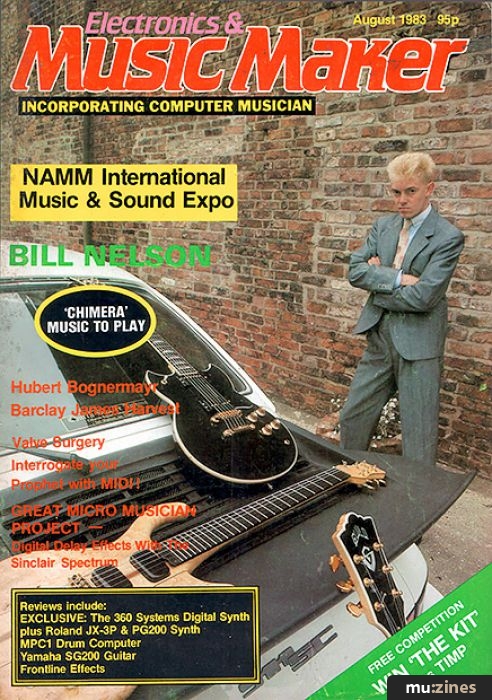
Bill NelsonArticle from Electronics & Music Maker, August 1983 | |
An in-depth interview with this multitalented musician/composer/producer who reveals the techniques used on his new LP and explains how to use the E-bow to best advantage

As the driving force behind Bebop Deluxe in the mid Seventies, Bill Nelson won acclaim both for his impressive guitar playing and stylish songwriting. Feeling constrained by the limitations of the 'guitar hero' status he had acquired, Bill unexpectedly split up the band whilst on the verge of commercial success.
Never one to stand still for too long, he returned with an adventurous new group, Red Noise, and a new musical direction that proved to be the blueprint for much of today's electro-music.
In between a series of highly acclaimed solo albums that followed the demise of Red Noise, Bill recorded soundtracks for theatre productions, established his own Cocteau record label and delved into production for such people as The Skids, A Flock Of Seagulls and most recently Gary Numan. Here, Bill talks about the unusual background to his latest work 'Chimera' and his involvement with home recording and production.
"The original release date for 'Chimera' was going to be November, 1982, and it was intended to be a stop gap between one main album and the next because I had a few songs which had been burning a hole in my pocket for a while. Although I spent two weeks doing the basic tracks for the album, I then had to go to Japan to record with Yellow Magic Orchestra and when I returned, had production things I was committed to, so I didn't have the opportunity to mix it until the beginning of this year.
So the whole thing got put back quite a long time and now it's almost the time when I should have had a main album out. It was originally going to be an EP but rather than have just four tracks we decided to add an extra two tracks.
I'd worked with Yukihiro Takahashi from YMO on his solo album called 'What, Me Worry?', playing E-bow guitar. After doing that I asked him if he'd be interested in providing me with some rhythm tracks to write to and he said he'd love to do it, went back to Japan and prepared everything.
I had given Yuki a rough idea of what I was looking for, so he put some things down on 24-track tape and sent them to me. I mixed them on to cassette which I took up to Yorkshire and transferred to my 8-track Fostex A-8. I then wrote the songs around the rhythm patterns, worked the instrument parts out, and went into the studio and reproduced them back on to the 24-track tape.
I didn't get a chance to finish them off until this year, but the whole thing took four weeks to do in total, as far as the proper recording went, although I spent probably a month writing the songs back at home on the 8-track first.
Let's talk about the equipment you used on 'Chimera'. The songs have a similar quality to them, it's as though you've decided to use a certain group of instruments and stick with them throughout. Is that correct?
Yes, it's true. A lot of the songs were written around certain sounds as well, in that I'd just got a Yamaha CS70M synthesiser - the beauty of it is that there are no factory preset sounds whatsoever. It's a blank machine when you get it and you build the sounds from scratch almost in the same way as you would with a Fairlight, but it's by no means as involved.
The sounds are stored in the memories and then dumped on to small magnetic cards that you insert into a motorised slot in the side of the instrument. It gives the cards back when the sounds are loaded and I have a wallet to store my various creations in.
The sounds I have in that synth at the moment are probably unique to that particular synth rather than any other of that model, especially the cello sounds, which are fairly realistic but still have that bright synthesiser quality which I like. Maybe there is a point in having absolutely 100% beautifully realistic string sounds in a synthesiser, but from a recording point of view it's more fun to record real cellos, but I like that one step removed from reality, surreal quality to sounds.
I'd got the little MT-30 polyphonic keyboard from Casio which is very small. There's some marvellous sounds on it, but they don't resemble what they're supposed to; but as sounds they're very interesting.
I wrote the majority of the songs on the MT-30 and CS70M with the drum track first and then started elaborating the songs with guitar or MiniMoog parts. There's also an ARP Omni string machine on some tracks which is a much 'washier' sound than the Yamaha.
I did the actual recording in three studios. The basic tracks were laid down at John Foxx's studio, The Garden, whilst the remaining vocal, bass and guitar overdubs were recorded at Riverside Studios. I did the mixing at a small 24-track studio in Leeds called Ric Rac.
I use this studio for a lot of the projects that I put out on my own Cocteau label because it's reasonably cheap and close to where I live. Obviously putting bands out on an independent label of my own, I can't afford London studio prices and I wanted to spend quite a bit of time on the mixes, so it seemed sensible to do it there.
I used a lot of things the studio had plus my own effects — an Eventide H910 Harmonizer and a Marshall Time Modulator. The studio had an Ursa Major Space Station, a couple of Klark Teknik delay units, Bel Flanger, Drawmer ADT unit and we hired a Yamaha E1010 analogue delay which I used on the vocals as well as an AMS digital reverb unit.
Rather than have any immediate ideas as to the use of effects, it was a matter of experimenting to see what best suited each track.
You seem to have created very interesting acoustic environments on each track. Was that intentional?
Well, the idea was to build little acoustic rooms for each instrument, yet to have them related in some way, almost as if you were in a hallway with smaller rooms off and you stood in the centre and heard instruments coming from the different rooms.
For example, the snare sound was a combination of putting the snare drum through a speaker in the 'live' room, recording that with ambient microphones in stereo, gating those off and mixing the ambience with a little reverb as well from the AMS digital reverb just to smooth it out.

Home Recording
At home I have the Fostex A-8 eight track, the 350 mixer and their digital delay and compressor-limiter which I've been very pleased with. I've actually released material recorded on that system. The 'Beauty and the Beast' album which came free with 'The Love That Whirls' was recorded on eight track for the Yorkshire Actors Company, who commissioned me to produce the soundtrack for their stage adaptation of the Jean Cocteau movie of the same name.
Home recording obviously has certain technical drawbacks, but if the music and sounds work within the limits of that context then there's no reason why people can't listen to them as if they were listening to a 24-track recording. In fact, a lot of people wouldn't notice as their ears aren't that finely tuned. For me, the charm of it lies in its roughness, not in its polished qualities.
If I got desperate and no record company would sign me, then I'd try and put records out using my home system. It wouldn't stop me releasing work.
Why then do you need to use 24 tracks?
Having 24 tracks isn't necessarily to add more instruments but perhaps to use the other tracks for recording various echo effects; just to expand the language of sounds really, although there is always the temptation to go a bit further when confronted with 24 tracks.
I think the only limitation is your imagination. It is quite possible to release records from a 4 or 8-track tape. With a little bit of care on the engineering side the quality is okay. And when you look back, some of the greatest music that the pop world's put forward, like the Beatles' early stuff, was done on 4 and 8 track systems.
Let's move on to the actual content of the LP. How did you come up with the title name 'Chimera'?
Apparently the correct pronunciation is 'Kye-me-ra'. One of the dictionary definitions is 'a vain fancy'. I'd found the word via a series of Pre-Raphaelite paintings and poetry. Chimera was a mythical half-woman, half sphinx creature that led men onward, or a vain folly that you chased after. The word had all kind of connotations and seemed to fit, as the songs were very much about chasing after positive things. During the last couple of years I've gone through a radical kind of personal change in philosophy allied to a feeling of optimism in a lot of pessimistic times and this is reflected in the music hopefully.
I can recognise the influence of Yellow Magic Orchestra and Ultravox in the melodies you are producing. Would you agree with that?
I've been listening to the last couple of YMO records a lot because I've been working with the musicians. Ultravox, funnily enough, is a band I've never listened to since their first album. I listen to a lot of modern contemporary music - Philip Glass, Steve Reich and Keith Jarrett, plus older things by Satie. When I've finished in the studio, I like to listen to music that isn't in the vein of the music I'm involved with professionally, because it just becomes too much.
Do you write the lyrics first?
I used to. Before I turned professional some years ago, I held down a job in a local government office and I used to write lyrics all day long. Then, when I got home I'd sit down with a guitar and write the song to the lyrics.
There was definitely a point of view to be expressed first with the lyrics. In those days the music was a framework for that viewpoint. That viewpoint also has its own atmosphere and character which to me suggests certain sounds and rhythms. There also has to be something said with the music. Lyrics for their own sake can be well crafted and attractive to the ear, but there is always something hollow at the centre that leaves the song wanting, for me at least.
Drum Tracks

I was sent five drum tracks from Japan, four of which I used on the album. I'd given Yukihiro a brief outline of what I wanted. The songs were quite long so there's variations which develop so that I could actually plug into it at one point and say 'I'll use from this point to this point.'
There was also a great variety of rhythmic devices, not just drums. Yuki used a Prophet 5 linked to a Roland MicroComposer and then tuned various percussive sounds into it. He used standard TR808 sounds for hi-hat and claps, some Linn tom-toms plus his own bass and snare drums which were recorded onto a Sony PCM digital recorder.
So by simply moving faders on the mixing desk I could drastically alter the rhythm patterns by taking sounds in or out. There would be the same rhythm all the way through and the final shape of it was created by using the desk.
I would start building the song by sorting through these drum tracks until I found one that suited the particular mood I had; keep the tape running and work different chords over the top, listen to it, play it back and alter it until I had a rough structure for a verse. Even if I couldn't come up with a chorus I liked, I'd leave a hole then start working a lyric and melody to the verse which would eventually suggest a route for the chorus.
Then I'd work on the countermelodies that go on top, the little effects, and if something I'd done initially didn't quite work with what I was putting on top (but I liked what was on top) I'd strip that out and rework the basic part again until the whole thing was harmonious.
The songs on this and my last album were based on a trance rhythm idea. The last album, called 'The Love That Whirls', was partly inspired by the idea of whirling dervishes and partly by an uncompleted Kenneth Anger film called 'The Love That Whirls'. The themes of the songs were dealing with the idea of ecstasy in the sexual sense allied to ecstasy in a spiritual sense, and the repetitive rhythms were tied up with that.
What instrument do you generally write your songs on?
My central instrument is guitar - it's the one I'm most proficient on. I got into synthesisers purely because I was tired of the same guitar sounds. At the moment there are only several sounds you can extract from a guitar whereas the synthesiser seems to be fairly infinite.
I went through a period where I had a Hagstrom Patch 2000 guitar synthesiser which was touch sensitive and very useful in that it would interface with my Mini Moog, but there were so many problems with it. For instance the note was produced by contacting the string on a fret without having to pick it with the right hand. So that meant that if you hit a string unintentionally, you'd trigger a note you didn't actually want. Also you couldn't bend a string as the contact for each note was directly under each string, in the fret itself. If you bent a string off that contact point, the note would stop immediately.
Nowadays, I tend to compose on keyboards and the guitar is added later if necessary.
As I've grown older I've seen the musician part of me become less precious than I thought it was. The music, in a way, is the colour on a palette, a way of expressing ideas but the important thing is to have the ideas first. No amount of skill is enough, it has to be linked to an imagination that is responding to the world around.
Sequencers
The track 'Acceleration' has a bass pulse going through it on Mini Moog. All the things that sound like sequencers were actually played in real time.
The Yamaha CS70M has a built-in polyphonic sequencer which I use as a musical notebook. It's very handy to store ideas on. As far as linking it to drum machines goes, I haven't actually done any of that yet.
The appeal of sequencers is probably because I've been listening to Philip Glass and Steve Reich, where they actually have an orchestra of people playing lots of percussive, repetitive phrases very fast which change very subtly, and the whole thing evolves, gradually becoming something else at the end. So my songs are a mild attempt at that sort of discipline.
I've been working with Gary Numan recently and much of his work has followed one route, where the melody line is repeated by other instruments and everything is going in one direction. Whereas with my music I like to have things go off at tangents that comment on the main melody, but also become a separate entity of their own.
'Every Day Feels Like Another New Drug' starts off with a tuned bongo sound from the Prophet 5. I've used a lot of reverse echo effects on this track. To achieve this you turn the 24 track tape around then record a reverb from the voice going backwards onto a spare track. When you replay the tape the correct way around the reverb occurs before, the voice creating a beautiful effect.
On the play out of this track I also used extracts from radio and TV. What I did was set up a couple of cassette machines on the radio and TV, leave them running for an hour or so then transferred that to a two track recorder. I then went through the extracts very carefully, itemising everything that was said in a notebook, then picked out sentences and worked out a surreal way of joining them together using tape editing techniques.
The idea behind the song is one of optimism. It uses the word 'drug' in a metaphorical sense, it's like saying that every day is a new 'high' so make full use of it.
I allowed some of the radio extracts to remain subliminal and where there were musical spaces the words would surface. The idea was taking things out of the air in effect, and saying these sounds are around us and they are part of the joy of the day.

Mixing
I regard the mixing desk as being as important as any instrument. It's not just enough to use it to route echo effects or to balance the instruments. Obviously one goes for a reasonably good quality sound at source when recording instruments but I do use the EQ rather heavily to create textures and so on.
With mono instruments I put them through a Roland Jazz Chorus amp. Particularly with some of the string sounds, I've found it helps them tremendously if I put the amp in a room that isn't too dead, put the chorus on and then use the Harmonizer to spread the sound left and right with it detuned slightly, so that there's that little bit more richness there.
Sometimes I ADT the hi-hat and split that left and right, but not centre. Often the cowbell and percussive things are panned to one side also.
Each part in itself is fairly simple, musically speaking, and it's the spaces that they occupy together that creates the overall complexity. I have done things that were far less complex in the past. Every part is there for a purpose. If something doesn't work then I have no hesitation in pulling the part out and abandoning it completely.
Guitars
I use a Fender Stratocaster, Yamaha SG2000 and a Viellette-Citron which was hand built for me by Joe Viellette in New York. It's a solid body guitar with stereo outputs, and two pickups, each one of which has a 3-position switch. These give a selection of preset tones plus you've got the normal tone and volume controls, an out-of-phase switch, stereo/mono switch and master volume control.
I very rarely use it live because it's a very beautifully made guitar but rather impractical on a dimly lit stage, and I'm also worried about getting it knocked about. It was used for the E-bow on 'Another Day, Another Ray of Hope'.
Tell me about the E-bow.
The man who invented that, an American called Greg Heet gave me one of the early ones when I was with Bebop Deluxe playing out in America. Quite a few people had them but not many people seemed to stick with them; they're an awkward little thing at times to use but they can be very effective.
I got very disillusioned with guitar for a while and felt I was going through my best cliches all the time almost, and when I came back towards guitar again it was via the E-bow. It seemed to bring out something else that people hadn't really explored very much and also it limited what I did technically because you can only really sensibly play on one string at a time with it.

The E-bow.
The E-bow looks like a small, silver handle which you hold above the string you wish to play on. It has a groove down the centre and two slightly more shallow grooves either side of this. These two shallow grooves clamp down the two strings adjacent to the one you want to play on, preventing them from vibrating. You press the E-bow onto the pickup and it holds the adjacent strings leaving the middle one free to resonate. There's an electro-magnet inside and once the pickup's magnetic pole piece and the electro-magnet in the handle of the E-bow come into contact or come close together, it sets up a magnetic field that drives the string infinitely, as long as you hold it over the pickup.
To change strings you have to lift the E-bow and move across and down to the next string, so it's a very difficult technique to master and it also results in an audible 'clunk' as you do it. So really it's only sensible to play on one string which means you get into very modal, oriental sounding music.
The sustain from it is as infinite as you want and by moving the E-bow away from the hot spot on the pickup you lessen the intensity, so you get a bowed effect by moving it backwards and forwards.
By keeping the E-bow over the pickup and hitting a harmonic at the fifth fret and then fingering the same note whilst keeping this going an octave above, that harmonic is transferred to the note above and you can get very high frequencies coming out. It's still a very unpredictable device to use though.
Glow World
You brought in Mick Karn on bass guitar for 'Glow World'. Why was that?
Well, I'd worked with Mick briefly on an album for Masami Tshuchiya called 'Rice Music', on which I played E-bow guitar. Mick was playing bass and we seemed to have things in common, so we decided to get together and record something. He actually played on three tracks but only one went onto the album.
The thing with the 'Glow World' rhythm track was that Yuki had put this phenomenal time change right in the middle of it. For a while I thought about how I could approach this and blend something across the change which made musical sense. In the end there was no way to achieve that so it had to become a different section, therefore I had a key change and made it into an instrumental break.
The atmosphere behind the song was inspired by the 'Blade Runner' film - the decaying city with constant rain and strange vehicles passing by.
Production Work
You've recently been producing a new album for Gary Numan. How exactly did you come to be involved with him?
He actually approached me. I believe the initial reason was that WEA and Beggars Banquet had been trying to persuade Gary to use an outside producer for sometime. He'd always produced his own stuff and been very insular in the recording process which is something I can understand because I've been that way very much myself sometimes.
Gary decided, because of what he'd heard of my work, that I might be the right person to do the production for him. So I went over to Jersey where he was living, to meet him and we decided it would be an interesting proposition.
Initially, there was tension between us and I totally understood it, because in his position I knew how he felt and sensed the fear and uncertainty. I purposely played it cool and low profile, just waiting for him to gain confidence in my opinions.
Things came to a head eventually, but that was necessary to resolve it and we now feel as if we're achieving things together.
I started producing other people about 4 years ago. The first thing was an EP by The Skids, followed by their album. I've also done material with The Original Mirrors, Nash The Slash, Last Man In Europe, Fiat Lux, an American group called The Units, Flock of Seagulls and now Gary Numan.
But you must be one of the few producers who are still actively creating their own music.
I don't really regard production as my main thing. I consider myself, first and foremost, a writer and creator of music rather than a manipulator of someone else's. I would never have gone looking for work as a producer. People have always asked me and I haven't had to do it for the money either, so I've been able to choose what I do.
Whilst not all of the projects I've done have been commercially huge, they've all been very interesting musically.
Exhibition
Earlier this year, for example, I set up a small tour called 'The Invisibility Exhibition' which involved several people. The opening act were the Yorkshire Actors Company performing 'The Cabinet of Dr. Caligari' with my soundtrack on tape. And then we had three Japanese girls called 'Frank Chickens', who are in fact performance artists who take the mickey out of what Europeans think of the Japanese lifestyle - it's a spoof Japanese culture send-up, but done very cleverly.
Then Richard Jobson, who's a friend of mine from The Skids days, was reading his poetry and at the end of the evening my brother Ian (on saxophone) and myself improvised on stage to pre-recorded tapes which I'd done at home on my Fostex 8-track. We had eight television sets on stage and a screen and we used a lot of Man Ray movies as a visual backdrop.
I used E-bow guitar, Yamaha CS 70M synth, six Casio VL-Tones - all programmed with different sequences, marimbas and a lot of percussion. I lost money on that venture but it was worthwhile and I plan to do another one next year.
Moving Forwards
My future plans include a photography exhibition of my own work set to music, which is going to be taken around Europe and hopefully London, if I can find a suitable gallery.
One of my big ambitions is to work on film scores. I'd love to work with the director David Lynch. There are certain things that can only be realised by an orchestra, no matter how sophisticated synthesisers may become and to be able to sit down and score for an orchestra would be a dream come true!
I've always maintained that everything I ever put onto a record is an example of how I felt at that point in time. But you cannot hold by that for ever - they're not absolutes. One has to move forward and one has to discover new things to maintain the excitement and purpose.
If you feel you've achieved the perfect thing and just go on repeating it, then it seems to me that you're occupying a space that someone else needs!"
Bill Nelson Discography
| Bill Nelson | Northern Dream | Smile |
| Bebop Deluxe | Axe Victim | Harvest |
| Futurama | Harvest | |
| Sunburst Finish | Harvest | |
| Modern Music | Harvest | |
| Live In The Air Age | Harvest | |
| Drastic Plastic | Harvest | |
| Best And The Rest Of (Double) | Harvest | |
| A's and B's (Compilation of singles) | Harvest | |
| Red Noise | Sound On Sound | Harvest |
| Bill Nelson | Quit Dreaming And Get On The Beam | Mercury |
| Sounding the Ritual Echo | Mercury | |
| Das Kabinett | Cocteau | |
| The Love That Whirls | Mercury | |
| Beauty And The Beast | Cocteau | |
| Chimera | Mercury |
More with this artist
 |
 Bill Nelson (Bill Nelson) |
 |
 |
 A Full Nelson (Bill Nelson) |
 Getting The Holy Ghost Across (Bill Nelson) |
 Peak Aid (Bill Nelson) |
 Bill Nelson - A Musical Luminary (Bill Nelson) |
More from related artists

Publisher: Electronics & Music Maker - Music Maker Publications (UK), Future Publishing.
The current copyright owner/s of this content may differ from the originally published copyright notice.
More details on copyright ownership...
Electronics & Music Maker - Aug 1983
Interview
Previous article in this issue:
Next article in this issue:
Help Support The Things You Love
mu:zines is the result of thousands of hours of effort, and will require many thousands more going forward to reach our goals of getting all this content online.
If you value this resource, you can support this project - it really helps!
Donations for October 2026
Issues donated this month: 0
New issues that have been donated or scanned for us this month.
Funds donated this month: £0.00
All donations and support are gratefully appreciated - thank you.
Magazines Needed - Can You Help?
Do you have any of these magazine issues?
If so, and you can donate, lend or scan them to help complete our archive, please get in touch via the Contribute page - thanks!
Please Contribute to mu:zines by supplying magazines, scanning or donating funds. Thanks!
Monetary donations go towards site running costs, and the occasional coffee for me if there's anything left over!

 @mu_zines
 RSS Feed
 Blog
Blog