


Magazine Archive
Home -> Magazines -> Issues -> Articles in this issue -> View
Carry on Mixing | |
Spirit Folio SX MixerArticle from Sound On Stage, January 1997 | |
The latest addition to the extensive Spirit range is their first to use surface mount technology, allowing even more facilities and features to be incorporated. Mike Crofts test drives the new Folio SX.
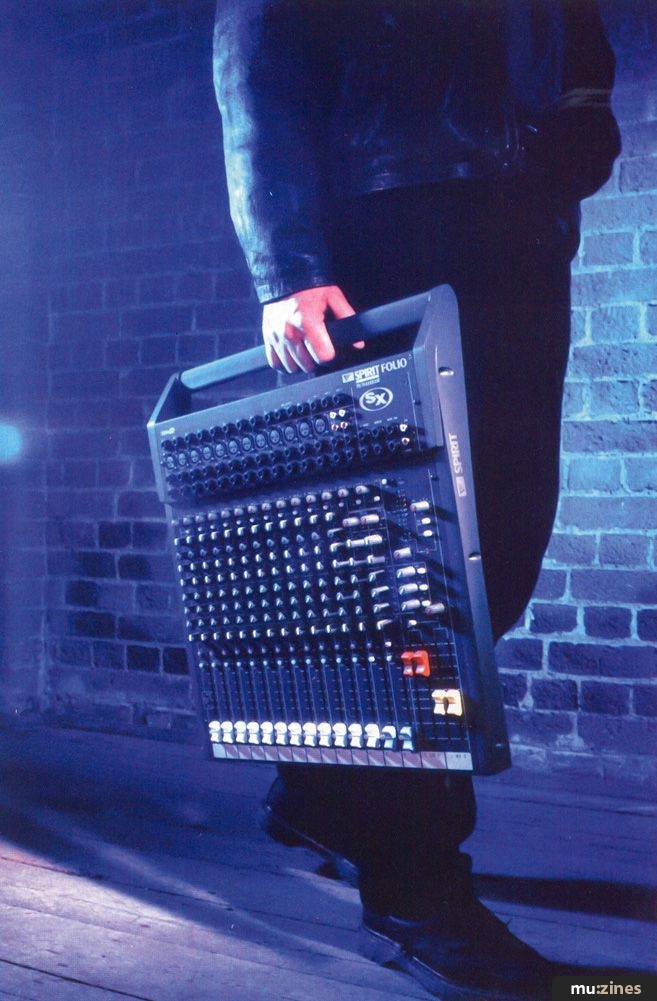
These days the small mixer market is getting to be pretty crowded, with a good choice of portable and well-specified desks available. Spirit's most recent addition to their Folio range is the SX, a versatile 20-input desk with two main output busses for use in both recording and live sound applications. The provision of these features in such a compact unit is possible due to the use of surface-mount technology in manufacture; this is actually the first Spirit mixing desk to employ these techniques.
THE NITTY-GRITTY
Channels 1 to 12 are mono microphone channels, with XLR mic inputs, jack line inputs, and insert point sockets. These mic channels use Spirit's own 'Ultra-Mic' front end circuitry, providing an impressive gain range of 60dB without the need for padding (they are used as the basis for the input stages on Soundcraft's top-of-the-range consoles). The first eight channels are also provided with direct output jacks, which can be set to send pre or post-fade signals. All these connectors are mounted on a slightly raised section at the top of the desk, and all are easily accessible from above.
On the main control panel are (top to bottom) the channel sensitivity control, with a useful 'U' marking (for unity gain), which relates to standard line input signals. Just to the south-east of this control is a small button, which switches in a 100Hz high-pass filter; this can be used for reducing rumble, microphone 'popping', and the like.
The EQ section is a three-band arrangement, having HF and LF shelving controls plus a swept mid control. Each control provides a maximum cut or boost of 15dB; the HF frequency point is 12kHz, LF operates below 60Hz, and the midrange is from 240Hz to 6kHz — all of which adds up to a lot of control for such a small machine.
This desk provides three auxiliary sends: the middle one of which is (globally) selectable as pre or post-fade by means of a switch alongside the Aux 2 master control.
Next comes the usual left-right pan control and two more push-buttons. The first is a channel mute switch which inhibits all outputs from that channel except inserts; the second is labelled 'mix/sub' and routes the channel signal output to either the sub-mix buss or main buss. The channel may be assigned to any of the four master channels by use of this switch in conjunction with the pan control. The channel fader is a nice smooth 100mm job, which should give enough control for even the most exacting requirements. There is a latching PFL button, which feeds the channel direct to the monitor section.
"Its low noise and sound quality certainly live up to the standards expected from this manufacturer."
Channels 13 to 20 are line-level only stereo pairs, but are arranged in two different configurations. Channels 13/14 and 17/18 are basic stereo line inputs via unbalanced RCA phono sockets for use with things like tape/CD signals or effects returns, having only a level control and sub/mix assign switch. Channels 15/16 and 19/20 are endowed with extra facilities and boast balanced line jacks, input gain control, two-band equalisation, and the same access and assigning features to the three aux and four main busses as the mono channels.
On to the master section, which is particularly well laid-out and offers lots of possibilities with its main and sub-mix output options. Nearest to you are the main faders — red for sub, yellow for main — with a switch for feeding the sub-mix signal to the main faders. The Folio SX provides a mono sum output (which could be used for an extra foldback feed, or to drive a sub-bass system), and the master control for this is located just above the main faders. Next are the three auxiliary masters, which are all rotary controls. Each of these has an AFL button, which functions in exactly the same way as the channel PFLs, except that here the entire auxiliary mix would be routed direct to the monitor section. Next to the Aux 2 master is the pre/post switch, mentioned earlier.
The monitoring section comes next and includes the headphone level control and three-colour bargraph meters, together with the two-track return level and monitor source switching. The two-track return can be routed to either main or sub-mix busses and also switched direct to monitor. This is a potentially useful feature, as it effectively provides an extra line input channel should you need it.
48 Volt phantom power is applied to all mic channels by means of a single switch with an associated warning light. In common with all other inputs and outputs on this desk, the main outputs, auxiliary sends etc. are all at the top of the main panel, which means you don't have to keep leaning over or running round the table to re-patch or check connections.
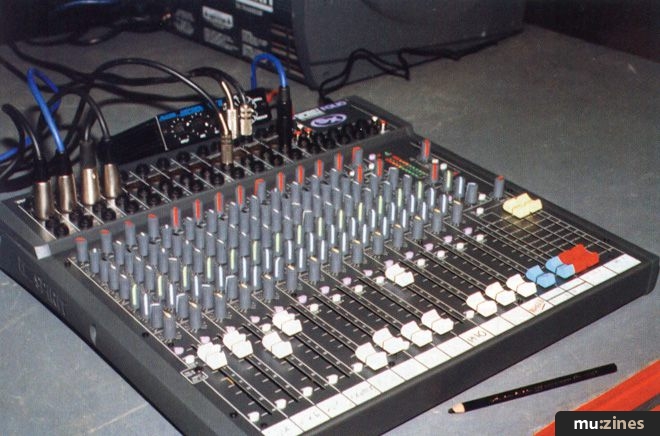
Having all the connectors mounted on a raised section at the top of the control panel makes them readily accessible, no matter where the desk has to be placed for operation.
FIRST IMPRESSIONS
The Folio SX has a fairly busy look about it, and the styling and colour scheme make it instantly recognisable as a member of the Spirit family. The neat, understated grey case and top panel makes the controls and markings easy to see. The nice neat rows of knobs have an instant 'twiddleability' about them. I spent the first few minutes fiddling with everything in sight, and I must say it all has a rather nice feel, especially the 100mm faders which are very light in touch and pleasingly smooth in operation.
Not having met one of these mixers in 'person' before, I was surprised at how slim the case was. 'How do they get the power supply in there then?' — then I found the power supply packed in its separate box ready to be plugged in externally. In some ways, this is a pity, because although the Folio SX is undoubtedly lightweight and slimline, it can't be used without the PSU. Personally I would rather carry the whole lot in one slightly larger package. If, however, you intend using your gear in more than one country with different mains voltages, you will love this arrangement, because, presumably, you could obtain the appropriate 'local' supply units to use with your favourite mixing desk. The PSU connects to the desk by means of a special latching plug, which has a nice positive mating action. However, I would be slightly concerned that if anything went wrong with this at an inconvenient moment (for example just as you're starting your soundcheck 30 miles from home), it wouldn't be the simplest thing in the world to re-wire it, and if it were actually damaged, then you'd be minus desk. On the plus side, the special connector means that you can't try to power it up with the charger unit from your train set, which makes lots of sense in safety and equipment longevity terms — not to mention invalidating your guarantee! An alternative power supply is available, which enables the desk to be run from a 12 Volt car battery — now this is a Really Good Idea, which could be invaluable when operating in the open air or recording in conjunction with other portable battery-powered equipment.
"...a well-specified compact mixer with a good inventory of useful features."
The integral carrying handle is very comfortable and feels secure thanks to its ribbed finish and chunky dimensions. The Folio SX is easy to carry briefcase-fashion, and I kept putting it down on its front edge — perhaps a couple of little rubber feet would help to protect it over a period of time. There is no cover provided — nor, as yet, carry-case — to protect the control panel when the unit is being carried. I expect that before long the nation will be deeply divided over the question of whether it is best carried with controls towards you, or 'knobs out' as you might say. The case appears particularly sturdy, and I like the neat way in which the moulded side pods blend smoothly with the metal top and bottom panels, thus maintaining an integrity of style.
The handbook supplied is both informative and easy to read, containing everything from pictures with little captions saying things like "connect mics here" and "listen on headphones here" to detailed connection diagrams and technical specifications. There are two pages devoted to various connecting lead possibilities, and even a section on delay towers!
TESTING! TESTING!
I took the Folio SX along to a band rehearsal and used it in place of the resident Spirit PowerStation, which for the purpose of this test was relegated to the role of power amp. The first joy apparent was the sensible number of mono microphone channels available, which should be more than enough for most general live music situations. There is no on/off switch (I tried looking in the manual for something labelled "switch on here"), which I suppose really makes no difference except perhaps where the desk is to be plumbed in as part of a fixed installation. In concentrating extra hard on remembering to not leave home without the power supply, I almost forgot to take along a reverb unit; it's easy to become spoilt by the Powerstation's built-in Lexicon! Many live music applications require reverb or other effects, so you have to remember to allocate two mixer channels for stereo effects returns, thus using up two of your 20 inputs — any of the stereo line input pairs are suitable for this purpose, although channels 15/16 and 19/20 will give best control over the return signal.
For initial settings I began, as ever, at 'all flat', which gave a good safe starting point, and I built the mix one channel at a time, maintaining a conservative master volume level. The band requirements were four vocal mics (two male, two female), four on kit, guitar mic (dangling, as I forgot to take the short boom stand — whoops!), with bass and piano going direct into the desk. All was fine, and I used a smidge of top edge on the vocal mics to produce a clear and intelligible result. The EQ comes in for a definite pat on the back here, as I found the degree of control available just right to help achieve a good balance between the four — very different — singers, an essential feature of the band's overall sound. Dealing with the kit was easy — sharp LF cut on the snare/hi-hat mic (Shure SM57) but no HF boost necessary, thus avoiding that nasty splashy noise which is sometimes used instead of good equipment! The sweepable mid EQ controls were especially useful in balancing the toms, as I was using two overhead mics panned quite wide to left and right, and therefore needed good distinction. It was a fairly straightforward job to use the mid sweep control to highlight the different voices of the toms, resulting in a nicely-balanced overall sound.
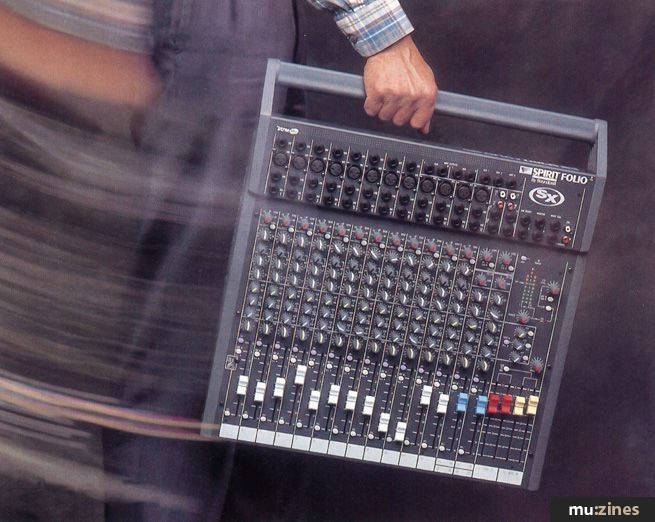
The Folio SX is easy to carry briefcase-fashion.
Just as when one drives a new and unfamiliar car, the controls aren't always where your hand expects them to be (how many times have you indicated your intention of turning right with a helpful flick of the windscreen wipers?), but this desk is very easy to get used to, and the neat vertical white lines which separate each set of channel controls are useful for reminding you which input you're adjusting. While we're talking layout, the write-on panels are a thankfully sensible size for such a compact and well-populated top panel and are not obscured by other fittings. The channel controls are all logically laid out and their use is quite intuitive, with centre detents being provided where appropriate. The small oval selector buttons are quite cute (my friend's little offspring kept trying to collect them up to eat). Due to their short travel, however, I found it a little difficult — especially in poor light, and depending (literally) upon your point of view — to tell whether they were up or down. I experimented by drawing a fine pencil line on the side, which was then only visible with the buttons in the 'up' position.
The sub-mix buss with its faders and separate outputs is a useful feature, especially for recording, but could also be a godsend in live theatre applications to drive a remote PA or monitor system for soundstage positioning, or to provide a complete alternative mix when swapping between two acts on stage — rather like the A/B master arrangement often found on lighting control desks.
On compact mixers, there is often a compromise to be found between having good facilities and enough room to actually use them, but the Folio SX is built to practical dimensions and the controls are easy to get at. Live operation should be no problem for practically anyone except those with a pathological affinity for woolly mittens. The desk sits on its built-in carrying handle at a useful angle and can, of course, be rack mounted if required (there is an optional kit available). As already mentioned, the power supply plug latches into place and is a bit fiddly to remove due to its position right next to one of the side panels, which does however afford it a degree of protection from accidental knocks when in use. The electronic reliability of the Folio SX desk should also be extremely good, as surface-mount components demand very accurate production techniques, which can only be good news for product quality.
CONCLUSION
I can't think of all that many PA jobs I've ever done where this desk wouldn't have coped easily. Its low noise and sound quality certainly live up to the standards expected from this manufacturer. There is a good deal of headroom available at the input stages, and there are enough output options to drive a fairly complex power system. I would imagine that this desk would best demonstrate its versatility in theatre applications where surround-sound effects were called for, or where the separate sub and main mix outputs (not to mention the additional feeds from the three auxiliaries, monitor, and mono sum!) could be used in a fixed installation to control coverage in a number of different areas.
The Spirit Folio SX presents itself as a well-specified compact mixer with a good inventory of useful features. The number of mono microphone channels and flexible output options will make it suitable for many live applications where previously only much larger mixers would have been appropriate.
Folio SX £611 inc VAT.
Spirit by Soundcraft, (Contact Details).
pros & cons
pros
- Compact, lightweight.
- Comprehensive facilities.
- Loads of output options.
- Plenty of mic channels.
cons
- External PSU.
- Push-buttons difficult to 'read'.
summary
A well-specified and versatile compact mixer, with excellent output flexibility and enough input channels for life on the road.
SPECIFICATION
| Noise | |
| - Mic EIN @ max gain (20kHz bandwidth 150 Ohm source impedance): | 139dBu |
| - Aux mix & Sub outputs, masters at max, 16 inputs routed with faders down: | <85dBu |
| Crosstalk (1kHz) | |
| - Channel mute: | <95dB |
| - Fader cutoff: | <90dB |
| - Routing isolation: | <95dB |
| - Aux sends posts 'offness': | <85dB |
| Frequency Response | |
| - Mic/line input to any output, 20Hz to 30kHz: | <1dB |
| THD | |
| - Mic sends -30dBu, +20dBu at all outputs @ 1kHz: | <0.006 |
| Input and Output Impedances | |
| - Mic input: | 1.8kOhm |
| - Line input: | 10kOhm |
| - Stereo input A/B: | 12kOhm |
| - Stereo input C/D: | 10kOhm |
| - Direct out, sub-mix, aux, insert: | 75 Ohm |
| Input and Output Levels | |
| - Mic input max level: | +22dBu |
| - Line input max level: | >30dBu |
| - Stereo input max level: | >30dBu |
| - Headphones (@ 200 Ohm): | 150mW |
| Dimensions: | 180 x 70 x 512mm (WHD) |
Publisher: Sound On Stage - SOS Publications Ltd.
The contents of this magazine are re-published here with the kind permission of SOS Publications Ltd.
The current copyright owner/s of this content may differ from the originally published copyright notice.
More details on copyright ownership...

Sound On Stage - Jan 1997
Gear in this article:
Review by Mike Crofts
Help Support The Things You Love
mu:zines is the result of thousands of hours of effort, and will require many thousands more going forward to reach our goals of getting all this content online.
If you value this resource, you can support this project - it really helps!
Donations for June 2026
Issues donated this month: 0
New issues that have been donated or scanned for us this month.
Funds donated this month: £0.00
All donations and support are gratefully appreciated - thank you.
Magazines Needed - Can You Help?
Do you have any of these magazine issues?
If so, and you can donate, lend or scan them to help complete our archive, please get in touch via the Contribute page - thanks!
Please Contribute to mu:zines by supplying magazines, scanning or donating funds. Thanks!
Monetary donations go towards site running costs, and the occasional coffee for me if there's anything left over!

 @mu_zines
 RSS Feed
 Blog
Blog