


Magazine Archive
Home -> Magazines -> Issues -> Articles in this issue -> View
Dangerous Liason | |
Greg PhillinganesArticle from Music Technology, November 1992 | |
Greg Phillinganes: The keys to Jacksonville
You're the most successful pop star in the world. You're about to undertake one of the biggest tours in history. Who ya gonna call...?

Wembley stadium, late afternoon. Teams of fit-looking men in shorts are running around. Managers look anxiously on from the sidelines. A battle of skill and stamina is underway, and there's some fancy footwork to be seen at one end of the pitch.
But, of course, there's no ball. The feet belong to the dancers, the shorts belong to the roadies, and the battle is literally to set the stage for the arrival of Michael Jackson in front of 70,000 adoring tans. It's one of those tours in which statistics begin to play a star role. 1,000 tons of equipment. 500lbs of laser projection units. 225,000 watts of power for the video system alone. 115 channels of sound. 180 cabinets. 10-15 miles of cable. 33 trucks, 13 tour buses, and 160 permanent crew. Meanwhile, somewhere in Fulham, a band arrives at The Swan with three Vox AC30s and a drum kit in the back of a Transit...
But this is no ordinary gig. The set list, for example, comprises a string of original numbers whose combined sales on record exceed 100 million. For each album, there is a set and costume change to reflect the different stages of Michael Jackson's recording career, including a nostalgic sequence dedicated to The Jackson Five. (For this, understandably, there are no costume or make-up alterations.) And for each note, each beat and each chord of the music, one man is ultimately responsible.
That man is Greg Phillinganes - a diminutive keyboard player who has developed a taste for the mega-gig on previous tours with the likes of Jackson, Stevie Wonder and Eric Clapton. And as the entire edifice takes shape before us, we sit in Block H, Row E, seats 12 and 13 and discuss Everton's use of the off-side trap. Or we would have done, but for the fact that Greg is an American and thinks that footballers are meant to wear crash helmets. So our conversation begins by my identifying him by his official title of MD...
"That's right, whatever that means... well, it could be a medical term, but in this case I am the Musical Director, which simply means that I translate whatever Michael wants musically to the rest of the band, and just kind of make a smooth line of communication between the two parties. It's a matter of making sure that all the parts are right, and that every song is ultimately the best it can be.
"It's mostly live, and the translation isn't difficult because even though a lot of the parts were sequenced on the records, we're not talking about difficult parts. They were sequenced, I guess, as a matter of preference, but that doesn't mean they can't be played live. And I figure if you have six people on stage with instruments, they ought to be doing something. So that's my policy. Along with all the special effects and gizmos, all the extra stuff that goes on in the show, it's nice to have certain fundamentals of live playing still functioning."
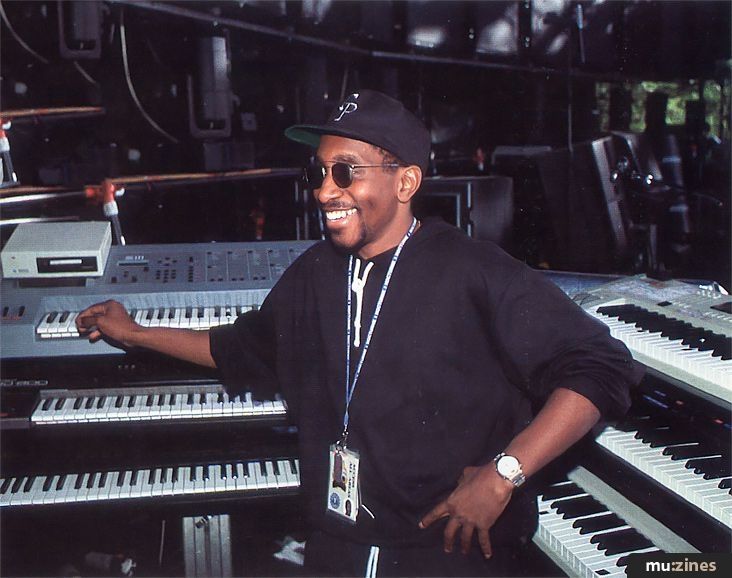
Considering his training as a classical pianist, performing with the Detroit Youth Symphony Orchestra, and his residency in the upper echelons of the LA session scene since joining Stevie Wonder's touring Wonderlove band in 1975, you can bet your buttons that Greg Phillinganes' fundamentals of live playing are, to say the least, still functioning.
"The record feels good, and you want the show to feel good. Some of the arrangements have been changed to protect the innocent. We've changed them mainly for the purpose of accommodating any extra dance routines, so we'll have extended sections in the middle of a song."
At this point, the first of a couple of communication breakdowns occurs: I have with me a list of keyboard players on the tour, and mysteriously Greg is not one of them... "Really? Well let me assure you there are two keyboard players, and I am one of them. Here's the other keyboard player now." At this point, our attention is distracted by the arrival of bits of the Thriller set. The crew are manhandling a huge polystyrene sarcophagus, on which rests the gaunt figure of a particularly gruesome skeleton. It's clearly been an exacting tour. Greg responds: "He's been working a lot with the crew lately, but he's in great shape. Actually the other keyboard guy is Brad Buxer, and the last time I saw him he looked a lot better than that...
"I am the Musical Director - which simply means that I translate whatever Michael wants musically to the rest of the band"
"I'm using four keyboards on stage, and rackmounted equipment behind that. Brad plays most of the sampled sounds, and I play most of the main piano and keyboard parts - some string sounds, some horn sounds. Things are divided up pretty equally. I use a KX88 as the main controller; on top of that is an M1, and to the right there is what will be an 01/W Pro - I've been using just an 01 up until today, in fact, so this is hot news! On top of that is a D50, and then I have a rack of equipment behind me - sundry modules.
"The entire 01 line is just great, it really is. They have very effective sounds, and they're easy for me to program; if someone like me can program a synth, it really is easy, I can tell you that right now! All the patch changes I do from the KX88. If there's any problem I have my crack sidekick, Dave Benson, to back me up, ever at the ready. It's a crack team - as opposed to a team that's on crack."
Heaven forbid. The phrase 'mostly' live prompts an inevitable question... "Yes, there is a click track which goes to Ricky Lawson (the drummer), and the things which are triggered are usually extra percussion sounds, but for the most part it's us. Ricky uses a lot of Akai stuff for the samples, and he takes care of all the drum and percussion sounds. But then, he's done this before, you know! We were both on the Bad tour."

At this point in the conversation, we are confronted by communication breakdown number two: I begin to formulate a question based on the observation that Ricky Lawson MD'd that last tour... "What are you talking about? I was MD both times! Wrong information, Phil." In my defence, I produce the official press handout, which clearly backs me up. There is a pause, and then a very musicianly response from Greg: "Record companies. What do they know?"
Greg Phillinganes is indeed a musician. And he exhibits a musicianly caution when it comes to describing his craft in words. He also has that lingering trepidation of the musician when confronted by what might be conceived as encroaching technology. It takes a while to come to the surface, but in discussing the high-tech requirements of this tour he leads the conversation to a point where the lines are clearly drawn.
"In general, this kind of setup is no problem unless you - how can I put this - unless you don't know what you're doing, but I don't want that to sound arrogant. What I mean is that it can be a problem if you're not aware of certain ramifications. The thing is to know what you yourself are capable of playing, especially within the realms of what everyone else can play, so that you will know what you don't need.
"That way, you're not doubling parts, or doing extra things that will end up cancelling out others because you're doing too much of the same thing. Its just knowing what everyone's capabilities are so that you don't sound like you're playing to a click track. The click track - and the sounds that are synchronised with it - will be the icing, a luxury, but won't sound as if it's controlling everything."
Does everything become too mechanical if you do sound as if you're playing to a click? "It can, but that depends on the tightness of the band, and the kind of understanding that you have with them, and the mentality involved; the mentality of everyone in the band. It doesn't have to be that way. That understanding is the ground rule, the bottom line, between you and the rest of the band.
"Along with all the special effects and gizmos - all the extra stuff that goes on in the show - it's nice to have certain fundamentals of live playing still functioning"
"Michael's music is becoming more and more street-oriented, but I don't think it's becoming based on technology. It's getting more of a raw edge to it, but the technology is about the same. It may be sounding more 'hip-hop', but that's to do with musical genres as opposed to technology. To me, there's no ground-breaking stuff going on technically - at least, not that I'm aware of. The technology that we're using is definitely sophisticated, but we use it only to embellish, really, what we're doing musically. I don't like being taken over by technology. I'm fascinated by it, it's great, but I only use it as an aid. It's not the primary ingredient.

"I don't think that hip-hop has come out of technology; it's come from combining different musical rhythms and then using the latest technology to bring that out. I think that the technology arrived at a point where it was more convenient for hip-hop musicians to work with, to adapt to their music, but not the other way around. Budding technology was around during the disco era - not at the level that it is today, but it was around, emerging more just after that in the early '80s, and you could say that there are other genres that grew out of it, too; but I wouldn't agree. I think it's just that the technology has grown to a level of sophistication where it's more of a convenience.
"It's an advantage and a disadvantage at the same time, because more and more kids are going straight for the drum machines and the sequencers, and they're practising less. Before that stuff you had to practise. This is not to put down anybody whose playing ability may not be the same as another musician who practises, because it's a great tool. I'm just saying that, at the same time, you have to be careful that the technology doesn't take over.
"That's what I meant earlier, that's the down side if it. Yeah, it's a convenience, it gives you adaptability, and it's developing a closer relationship with whatever music you're doing, but... I mean, if there's any genre that's grown directly out of technology I would say it's techno music, stuff they were doing in Germany in the '70s and early '80s, groups like Kraftwerk. And there was Yellow Magic Orchestra, who were expanding on that too. Maybe some dance styles, like house music, go back to that, but not really Michael's music."
Our particular little corner of Wembley Stadium is gradually becoming engulfed in the kind of sounds you might expect with the construction of a stage 260 feet wide and 90 feet deep, and a PA system producing 240,000 watts of power. It's easy to imagine quieter spots for an interview. The middle of the Blackwall Tunnel, for example. Greg raises his voice as a truck reverses by, full throttle.
"This is the kind of ambience we want! The noise of hard labour! Lots of sweaty guys running around! Lorries and fork-lifts everywhere! Steel! No girls, though, which is kind of sad. Hang on, there's one I've seen before..." Yes, he has met her before - once or twice. It's Jennifer Batten, the striking lead guitarist in his band. She and her hair-do are settling into a nearby seat for the purposes of another interview. No doubt about it, the Michael Jackson show has rolled into town. Between pantechnicons, Greg continues his analysis of running the most high-profile band of the moment.
"So it depends on the precedent that you set with the band; the goal that you want to attain. It doesn't have to feel mechanical at all, it doesn't have to have that rigid feeling. You can still develop a feel within a click track. People say 'how can you play the same thing night after night?' but it's no different from any other job that you have to do repeatedly. If you enjoy it, you are able to expand on your own creative boundaries. It's the same as a Broadway show; people do that night after night and there's a discipline, quite frankly, which you get from that. Everything doesn't always have to be loose."
"Michael's music is becoming more and more street-oriented, but I don't think it's becoming based on technology. It's getting more of a raw edge to it, but the technology is about the same"
There is the faintest hint of defensiveness about Greg's insistence that such a strictly choreographed show is still a worthwhile exercise for a musician.
Perhaps this is the response of a virtuoso pianist seconded to a pop project occupying the most main of streams. Perhaps the tour has simply attracted too much non-musical interest. This is, after all, the second consecutive day on which The Daily Mirror has published an unflattering front page photograph of the star of the show, whose reputation as a songwriter has long been eclipsed by his medical record.
Equipment List
Korg 01W Pro, M1
Roland D50
Yamaha KX88
Modules
Korg M3R
Wavestation AD, A3, EX8000
Akai S1100
Roland D550, MKS70, MKS80
Yamaha TX816, TX802
E-mu Proteus 2
"It's different from playing with someone like Eric Clapton, that's for sure. That's a completely different thing; the music's different; the band is different; the setup's different. I'm not saying it's better - it's just different, like apples and oranges. So this is a slightly different challenge, but it's still fun. People do try to make it sound as though this could be a bad tour to do, but if it was that bad I wouldn't be here. I have a choice in this, you know. I wasn't sentenced to it.
"I just like big productions; I like playing in stadiums, I like the whole ambience of it, the excitement of it. OK, we've done it 800 million times, but the audience is new in each city we're in. They're seeing something for the first time, and you want to give it that freshness; you want to display that kind of excitement. The show's the same, but the crowds are different from show to show, and because of that you have areas of give and take. Those aspects will keep the show fresh, in general."
Recommended Listening
SONGS IN THE KEY OF LIFE (Stevie Wonder, Tamla Motown 1976)
BISH (Stephen Bishop, MCA 1978)
HEART STRING (Earl Klugh, Liberty/UA 1979)
GIVE ME THE NIGHT (George Benson, Warner Bros 1980)
BLACK & WHITE (The Pointer Sisters, Planet 1981)
EVERY HOME SHOULD HAVE ONE (Patti Austin, Qwest 1981)
RAISE (Earth Wind & Fire, Columbia 1981)
WHATCHA GONNA DO FOR ME? (Chaka Khan, Warner Bros 1981)
IT THAT'S WHAT IT TAKES (Michael McDonald, Warner Bros 1982)
THE NIGHTFLY (Donald Fagen, Warner Bros 1982)
THRILLER (Michael Jackson, Epic 1982)
HEARTS AND BONES (Paul Simon, Warner Bros 1983)
FINDER OF LOST LOVE (Dionne Warwick, Arista 1984)
WE ARE THE WORLD (USA For Africa, Columbia 1985)
THE COLOR PURPLE (Film soundtrack 1985)
BEHIND THE SUN (Erie Clapton, Duck 1985)
AUGUST (Eric Clapton, Duck 1986)
JOURNEYMAN (Eric Clapton, Duck 1989)
COMPOSITIONS (Anita Baker, Elcktra 1990)
DANGEROUS (Michael Jackson, Epic 1991)
Solo albums
PULSE (Planet/RCA)
SIGNIFICANT GAINS (Planet)
Publisher: Music Technology - Music Maker Publications (UK), Future Publishing.
The current copyright owner/s of this content may differ from the originally published copyright notice.
More details on copyright ownership...

Music Technology - Nov 1992
Interview by Phil Ward
Previous article in this issue:
Next article in this issue:
Help Support The Things You Love
mu:zines is the result of thousands of hours of effort, and will require many thousands more going forward to reach our goals of getting all this content online.
If you value this resource, you can support this project - it really helps!
Donations for August 2026
Issues donated this month: 0
New issues that have been donated or scanned for us this month.
Funds donated this month: £0.00
All donations and support are gratefully appreciated - thank you.
Magazines Needed - Can You Help?
Do you have any of these magazine issues?
If so, and you can donate, lend or scan them to help complete our archive, please get in touch via the Contribute page - thanks!
If you're enjoying the site, please consider supporting me to help build this archive...
...with a one time Donation, or a recurring Donation of just £2 a month. It really helps - thank you!

 @mu_zines
 RSS Feed
 Blog
Blog