


Magazine Archive
Home -> Magazines -> Issues -> Articles in this issue -> View
Deep House | |
House of LoveArticle from Phaze 1, June 1989 | |
on playing live, major labels and the prospect of being famous
GREETED LAST YEAR AS THE NEW GUITAR MESSIAHS, THE HOUSE OF LOVE ARE DESTINED FOR THE BIG TIME. TERRY BICKERS AND PETE EVANS REVEAL THE SECRETS OF BUILDING A BRIGHT FUTURE.

THE INDEPENDENT SCENE is sometimes very predictable. With an audience constantly in search of new heroes, the arrival of a new band is often greeted with a reverence that verges on the religious. It happened with The Smiths, it happened with The Jesus and Mary Chain, it happened with The Wedding Present. Last year it happened with The House of Love. Their arrival was timed just right — with Morrissey seemingly spiralling into cabaret and the Bunnymen in disarray, The House of Love's Guy Chadwick was the prime candidate for canonisation by Britain's anorak draped youth. His songs were sufficiently introspective to strike a chord with a young audience and on the surface, the group had all the "right" reference points — The Velvet Underground, The Doors, everything late sixties. But the same course had been mapped out by countless shambling bands, both hapless and hopeless, since the early eighties. What was it about The House of Love that gave them that bit extra? Well, in their own words, they were brilliant.
Signed to Alan McGhee's Creation label, their 1987 debut single, 'Shine On' caused a ripple rather than a wave, but in early '88 The House of Love fully signalled their arrival. With 'Christine' came the buzz that has surrounded the band ever since. Complete with droning guitar, the single attracted some ill-fitting comparisons with The Jesus and Mary Chain, but despite it's huge production, the atmosphere was one of understatement and restraint — The House of Love sounded like a band on the verge of something very big.
Laid-back and loose, but certainly no disappointment, the eponymous debut album was released halfway through 1988. The guitars of Terry Bickers and Guy Chadwick are exquisitely layered and give the album a texture that laid to rest any suspicions of "just another three-chord-thrash" - guitar bursts are few and far between but when they do arrive they explode like fireworks. The album took up a residency at the top of the independent charts, and while clubland echoed to cries of "Acieeed", the independent scene was enjoying it's own "Summer of Love". The group built on this initial success with the 'Destroy the Heart' single in the second half of '88. Eagerly awaited at the time and subsequently voted best single of the year by those ultimate arbiters of style (?), the readers of the NME and the listeners of John Peel, 'Destroy the Heart' conveyed a power and emotion that was somewhat muted on the album. The House of Love were here to stay.
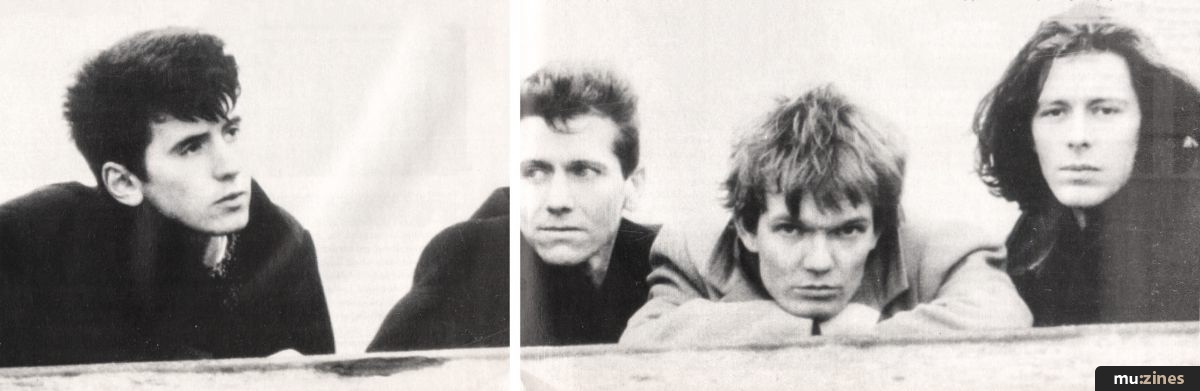
A third of the way through 1989 and things are looking good for the band. Currently recording some preliminary tracks for their second album, they have recently dented the lower end of the Top 40 with 'Never' their first single for Fontana. When I arrive at the West End studios, they are working hard — at the pool table. While guitarist Terry Bickers and drummer Pete Evans take a break to reflect on how they got this far, Guy Chadwick and bassist Chris Groothuizen scuttle downstairs to the studio.
"Sorry," apologises Pete, "Guy gets really tired of interviews, really pissed off in fact. He's always being photographed at the front of the band and being put on the cover of various magazines."
To an extent Guy Chadwick has become the public face of The House of Love, but even if he finds it tiresome, the rest of the band are quite content.
"It's a comfortable position for us not to be in the limelight as much as Guy is," says Pete. "I wouldn't be a drummer otherwise! Some people might see us as Guy's backing band, but it's just not like that. Even if it was, it wouldn't bother me at all. I always wanted to be in a group that I knew, if I wasn't in that group, I'd be a huge fan. I'm Guy's biggest fan, I'm the group's biggest fan, so I'm happy. I'm just bloody lucky to be sitting in the drumstool."
"In terms of ideas, it is very much a group effort" insists Terry.
Now they've been together for three years, the group see the chemistry between them as being important in keeping them sane, after what was a very eventful year. After critical acclaim was heaped upon their debut album, came the inevitable press and record company interest. Midway through 1988, The House of Love seemed to be on the cover of every music paper going and were very much last year's "big thing".
"It was a bit frightening, it freaked us all out a bit" Pete admits. "It was really doing us in. Every day there'd be another record company coming to see us. We went on tour in Europe to escape for a bit, but being stuck in a van with nine blokes for days on end freaked us out as well! Definitely a weird period."
"It depends on the people, I suppose, but I think we were fortunate in that things progressed at a reasonably comfortable rate," says Terry. "You've got to be tough when you're put 'right up there', but you've just got to greet these things as a challenge. You can't run around forever freaking out and shouting 'Oh shit!!' If you've got belief in what you do then there's nothing to be scared of."
The last year has seen a number of the darlings of the indie-scene take the plunge and join major labels. The Darling Buds, The Wonderstuff, The Wedding Present and The House of Love have all signed on the dotted line. Do such developments signal a new realism among young bands?
"I don't know," says Terry. "For us it was just the way things happened, but you certainly need a lot of push from the record company these days if you're going to succeed."
"There were some problems with distribution" admits Pete, "but we've certainly nothing against Creation. We really enjoyed our time there. It was just time for the next step."
The departure of these bands for major labels is the sort of thing that can split their fans. They fear the crumbling of bands' creativity in a big business environment.
"JUST 'PLAYING WITH MUSICIANS' IS LIKE A ONE NIGHT STAND. PLAYING IN THIS GROUP IS LIKE A LOVE AFFAIR."
"People are precious about the independent scene, but understandably so", argues Pete. "It's the only place where you get interesting new music... It's certainly not coming from anywhere else. We'll always have a leaning towards independent music, I think."
"But for us, there hasn't been a great change in moving from Creation to Fontana. It's very much business as usual" Terry maintains. "We're still very much involved with Alan McGhee, who's still managing us — he 'deals' with Phonogram for us. It's important to us to keep a team of people around us who we trust."
The band have picked their working partners carefully. When they were first approaching record labels, they went to Creation specifically because they felt Alan McGhee was someone who'd be interested in them. When the majors were chasing their signatures, Pete reveals that it was the prospective label's attitude that was most important.
"Even at the final stages of the Phonogram deal we were being offered deals left, right and centre — for half as much money again! It was really ridiculous. But Phonogram were the only ones who seemed genuinely interested in the music. Their A&R man is just a really big music fan, which was very refreshing compared to all the others we met."
The record company's attitude extends further, and they seem to appreciate the bands aversion to some elements of the pop circus. Don't tune into 'Top of the Pops' and 'Going Live' expecting to see The House of Love.
"Funnily enough, even Phonogram don't really want us to do that sort of thing initially." muses Pete. "Personally I'd rather not do it at all. But the Mary Chain have done 'Top of the Pops', so I guess anybody can! They do it in their own way though and I think that's how we'd have to approach it. I can't really see us smiling into the camera and jigging about..."
"We're much more interested in albums than singles anyway," affirms Terry. "We're not really bothered about singles success."
"I hate the singles chart... apart from perhaps New Order and the Pet Shop Boys" opines Pete. "The rest make me want to vomit."
Yet part of the appeal of The House of Love is that while keeping their distance from the more vulgar commercialism of the business, the band are at the same time proving to be one of the most accessible of their ilk. Terry has no doubts about the band's strengths.
"The great thing about Guy's material is that they're really, really good songs. There are no tricks, there's no fad. It's a very traditional thing of a song with some depth and some meaning." Appealing simplicity to many — to others, bands like The House of Love are simply recycling the back-end of the sixties, for a younger generation. True to character, they are brutally honest about their influences.
"We are very influenced by the Velvet Underground, the Stones, the whole sixties thing" admits Pete. "When I first joined we thought we were the Velvet Underground. But we've developed so much since then, and there are other influences too. We all really like New Order, the Pet Shop Boys, I really like Soft Cell...
"I'm listening to a lot of Kraftwerk" says Terry.
The group's more contemporary influences have seen them working with Stephen Hague, famous for his work with New Order and the Pet Shop Boys. Having admired his previous work, the band were lucky enough to learn that Hague wanted to work with them.
"He's a great thinker," affirms Pete. "It's very important to have ideas coming from outside the band. You get so close to your work sometimes, it's great to have a few other people there to say, 'well, I'm not too sure about that' or 'that's brilliant', although we'll often think it's crap. We're painfully self-critical. Working with lots of different people helps you to find out what works best"
"WE DID SOME DEMOS AT THE END OF LAST YEAR AND WE WENT IN THINKING WE WERE GOD'S GIFT AND CAME OUT FEELING LIKE MICE. YOU SHOULD NEVER FORGET THAT THE MUSIC IS MORE IMPORTANT THAN YOU ARE."
As a result the next album will be recorded using a number of different producers, including Hague and Daniel Miller of Mute records. But despite working with people who might bring a more commercial edge to the band, Terry seems unconcerned with either commercial success or critical acclaim.
"It takes a lot to 'lift us up'. Accolades don't really mean much to us."
"I'm afraid not much does." apologises Pete. "We're only affected by our own feeling for the music really. It would be nice to sell more, but we're still really pleased with the way things have gone. The album is still selling after almost a year and although we weren't blown away with the final sound, it's a great achievement. We were playing around with very little money and we recorded it in ten or eleven days. I'd like to see anyone else make an album so quickly and make it sound like that!"
Now there's a challenge, for it's an impressive album. Injecting much needed life in to a tiring genre, it reaffirmed the strength of guitar music, and induced a frenzied response from both public and business alike. The rest is history. Although since their debut, Terry reveals that things haven't all gone smoothly. They started to believe the hype just a little too much...
"We did some demos at the end of last year and we went in thinking we were God's gift, and came out feeling like mice. It just didn't work at all. You should never forget that the music is more important than you are."
Now as they prepare for the follow up album, The House of Love feel more like "a band" than ever before and Pete reveals how they approach playing together.
"We're enjoying recording more than we ever used to, partly because we've got more time now. But we're also playing much better together — it's what comes of getting to know each other musically, I suppose. The touring has helped too. Ar first we were just a noise, literally falling to pieces every eight bars. But just being wrapped up in the sound was great. We didn't mind the mistakes either, it was all part of the buzz. Hopefully we'll never lose that looseness. Unfortunately, I think we lost that on the 'Never' single..." he admits. 'Never' doesn't quite have the fire of it's predecessors — perhaps a reflection of the extra time and money the band are now able to invest in recording. "It was a bit too slick really. We kind of see ourselves as a diamond, but we want to stay rough cut."
Live, that roughness has ensured they are a force to be reckoned with, and they believe the stage is the best place to make a mark.
"It's important to build a reputation touring," insists Pete. "On the last tour we tried to keep about a third of the set new material. It keeps things interesting and lets you sort out new songs a bit better before they're recorded. We do worry about bad receptions, but we've never had one. We're really good live.
"It's great when you get a reaction. We'll always have a soft spot for London, because of our gig at the Falcon in Camden. That's when we started to realise something was happening. We were expecting about 10 people to turn up and the place was packed. It was brilliant... I don't think we'll ever forget that..." As Pete's eyes mist over with fond memories of the beckoning big time, Terry explains how they built their live reputation.
"When we first started playing live we'd go out on stage for about 20 minutes and aim to completely devastate everybody who came into contact with us. We worked so hard at that — the short, sharp shock treatment. When you're first trying to win an audience the worst thing you can do is go out for a couple of hours. You'll bore them to death." With tickets for their short June tour selling like the proverbial hot cakes, there seems no danger of that.
"Phonogram have got great expectations for us, but they're no greater than the general public's" argues Terry. "We've got a great deal of belief in what we're doing."
"There's got to be that deep feeling" Pete continues. "You can't just work hard at it... you'd be able to tell with the end product. Just 'playing with musicians' is like a one night stand. Playing in this group is like a love affair."
The House of Love are busy building themselves a very bright future, but manage to retain as much youthful enthusiasm as when they started.
"I'm just really looking forward to hearing the album, the end product", confesses Pete. "I think it's very important to keep your enthusiasm for the group, aim for something a couple of months ahead — like a gig, or even doing some photographs. You've got to try and keep your momentum, because once you've lost that, you're buggered, really." Plain talk and plain sense. The House of Love take themselves as seriously as their audience does — they know that they're going to be very big, very soon. Weil, who's going to tell them they're wrong?
Publisher: Phaze 1 - Phaze 1 Publishing
The current copyright owner/s of this content may differ from the originally published copyright notice.
More details on copyright ownership...

Phaze 1 - Jun 1989
Interview by Michael Leonard
Help Support The Things You Love
mu:zines is the result of thousands of hours of effort, and will require many thousands more going forward to reach our goals of getting all this content online.
If you value this resource, you can support this project - it really helps!
Donations for June 2026
Issues donated this month: 0
New issues that have been donated or scanned for us this month.
Funds donated this month: £0.00
All donations and support are gratefully appreciated - thank you.
Magazines Needed - Can You Help?
Do you have any of these magazine issues?
If so, and you can donate, lend or scan them to help complete our archive, please get in touch via the Contribute page - thanks!
If you're enjoying the site, please consider supporting me to help build this archive...
...with a one time Donation, or a recurring Donation of just £2 a month. It really helps - thank you!

 @mu_zines
 RSS Feed
 Blog
Blog