


Magazine Archive
Home -> Magazines -> Issues -> Articles in this issue -> View
Article Group: | |
Dynacord DC60 Amplifier | |
Article from Phaze 1, February 1989 | |
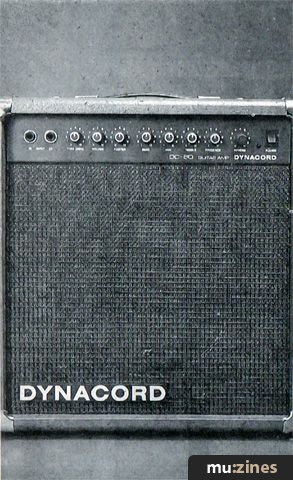
THEIRS MAY NOT BE the first name you think of when it comes to quality amplification, but the West German firm of Dynacord have been turning out all kinds of "sound reinforcement" equipment, to a consistently high standard of construction, for a long while now. Yet though their amps have always been well built and have also sounded good, they've never been "cheap". Not even "reasonable". In fact, "damned expensive" is the phrase that comes easiest to mind.
Until recently, Dynacord gear was distributed in the UK by Washburn, who made a considerable effort to promote the range with live demonstrations and extensive advertising. But even with this exposure sales flagged, and the parent company has now appointed a small network of franchised dealers throughout the country. As a result, the price tickets on Dynacord equipment have got lower, and demand for the amplifiers, especially, is now on the up.
Last summer, I was lucky enough to be invited to a private showing of Dynacord's latest technology. Sitting in the middle of some incredibly advanced musical equipment was a guitar amp that somehow looked out of place in this hi-tech setting. It looked too small to be a serious practice amp - OK for the bedroom perhaps, but not practical for use with a band. Then I plugged it in... and got the shock of my life. Some person of questionable parentage had left the volume flat out, with full distortion!
After checking the pacemaker and turning the hearing-aid down, I set about a thorough examination of this little monster. I could see that the Dynacord staff were not amused by my endless Van Halen licks, so I politely asked if they could send me a sample for review. Which they did.
To be fair to the DC60, I should qualify what I said above about its suitability as a "practice amp". From a design standpoint, it looks like it's intended to bridge the gap between smaller practice amps intended strictly for solo domestic strumming, and bigger beasts suitable for fullblown band rehearsals and small-scale gigs. Whether it succeeds in bridging that gap depends to some extent on how well it's put together: have Dynacord compromised on their build quality to bring the price down?
Overall, the answer is no, they haven't. Measuring 42cm X 39cm X 23cm, the cabinet is made of 18mm high-density chipboard and is sprayed with a grey, hammer-finish paint. Tough-looking metal corners are fitted, and the amplifier section is fixed to the top of the cab with four sturdy bolts. The speaker cloth is made from a black nylon material and the 10" speaker is rear-mounted. There's even a large Dynacord logo at the bottom of the speaker grille - so now you've no excuse to forget the name or spell it wrong.
The back of the cabinet is open with the exception of a panel at the bottom, which means plenty of handy storage space for leads, strings, and anything else you might want to carry around from rehearsal to rehearsal. The construction of the cab is extremely robust, and the unit weighs in at a generous 11kg. The only weak point in the design is that the speaker is quite vulnerable, and could be damaged if you're not careful storing away leads. The mains transformer is accessible from the back, but is well protected by a plastic shroud.
Built-in reverb (a fairly standard effect that makes an amp sound like it's in a big hall, rather than a pokey room) is very much a part of the DC60 package. It's provided by an Accutronics folded spring reverb pan, mounted vertically on the right-hand side of the cab - far enough away from the speaker to eliminate any possible acoustic feedback, often a bugbear with reverb springs. A power output of 30 watts seems quite high, considering the size of the amp, but it probably helps to explain the sound and tonal flexibility (see below).
The front panel layout is neat and simple. There are two input jacks (high and low), and controls for "tube drive" (switchable - for that mega distortion effect), volume, master volume, bass, mid, treble, presence, and reverb (also switchable). Oh, and there's a power switch, complete with a little red light to tell you when the thing is switched on.
If you're interested in using additional effects like distortion pedals, digital delay racks and the like, there are two send/return loops which allow you to connect them to the amp. One of these is between the preamp and the power amp, while the other allows you to patch in an external device in parallel with the built-in reverb. That reverb is de-activated when a mono jack lead is inserted in the return line, but remains active when a stereo jack plug is used. The mix balance between the internal reverb and external effect is controlled by the levels on the external device, while the reverb control on the amp acts as a master control for both internal and external treatments. Clever stuff! These connections are to be found on the rear panel, along with such mundane things as a socket for the mains lead. There's also a headphone socket for use during those private, personal, four-in-the-morning moments of thrashing ecstasy.
The DC60's tonal circuitry, described briefly above, is extremely flexible - to the point where you have to be careful not to use the controls at their extreme settings. Although a useful handbook and circuit diagram are provided, no specifications are given for these controls. Judging by ear, though, I'd say there is at least 18dB cut or boost for each frequency range (bass, mid and treble), which is more control than you would probably ever need.
The "tube drive" option is switchable either from the front panel or by a footswitch (not supplied), and with careful use of the tone controls, a more than passable "overdrive" distortion sound can be achieved. At the other end of the scale, the clean sounds on this amp should suit virtually any guitar/pickup combination, from the weediest single-coil to the fattest humbucker. Another important point is the smoothness of the reverb - positively no clanking springs.
Thanks mainly to its high output power, I found the DC60 very useful, even at the higher levels, for band rehearsal. The two send-return loops came in handy: I patched a chorus into the preamp loop, and a delay into the reverb loop. This gives more control over the delayed signal than usual, as you can mix the volume level of this effect with the reverb control, and still retain the use of the reverb if you need it.
Simply put, the DC60 not only bridges the gap between diminutive practice amps and fully fledged combos, but could - depending on your personal circumstances - actually make either device more or less redundant. If you're looking for a practice amp but feel you could afford a little more than most of them cost, it's worth stretching your wallet for something that's a great deal more versatile. If you already have a practice amp and are on the lookout for something more substantial to rehearse with, you could sell your existing baby, go for the Dynacord, and put it to use in both situations.
You'll have to look hard to do better - in terms of either sound or facilities - for the same sort of dosh.
DYNACORD DC60 AMPLIFIER: £120 including VAT
INFO: From your local Dynacord dealer
Publisher: Phaze 1 - Phaze 1 Publishing
The current copyright owner/s of this content may differ from the originally published copyright notice.
More details on copyright ownership...

Phaze 1 - Feb 1989
Review
Review by Robbie Gladwell
Previous article in this issue:
Next article in this issue:
Help Support The Things You Love
mu:zines is the result of thousands of hours of effort, and will require many thousands more going forward to reach our goals of getting all this content online.
If you value this resource, you can support this project - it really helps!
Donations for June 2026
Issues donated this month: 0
New issues that have been donated or scanned for us this month.
Funds donated this month: £0.00
All donations and support are gratefully appreciated - thank you.
Magazines Needed - Can You Help?
Do you have any of these magazine issues?
If so, and you can donate, lend or scan them to help complete our archive, please get in touch via the Contribute page - thanks!
Please Contribute to mu:zines by supplying magazines, scanning or donating funds. Thanks!
Monetary donations go towards site running costs, and the occasional coffee for me if there's anything left over!

 @mu_zines
 RSS Feed
 Blog
Blog