


Magazine Archive
Home -> Magazines -> Issues -> Articles in this issue -> View
Article Group: | |
Editorial | |
Article from Electronics & Music Maker, January 1985 | |
The copyright dilemma rears its ugly head once again.
There's a major row brewing on the music publishing scene at present, and it's all a result of the problems posed by trying to pigeon-hole new technology. Let's take an example: a new band called 'Deep Perforators' has penned a successful ditty ('Venus Returns') that's been immortalised in vinyl by a record company called Deep Records Ltd and turned into sheet music by a publishing company called Deep Music Ltd. Every time a copy of the 'Venus Returns' single is bought, a slice of the action goes in the direction of the group, another slice in the direction of Deep Records Ltd, a further slice to Deep Music Ltd, and a standard 10% to the Mechanical Copyright Protection Society, or MCPS for short. The MCPS looks after the interests of the composer, musician, or record company when the sound on a record is recorded onto a particular sort of medium - vinyl, tape, CD, film, video or whatever. But note the tag 'sound'.
Every time 'Venus Returns' is played over the air (assuming that enough freebies have been pushed in the direction of Radio 1 DJs and it's got past the BBC's obscenity squad), the Performing Rights Society (PRS for short) collects royalties which are distributed between the composer (in this instance the group, the creation of 'Venus Returns' being a democratic process), the publishing company (Deep Music Ltd), the arranger (the Trevor Horn lookalike), and the PRS itself ('for administration costs'). Fair enough.
But let's suppose you don't want to listen to 'Venus Returns' on the radio, or even purchase the single. Let's say, being of a more creative bent, you want to play the music from the sheet music score. So you go along to the aforementioned shop, part with a bob or three, and walk back to your home studio. As you start to think of ways and means of playing the music, bear in mind where that money will be going after subtraction of profit margins and the like - namely 50/50 between the group and Deep Music Ltd. Note that neither the MCPS nor the PRS are involved in this transaction.
After much deliberation, you decide that the best way to do the piece justice is to enter the printed notes into a computer so that it'll play via some MIDI keyboards and a drum machine. Let's say you're so pleased with the outcome that you decide to add your arrangement of 'Venus Returns' to a collection of MIDI-fied pop songs that you're marketing on floppy disk. At this stage, you start to think about copyright. Well, you're the arranger of this version of 'Venus Returns', so you write to Deep Music and tell them about what you've done. They're quite happy about this, and you agree on directing a percentage of the sale of the floppy disk in their direction. Next, you write to the PRS to notify them you've made an arrangement of 'Venus Returns' for performance via MIDI, and as the arranger, you know you'll receive a third of any royalties that might come in. Now all you have to do is sit back and wait for the PRS cheques.
And that's where it all ends. Or does it? Well, this is where we introduce the thorn in the flesh - the MCPS. They'd argue that the encoded MIDI score on the floppy disk comes under their jurisdiction. They'd maintain that it's a 'transcription' of the copyright work, and that this sort of storage of copyright music (meaning 'sound' in their eyes/ears) by a machine is a mechanical copy. But as anyone with an ounce of sense can see, it plainly isn't - that's why the distinction between 'sound' and 'score' is so important.

The reason all this has come to a head just now is not entirely unconnected with Hybrid Technology and their new Music 500 system. Not surprisingly, HT wanted to put together a number of AMPLE-encoded pieces for their demonstration (software!) cassette. They thought it'd be a good idea to check with the MCPS that it was OK with them for arrangements of various pieces to be included. After many months of deliberation, the MCPS informed Hybrid that they couldn't use arrangements of pieces by Paul Simon, Kraftwerk, or Ultravox, and that they'd have to pay a mechanical royalty on two other pieces ('Popcorn' and Satie's 'Gymnopedie'). On top of that, they put their collective feet well and truly down on the idea, of the listing of AMPLE-encoded score being printed in any form.
Well, we all know that this is absurd. After all, an AMPLE-encoded piece, like any MCL- or MIDI-encoded piece, is merely an alternative format of the score, and has nothing directly to do with the sound itself. So by all conventional logic, this should be outside the territory of the MCPS.
Which begs the question as to why the MCPS are insisting that they have mechanical rights on something that's purely and simply a variant of music publishing. More to the point, who's going to be able to convince the MCPS now that they think they've got Hybrid Technology where they want them?
What's curious is that floppy disk music publishing had been going on for several years prior to Hybrid coming on the scene. Syntauri Corporation in the States have been gaily giving away disks with their arrangements of Henry Mancini et al for their alphaSyntauri system, Yamaha have their bar code versions of Christmas Carols and sundry pops, and Passport Designs and Rittor Music have released MIDI disks of music by artists as diverse as The Beatles and Richard Clayderman.
All of which makes me think that what appears to be a publishing loop-hole in the UK is something that's already been plugged elsewhere. But then again, maybe music publishers haven't woken up to the new technology, and maybe that explains why they're not doing anything to stop the MCPS from milking their just rewards.
No doubt we'll be hearing more about this in the New Year...
Publisher: Electronics & Music Maker - Music Maker Publications (UK), Future Publishing.
The current copyright owner/s of this content may differ from the originally published copyright notice.
More details on copyright ownership...
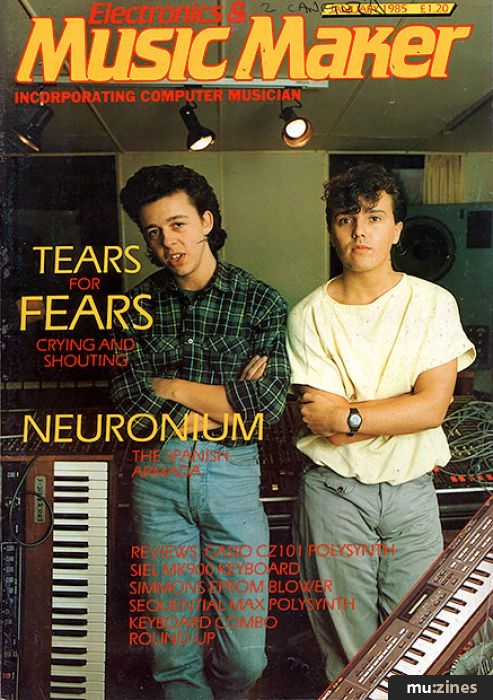
Electronics & Music Maker - Jan 1985
Scanned by: Stewart Lawler
Computer Musician
Editorial by David Ellis
Help Support The Things You Love
mu:zines is the result of thousands of hours of effort, and will require many thousands more going forward to reach our goals of getting all this content online.
If you value this resource, you can support this project - it really helps!
Donations for September 2026
Issues donated this month: 0
New issues that have been donated or scanned for us this month.
Funds donated this month: £0.00
All donations and support are gratefully appreciated - thank you.
Magazines Needed - Can You Help?
Do you have any of these magazine issues?
If so, and you can donate, lend or scan them to help complete our archive, please get in touch via the Contribute page - thanks!
If you're enjoying the site, please consider supporting me to help build this archive...
...with a one time Donation, or a recurring Donation of just £2 a month. It really helps - thank you!

 @mu_zines
 RSS Feed
 Blog
Blog