


Magazine Archive
Home -> Magazines -> Issues -> Articles in this issue -> View
Article Group: | |
Eight track mind | |
Tom DowdArticle from The Mix, April 1995 | |
The 60's R&B producer talks to us about those classic takes, and how he got them
Think of your favourite soul classic from the 1960s, and the chances are that Tom Dowd was at the controls. A pioneer of 8-track recording, he has plenty to reminisce about with Mark Cunningham...
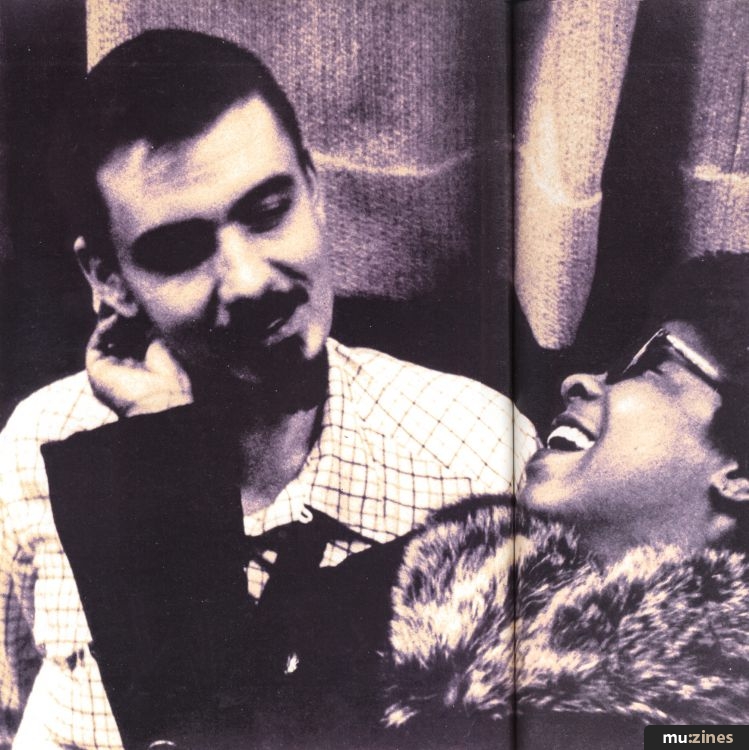
A young Tom Dowd pictured in 1957 with Lavern Baker
When Primal Scream were searching for the right producer to work with on the album Give Out But Don't Give Up, they turned not to the industry's flavour of the month producer, but to a man approaching his 70th birthday, with a list of credits that would make today's compulsive knob twiddlers wince with humility.
For not only did Tom Dowd engineer and co-produce the most celebrated works by Aretha Franklin, Otis Redding, Booker T & The MGs, Ray Charles and Cream in the 60s, he has continued to enjoy enormous success with artists as diverse as Rod Stewart, Yes, Meat Loaf, Diana Ross, Lynyrd Skynyrd, New Model Army, Eric Clapton and the Allman Brothers. Phew!
Despite the wealth of changes in technology he has witnessed since his induction into the recording art at Atlantic Records in 1947, Tom insists that there remains little difference in the human aspects of music-making. Synonymous with the tight Atlantic sound, Tom was one of the pioneers of 8-track recording back in 1957, when he received Ampex number 0003 (Les Paul and songwriter Mitch Miller owned serial numbers 0001 and 0002). Tom remembers those days well:
"I was anticipating things. The people at Atlantic Studios were sensitive to stereo, and we were recording stereo or binaural tracks as far back as 1952. That's when I set up the initial mono and stereo simultaneous recording consoles, so that anything we were doing in the mid-1950s was recorded on both one and two-track.
"Hearing what Les Paul was doing prompted me to think we could make superior records if we were to record on multi-track tape, because instead of reacting to the mix and trying to capture the performance in one hit, we could enhance it, re-live it, improve parts, and generally make a better tape for transference to disc. But hardly anyone appreciated the power of 8-track. They didn't realise that an hour after the session, or even the next day, you could sit down and push up the level of the bass or the guitar on a particular recording, to create a whole new different mix that would make a much better LP or 45."
By 1958, when most studios were still pondering over whether to progress to 4-track, Tom was already making 8-track hit recordings such as 'Charlie Brown', 'Yakety Yak', and 'Poison Ivy', by the Coasters, 'Splish Splash', and 'Queen Of The Hop', by Bobby Darin, and 'What'd I Say', by Ray Charles. All of them were recorded at New York City's famous Atlantic Studios at 234 West 56th Street, where Tom was the house engineer and resident electronics boffin.
"The studio was used as an office in daylight hours, then they would push the desks and chairs into the corner, and bring out the mics and stuff to make a studio in the night time. When they moved to another office, they gave me that room, and I designed a new 35' x 45' studio with the space that was available, so that we could accommodate the bigger sessions we had been doing outside, at Capitol or Coastal Studios. We would often record 12 or 14 string players, four horns, six rhythm players, five background singers and one principal, simultaneously. That's where we did things like 'Stand By Me', by Ben E. King, and The Drifters' 'Save The Last Dance For Me', 'Up On The Roof, and 'On Broadway', all around the early '60s."

"If they know the song well enough to sing the vocal, then their playing won't get in their own way"
Atlantic Studios boasted possibly the world's most famous echo chamber but, as Tom explains, there was precious little theory behind its eccentric, tiled design.
"I bought lots of boxes of leftover tiles from local hardware stores because I only wanted fractured pieces. We intentionally had the most non-symmetrical room in the city! We did everything the total opposite to what a carpenter or mason would do. We made that room so screwed up, that the only thing level was the floor. The ceiling and four walls had nothing in common with symmetry whatsoever! When we put the tiles on, we did it in such an erratic fashion that no two pieces looked the same. I mean, it was a nightmare of a room, aesthetically, but it was a nice echo chamber!
"Columbia Records on 799 7th Avenue used to use the stairwell for their echo chamber. They'd have to wait until everyone left the building after office hours, and they would put a microphone up on the 8th floor and wheel a speaker out on the landing of the 3rd floor and another up between the 4th and 5th floor, and so on. They would experiment to see which way sounded better for the strings or the vocal or whatever. But things got so expensive that it was a totally uneconomical use of space."
Between the late 1940s and early 60s, most recordings were produced on hand-me-down broadcast equipment. When Atlantic graduated to 8-track, Tom was forced to design a purpose-built console for the studio.
"We were still using tubes (valves) and sitting behind the console. You'd get sunburn on your kneecaps because of the heat. It was ridiculous. It's a hell of a lot safer these days."
One of the recording industry's biggest controversies of the mid-1960s concerned the broadcast of stereo records on AM radio. EMI, for example, would provide American AM stations with stereo albums to be played on their mono equipment, only to hear vocals drop out of the records during broadcast. This was particularly noticeable on Beatles tracks, and a cause of great embarrassment to producers. Tom recalls the problem:
"The people at Capitol were listening and saying, 'It's not cutting in and out', but they were listening in stereo. George Martin and I joked about it once or twice. Unfortunately, the tape machine manufacturers didn't realise that producers would want to bounce from track to track. But the sync or record heads were not always the same polarity, so when you bounced something from one track to another, as long as you listened to it in a stereo configuration you never heard a phase shift. But when you took that stereo product and played it in mono, there would be places where a voice or instrument would drop out in the middle of the recording and come back again, at the point where parts had been bounced from one track to another to form a vocal or instrumental track. It was insane that all of these people spoke the same language but couldn't understand each other. When I compare the naivety of the business back then to the amazing advances we've made today, it's like the difference between the Wright Brothers flying the first aeroplane and a supersonic jet. They both leave the ground, but there the similarity ends!"
"It has to have a horizontal motion, it has to be going somewhere, from the first note to the last"
Aside from their talented roster of artists, Atlantic's magical hit formula can be largely attributed to the awesome oligarchy of producer Jerry Wexler, arranger Arif Mardin and engineer Dowd. "There was a wonderful chemistry," says Tom. "When the three of us worked on a project, if one of us had an idea, the other two would ask how they could help, and it became a collaboration. Maybe not all three of us were in love with the same song or arrangement, or even the same take. But something would inspire one of us, and the other two would say, 'Go ahead and do it'.
"I think Arif and I deferred to Jerry because he was closer to most the artists at the outset than we were, and he would do the preliminary work with them. But then there were times when Jerry might send me to Memphis with Wilson Pickett or send Arif someplace else with Bette Midler. We would all meet up again back at base five days later. I would have my two cuts and Arif would have his, and Jerry would have some cuts with Aretha Franklin, and Jerry would say, 'Hey Dowd, whaddaya say, let's put some horns on this one. Mardin, how about some strings on this one, and when we get them together then we gotta come up with some background'. It was like a board meeting about what we were each going to do. We'd have our individual responsibilities and get on with the job.
"We were constantly switching hats. Arif is an immaculate arranger and conductor, and he'd even be writing melodic parts while the tape machine was in record. He'd be writing the paste-on arrangement before the previous take was finished! There were times when Arif and I would be in two different cities, maybe in Memphis and Muscle Shoals, and I'd call Arif to ask what he was doing with strings. I'd say, 'I'm sending you a song that I'd like strings on', and I'd sing him a line over the phone that he'd write down and modify. By the same token, he might ask what rhythm section I had and say, I need a song at this tempo, in this key, a blues progression with an instrumental in C for 20 bars. Can you send me a track?'"

Re-united with famous friends; L to R, Dickey Betts (Allman Brothers), Tom Dowd, George Terry (Eric Clapton Band), Andy Genaro (Michael Bolton band).
When not employing the cream of Memphis and New York's session musicians, Tom would often choose to work with the legendary Muscle Shoals rhythm section which included the likes of drummer Roger Hawkins and bass player Jimmy Johnson.
"They had a unique identification quite dissimilar to the Memphis section, in the same way that Nashville did. Elvis Presley was using mostly Nashville musicians. When we were recording Percy Sledge and Aretha, we were using people from Muscle Shoals or Memphis, because these were musicians who were around the same age as the artists, early to late 20s. They had grown up in this culture where black and white music were mixed, and you didn't have to be black to play black music, just as you didn't have to be white to play white. People in other parts of the United States were listening to something coming out of the South, not realising that some of those musicians were white."
Mention the word 'quantise' to Tom and he gets hot under the collar.
"I can't stand time-corrected tracks or sterile, vertical recording. It has to have a horizontal motion, it has to be going somewhere, from the first note to the last. I will raise hell with a band over the principle of contributing to anything sterile. A lot of people don't realise before they work with me, that I'm going to get in their face for being a perfect time-keeper or memorising parts.
"When I record, I give a chord chart and sheet music to the musicians, I let them see the lyrics, so that they learn what the piece of poetry is about that they're playing to. If you just put the music in front of them, they won't even listen to what the song is about, so they'll invent melodies that may not have anything in common with the lyrical subject. So I like to think that if I'm on a session with six or seven musicians, if the vocalist didn't show up, each of them could sing the vocal. If they know the song well enough to sing the vocal, then their playing won't get in their own way. A lot of artists don't appreciate that point. For the most part, I try to make the musicians more sensitive to the song they are playing on, and get the music to flow, rather than like a metronome. So it expands, dilates, contracts, lives and breathes."
Cream — Disraeli Gears/Wheels Of Fire (1967/68)

'Sunshine Of Your Love', 'Strange Brew', and 'Crossroads' continue to stand as icons from the early progressive rock era. But the sessions for Disraeli Gears and Wheels Of Fire at Atlantic proved to be somewhat of a culture shock for Tom, who was not prepared for the huge live sound of the band.
"My biggest concern was how I was going to protect Ginger from the guitar and bass. When the roadies were setting up the equipment and I saw those double speaker cabinets for the bass and the big Marshall guitar stack, I thought, 'That's all well and good, but where do I put these things, so at least I can get a sound on the drums!' Then I saw the drum kit go up, with two bass drums and five cymbal trees, and I thought, 'Oh God, I'm gonna have guitar and bass spilling down every damn drum mic'.
"I just made them feel comfortable and tried to keep them as far apart as I could in that studio that I'd designed for Atlantic on 60th Street. They had Ginger in one portion of the room, and I had the guitar and bass amplifier stacks positioned 90' away, so that Jack and Eric could stand in front of their amps and still have eye contact with each other and Ginger. There was no need for earphones, although ear protectors would have been a good idea, 'cause they were so loud!"
Surprisingly, Tom chose not to use limiters.
"I very seldom used limiters on anything except vocals, and that was just to cut the peaks down. I would just ride the peaks with my hand on the fader after I'd heard a song once or twice, to get a feel for what the band were doing. I preferred it that way."
Primal Scream — Give Out But Don't Give Up (1994)

With plans to adopt a more rootsy, rock-funk approach for their 1994 album, Primal Scream persuaded Tom Dowd to give the band the benefit of his mammoth experience.
"They contacted me in early '93 and I asked them to send me something to give me a clue as to the type of music they were into. They sent me their previous album (Screamadelica), and when I heard it I called and said, 'Are you sure you want me to record this, because that's not the nature of recordings that I'm strong at doing'. They explained that it wasn't the style that the band had endeavoured to make when they started recording the album. So they sent me some demos of some new songs, and I recognised things that I could identify with.
"Roger Hawkins and David Hood from Muscle Shoals went over and spent a week with them to make sure that they would all play together comfortably. I said that if the music was graceful, then I would come over, take charge and start dictating arrangements and tempos, and so on. So I flew over to England in March and rehearsed the band every day for about 10 days, finalising songs. When we were done with that, we took about a month off and flew them to Memphis to start recording.
"For the songs that I could help them the most with, I reverted to traditional recording techniques. However, for three or four of the songs that they played me, I suggested that they get the people who mixed their previous album to use some of the programs that I have recorded, sample them and program them like the last album. I was the first one to promote that idea, because I realised there were those songs that they had conceived in their writing and preparation that would become sterile if I did them my way. I would not allow that to happen. I recorded them so that they had good, clean recordings and samples, digitalised, so that they could use them on a computer, and start programming them and using them in any fashion they desired. I then went up-scale and did the most sophisticated recording that they could do, using the most sophisticated equipment, to give them the luxury of being able to play with it to their ultimate desire, to get the best results."
Otis Redding — Otis Blue (1966)

Widely regarded as the greatest-ever soul album, Otis Blue was recorded at Stax's Memphis studio by Tom Dowd in two days. Tom says:
"The record company called me and said, 'Otis is coming in for the weekend and he has to leave by Sunday, but we'd like to make an album with him, so we can put out a collection of all new songs rather than an album of his singles'. So I took a Thursday night flight into Memphis, so that I was ready to start promptly at 10am on the Friday morning.
"We had the finest musicians money could buy, people like Steve Cropper, Duck Dunn, Al Jackson, Isaac Hayes, David Porter and Booker T. On horns were Bowlegs Miller, Wayne Jackson, Paki Axton, Andrew Love and Floyd Newman. Booker T. was the band and the MGs, or Memphis Group, were the horns.
"Otis was a very controlled person. He would save up all that emotion and energy, that others might use in demonstrating, stomping and screaming, for when he was going to sing. The Stax studio was actually a 4-500 capacity theatre with the seats pulled out, so it was a pretty big room. It was easy to isolate sounds without having to use screens. You'd just keep the musicians far enough apart from each other and it was OK. The vocal was always recorded up at one end of the room and Otis learned very quickly after we had recorded once or twice how to fade in and out of a mic, or sneak up on a microphone.
"Otis was the ultimate artist. Every now and again, he would stop a take and say, 'We've got to do it again because I messed up'. He'd say, 'If you guys can play the song that well, you can do it again one time for me'."
Publisher: The Mix - Music Maker Publications (UK), Future Publishing.
The current copyright owner/s of this content may differ from the originally published copyright notice.
More details on copyright ownership...

The Mix - Apr 1995
Donated by: Colin Potter
Coverdisc: Chris Needham
In Session
Interview by Mark Cunningham
Help Support The Things You Love
mu:zines is the result of thousands of hours of effort, and will require many thousands more going forward to reach our goals of getting all this content online.
If you value this resource, you can support this project - it really helps!
Donations for October 2026
Issues donated this month: 0
New issues that have been donated or scanned for us this month.
Funds donated this month: £0.00
All donations and support are gratefully appreciated - thank you.
Magazines Needed - Can You Help?
Do you have any of these magazine issues?
If so, and you can donate, lend or scan them to help complete our archive, please get in touch via the Contribute page - thanks!
If you're enjoying the site, please consider supporting me to help build this archive...
...with a one time Donation, or a recurring Donation of just £2 a month. It really helps - thank you!

 @mu_zines
 RSS Feed
 Blog
Blog