


Magazine Archive
Home -> Magazines -> Issues -> Articles in this issue -> View
Article Group: | |
Epiphone Emperor Guitar | |
Article from Phaze 1, June 1989 | |
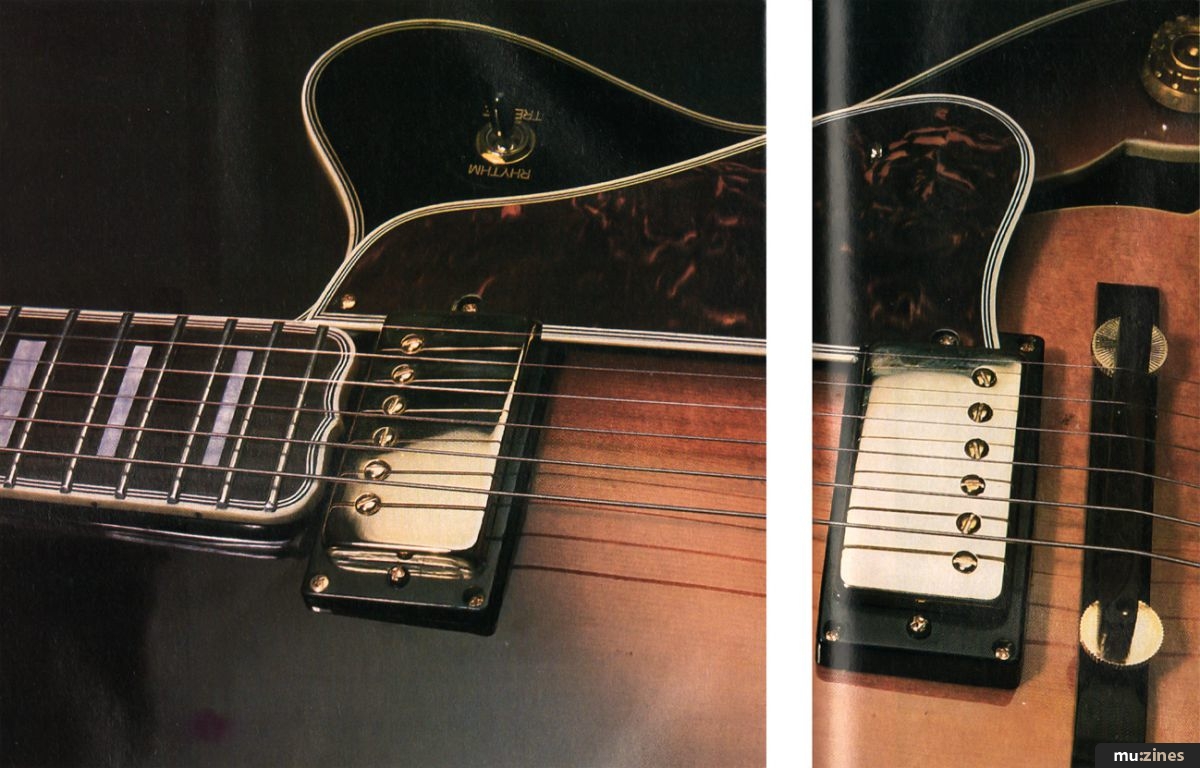
WHEN I WAS 14 or 15, to own "a guitar like this" was my ultimate ambition. The reasoning was simple. Big guitars were good guitars. Whether it was a glorious Gretsch White Falcon or "just" a Gibson 335, it made a much bigger visual impact than a plain old Strat. If I needed any more convincing, big guitars were also played by good guitarists — Steve Howe, B B King... Small guitars were played by bad guitarists — Francis Rossi, Angus Young...
Of course it was a ridiculous attitude, but that was half the fun. The thing is, even now I have to admit to an unreasonable bias towards stately semi-acoustics and hollow-bodies, although my reasons are now slightly more logical. Imagine my excitement, then, about being presented with a guitar like the Epiphone Emperor.
The 1940 Epiphone catalogue bleats: "Undoubtedly the finest instrument ever made, the Emperor is custom-built and pre-tested before final finishing, assuring each artist of the uniform quality for which Epiphone is world famous."
Well, undoubtedly things have changed — 50 years on, it doesn't quite look like it used to, and the Emperor's "uniform quality" is now down to the technical proficiency of its Korean manufacturers. Yet the Epiphone Emperor, one of a new range of guitars built by Epiphone under licence from Gibson, remains a guitar with a distinguished past. In terms of design, the Emperor could be the bastard son of a Gibson L5 (if that helps), but deserves to be judged on its own merits.
Unless you've had your head in the sand for the last few years, you'll no doubt realise the recent fashion for flash semis and hollow bodies at the expense of workhorses like the Strat and Les Paul. Players like The Edge, Roddy Frame and Johnny Marr have helped to sustain the "big is better" theory. But is it just a fashion? Is it simply the case that half the time, people are just using these guitars for publicity shots? Or is big really better?
Well no, just different. As a jazz guitar, the Emperor will naturally appeal to those with mellow tastes — the guitar possesses a richness of tone you simply won't get out of a solidbody. The neck pickup particularly gives a lovely tone. With a touch of chorus the sound is as deep as the Grand Canyon, and for full chordal work, the Emperor is perfect — the sort of guitar that begs for an encyclopaedic knowledge of obscure chords, for that real jazz feel. (If you're not too au fait with your Eb m6s, play a few E minors with a sprinkling of bum notes.)
But having proved itself on its home territory, the Emperor turns in a useful performance in other areas, too. On the bridge pickup, for example, it offers quite a bright, edgy sound. It won't impress yer average metal-mutha, that's for sure, but it does have a bit of bite to it and the sustain is pretty good. Being a complete peasant, I cranked my amp up and found the guitar gave a great bluesy sound — well, my B B King impersonation is slightly more passable than my Charlie Christian one. Of course, hollow bodies are more susceptible to feedback than semi-solids — a problem the Emperor quickly confirms.
Yet for all its versatility, this guitar won't be a natural choice if your forte is screaming, high-register solos. Because of the depth of the body, the heel is large and despite the fact that the body is cutaway to the 18th fret, this does prohibit easy access to the top of the fretboard.
The neck has a nice chunky feel, the action is easy, and overall the Emperor is a very comfortable instrument to play. There's a solid, secure feeling about playing a guitar this big — even if it only acts as an expensive arm rest!
The fingerboard is rosewood with large pearloid block inlay, and there's a rather elaborate "tree" design on the headstock to add some decoration. The two humbuckers (gold-plated, like all the hardware) have enough power to make the Emperor more than just a jazz guitar, and can induce some serious axe heroics if you're not very careful. The tailpiece is of the trapeze type and the bridge is a simple design, adjustable for height only — rather odd, as I'm sure models from just a few years ago were fitted with the more familiar tune-o-matic bridge (as on a Les Paul). The bridge adds to that "oldie but goodie" feel, but sacrifices the option of making small adjustments to the intonation. I was worried about this at first, as I had a few tuning problems, but things settled down eventually.
The sunburst finish makes for a classic-looking guitar, and liberal use of binding (cream and black stripes, no less) top off the finish. All in all, the Emperor has a pretty expensive look about it. It's not swamped by hi-tech regalia, does not offer any "custom" finishes, yet still manages to outshine the "flashier" opposition.
This is quite a versatile guitar, well-crafted and full of warmth, and as easy to play as a game of shove ha'penny. Hollow-bodies are not cheap to make, and at over £400 the Emperor would be a pretty serious purchase for a fledgling muso — I suppose you'd just have to be sure it was your kind of thing.
To these hands it's an extremely fine guitar, with a bit more to offer than just your average Ebm6 thingy.
EPIPHONE EMPEROR GUITAR: £435 inc VAT and case. Available in Sunburst or Natural finishes.
INFO: Rosetti, (Contact Details)
Also featuring gear in this article


Publisher: Phaze 1 - Phaze 1 Publishing
The current copyright owner/s of this content may differ from the originally published copyright notice.
More details on copyright ownership...

Phaze 1 - Jun 1989
Review
Review by Michael Leonard
Help Support The Things You Love
mu:zines is the result of thousands of hours of effort, and will require many thousands more going forward to reach our goals of getting all this content online.
If you value this resource, you can support this project - it really helps!
Donations for May 2026
Issues donated this month: 0
New issues that have been donated or scanned for us this month.
Funds donated this month: £0.00
All donations and support are gratefully appreciated - thank you.
Magazines Needed - Can You Help?
Do you have any of these magazine issues?
If so, and you can donate, lend or scan them to help complete our archive, please get in touch via the Contribute page - thanks!
Please Contribute to mu:zines by supplying magazines, scanning or donating funds. Thanks!
Monetary donations go towards site running costs, and the occasional coffee for me if there's anything left over!

 @mu_zines
 RSS Feed
 Blog
Blog