


Magazine Archive
Home -> Magazines -> Issues -> Articles in this issue -> View
Feeding the 5000 | |
Article from Sound On Sound, January 1987 | |
Hybrid Technology's Music 500 synthesizer for the BBC B micro gains a '0' and a whole host of new features. Phil South states the facts and wonders why more musicians don't know about the power of this system.
More miracles from Hybrid Technology as the Music 500 gains a 0, and a whole lot more besides. Phil South reads the lesson.

As you may or may not know, the Music 500 was a good, cheap digital synthesizer which bolted on to the BBC range of computers. In the year since it was released it has gleaned an awful lot of public and critical acclaim, for its design, its innumerable applications and, most of all, for its sound. It was inevitable that sooner or later there would be a sequel, and in the movie tradition here it is - the Music5000. (And why not?)
Before I wade, suitably clad, into the deepest little crevices of its new facilities and improvements, it might be prudent to point out, to those of you who missed the previous gizmo, what all the fuss was about.
IN THE BEGINNING
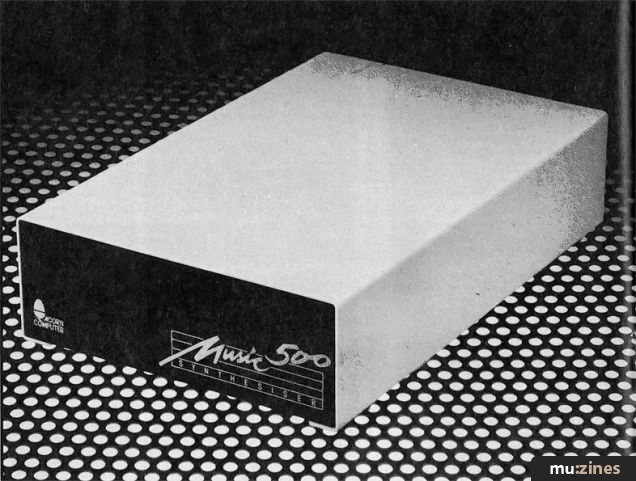
The original 500 resided in a box, looking for all the world like a disk drive without the appropriate slot, connected to a ribbon cable which plugs in under your Beeb. The way you made sounds on it was via a programming language called by the acronym AMPLE, (Advanced Music Programming Language and Environment). The important bit about this language is, aside from it's ease of use, the word 'Environment'.
Far from being a hi-tech system designed to be used only by eggheads, brainy people and computer programmers, AMPLE was designed to free any user from the constraints of musical skill (ie. not having any) and hand all the sounds of a sophisticated music synthesizer and sequencer over to the average Joe on the street.
The AMPLE language on the Music 500 was made like FORTH or PASCAL (serious computer languages) in that it took a series of instructions and assigned a word to them; typing the word executed the instruction attached to it. If you then assigned a lot of words to yet another word, like PLAY, typing this would execute all the other nested words and their attendant instructions. In this way programs, or in AMPLE's case, songs, could be built up of smaller routines or riffs. This made AMPLE not only a very powerful music language, but potentially a good programming language for any task. It may sound really technical, but believe me it's very simple in practice. (Reread the last paragraph a few times if you don't get it. I had to!)
In this vein, instead of musical notation (blobs and sticks) on a stave, or input via a musical keyboard, the AMPLE user wrote his music in the G///A/// fashion (so beloved of folk guitarists the world over!). Changes in pitch were indicated in the way that if a lower case letter (ie. g) followed a higher case one (ie. G), then the pitch had dropped, and vice versa. So, if you typed out the two lines BDG and Bdg, the second would go down to a low D, whereas the first would go up to the next highest D. Simple innit?
The machine had 8 voices, with a total of 16 separate channels assigned in pairs to each. There were a cluster of pre-drawn waveforms, or the user had the option to create his own, given the time and lots of strong coffee. As well as all this, there were a bunch of pre-designed pitch envelopes (Eeooooppp!), amplitude envelopes, plus ring modulation and the ability to synchronise channel pairs, for all those Radiophonic Workshop fans. Oh yes, and you could pan any of the voices through seven positions in the stereo spectrum too.
But could you use it? Yes, you could, but the drawback was that you had to retain all the information about channels, voices and words in your head (or print it out), and if you did anything wrong it was a longwinded affair trying to find where the problem lay. It was easy to use, sure, but only if you knew what you were doing in the first place. But, for all that, it was a fine system and many a fun hour was had by owners and serious computer journalists alike.
AND IT CAME TO PASS
So, armed with all the grumbles about how fiddly and unhelpful the system could be to the computer virgin, the designers, Hybrid Technology, set about fixing them. Son of 500 was born. (Fanfare) And he shall have user-friendly menus, so that all men can utilise and enjoy the AMPLE environment in years to come... and he shall take on another zero and be called Music 5000. (And on the seventh day they patted themselves on the back.)
The old AMPLE was called BCE, it said so on the system disk. The arisen (and now ROM-based) AMPLE is called Nucleus, and it is from here on in that you and I find out the meaning of the word 'environment'.
AMPLE Nucleus is the first step towards a complete, computer-based, musical environment. Now if this sounds a bit Brian Eno to you, hold on there. What I refer to by 'environment' is a set-up whereby you have control of the soundmaking apparatus, say a musical keyboard too, plus AMPLE is also taking care of computer mixing on your desk... it might even have time to run your light show too! Do you begin to get the idea? It's a centralised system, where you can flit between MIDI-ing a keyboard to your sequence on the 5000, to mixing the whole sound, from one easy menu.
So the Music 5000 is now the basis on which the whole AMPLE concept (I hate that word) will stand.
HE HAS RISEN
So, faced with the new, improved gadget comfortably nestled next to one's Beeb, and the AMPLE ROM chip safely pushed into the right slot inside the computer, we also have an ID'd issue disk containing all the Studio 5000 software, and a neat and comprehensive spiral bound manual. Incidentally, this is a vast improvement over the previous version, because I for one found the original 500 manual faintly printed and impenetrable. The new one is clearly printed and well laid out, containing not only tutorial and troubleshooting pages, but also a glossary of AMPLE terms. Having said that and booted up the system disk, what do we find?
The ROM contains the new AMPLE language (Nucleus), and instead of being loaded from disk, like the previous version (BCE), Nucleus can be called up in microseconds, to turn your BBC into an AMPLE computer. Nucleus becomes the computer's operating system, allowing it to use all the AMPLE programming commands and musical notation. Although it is designed to take in future extensions to the system, for now it has to be content with running Studio 5000 extension. This is the set of software modules which turn the Music 5000 from a disk drive impersonator into a fully-blown, active (sometimes interactive) music system.
STUDIO 5000
The main constituents of Studio 5000 are the Main Menu page, the Notepad page (incorporating Panel mode), the Staff Editor page and, finally, the Mixing Desk page. Now hold on; didn't I say before that the whole idea of AMPLE was to get away from all those nasty sticks and blobs? So why is there a Staff Editor included in the new user-friendly image? A-ha, it would seem that Hybrid Technology has noted another minor niggle from the previous machine. I can just hear the serious musicians saying that they spent a longtime learning conventional music notation, so why didn't this system give them the option? Et voila! No sooner said than coded. But let's take the individual bits in turn:

MAIN MENU: this page is, as the name aptly suggests, the clothes horse on which the other pages are draped. Using the BBC computer's cursor keys, you can call up any of the other pages, load and save programs, and indeed run ones which you already have in memory. At the bottom of the page is the familiar (well, if you own a BCE system) screen window for the entry of AMPLE and operating system commands, following the usual AMPLE "%" prompt.

NOTEPAD: this is where AMPLE really lives. On the Notepad's text editor you can prepare scores, AMPLE tunes, and edit them once you've written them. So you can take out that D-minor (the saddest of all chords) and lighten the tune a bit, or rewrite that segue at the end of the first part of your fugue, because it doesn't quite twang your heartstrings the way it should...
When it says 'Notepad', it means it. You can change everything, just like a sort of music word processor.
The other half of the Notepad page is the Panel mode. This is where you can do for your sounds what the Notepad does for your tunes, by altering the parameters on each 'instrument'. You can listen to the piece as it is playing and tweak any part of the sound, interactively shaping its tone colours to your taste. There are also dropdown (now you see'em, now you don't) menus for waveform, pitch and amplitude envelopes, which you can also modify while the music is playing.

STAFF EDITOR: this page presents you with the usual bass and treble clef stave, with provision for all the traditional minims, crotchets, semibreves, quavers and all other breeds of cheese-flavoured corn snack. Plus, there's all the dotting, tying, triplets and duplets your heart desires, so, given the slightest provocation, and the sheet music to Yellow Submarine, you too can can become a famous musical arranger... or at least seem like one.
Oh, nearly forgot, there's one important feature of the Staff Editor that is very handy. It converts musical sticks and blobs (notes) directly into AMPLE notation, and back again. Handy if you wanted a musician to play along with your BBC. Just print out the score of music, and off he'll go. (Well, it is possible!)

MIXER: this final page gives you a graphic representation of a mixing desk, with each of your sounds labelled on one of the eight 'channels'. You can mix and pan the instruments, in realtime, and quickly save the results to disk. The practical upshot of which is that you can play your piece back, perfectly blended with echo and other special effects already added by the computer, with no extra outboard equipment needed. Okay, so you and I know that a certain amount of outboard gear is essential to a polished sound - reverb, perhaps - but for the most part the Mixer section makes the Music 5000 virtually a stand-alone musical environment in its own right.

The special effects I mentioned take the form of instructions which affect AMPLE programs. For instance, Echo. This effect is put into an AMPLE program like so:
24 2 Echo
That would be the actual command you'd type in, 24 being the delay time (not seconds I might add), 2 being the voice it affects and Echo telling the computer that it's echo effect we're talking about here.
The same level of simple programming can be used to 'autopan' a voice through the stereo spectrum, the command word used being... yep, Autopan. This English input style is what makes AMPLE Nucleus so easy to programme. Even the computer illiterate (and I still consider myself one of that happy crew in some respects) can grasp the basic concepts of the language and be happily programming on the first day.
From the Notepad screen, you have access to the preset waveforms - 14 of the little devils. These are your basic sound building blocks. They have nice cheery names like 'Bright', 'Broad', 'Hard' and 'Clear'; even 'Metal', 'Pure' and 'Watery', which you use to call them up from a program. They cover the most comprehensive range of possible sounds, but if even they aren't enough for you, then you may possibly be too far ahead of your time to be using such a machine in the first place.
The pitch and amplitude envelopes also have names, which you use to call them up. They are called things like 'Percuss', 'Swell' and 'Spike', which all give you a very good idea of what the thing sounds like before you've even heard it.
And lastly, a selection of pre-cooked sounds are at your immediate disposal, in the form of the 14 preset instruments. You can use these at once in your own tunes, or modify them to make your own instruments. The selection is quite mind bending, with tempting little noises like 'Elguit' - a reverby electric guitar sound - or the self-explanatory 'Slapbass' and 'Moog' sounds.
JUDGEMENT DAY
So what's it like, this hi-spec digital synth on a stick, hmm? The answer is complicated. First off, it's hard to compare the Music 5000 system (and its variants) with anything else... because there's really nothing else like it. The applications of a computer-based digital synth with a programming language attached are, especially when the system acquires MIDI capability, endless.
The funny thing is I get a strange feeling about this box. Like it could be the vanguard of a whole new age of music making - a bit like taking us back to the first murmurings of the Moog family with a digital synth in our hand. It smacks of a kind of cult/hobbyist ethic, but at the same time the facilities are so adaptable that I can't see how any professional electronic musician can pass up the opportunity to make something really good with it.
The sound of the Music 5000 is surprising. I'm not quite sure what I expected, but whatever it was I was wrong. The sound is warm, like a Moog, with that bass-end favouritism, but also with a sharp top-end that can sound brittle and biting. The stereo effect is pleasing, when used to good effect, like the autopan, but it could still use a bit of conventional mixing; seven position stereo is okay, but not through headphones. The quality of the sound is very high, as clear as any other digital synth I've heard, so don't let anyone give you the idea that just because it's an add-on for a computer, that the Music 5000 is just a low grade substitute for the real thing. It isn't. It is as pure and true as anything on the market.
The improvements in the system are very much for the better. The front end (the bit that connects you to the program) is simple to use and understand, but none of the complexity and depth of the original AMPLE has been compromised. You can still programme a piece which self-generates and builds on itself within certain parameters; real computer-generated music. You could write a program with AMPLE that produces musical 'fractals' - random mathematical formulae which mimic real sounds or musical styles. This is real high art/pure maths we're talking here!
At the other end of the scale, the Music 5000 could be used to take the place of the facile and offensive home organ, playing Christmas hits input from sheet music (how topical), on instruments tweaked by the novice user. A creative process that anyone who loves music but can't really play can enjoy.
But also, and more relevantly from a musician's point of view, it could form the basis of an integrated MIDI/AMPLE studio set-up - as I inferred at the beginning of this article - controlling everything. Hybrid Technology have promised that MIDI and a dedicated keyboard are in the offing, so watch this space for further developments.
Good news for existing Music 500 owners is that the 5000 upgrade kit can turn your old BCE machine into a Nucleus whizz-kid, for the fraction of the price of the new unit. So, if you were far-sighted enough to buy one last year, you haven't been gazumped. You too can expand your system to take over your entire workspace. On the downside though, the BCE system hardware was never compatible with the BBC B+, 128, or Master Series computers. This upgrade won't remedy this for you, but being as you're probably running the thing on an old BBC B anyway, this won't affect you very much.
So, my conclusion, as conclusions must be drawn, is this. The Music 5000 is a welcome enhancement to what was a very good idea in the first place. But I reckon now that it's easier to find this out, more people will begin to agree with me.
Prices (inclusive of postage, packaging and VAT):
Music 5000 synthesizer £161.00
Music 500 Upgrade Pack £69.00 (includes Music 5000 software and manual for Music 500 owners)
Music 5000 audio demonstration cassette £2.95
(Contact Details)
Also featuring gear in this article


Featuring related gear

Acorn 500
(12T Apr 85)

Beeb Breakthrough - MUSIC 500
(ES Feb 85)

Hybrid Technology Music 2000 System
(SOS Oct 88)

Hybrid Technology Music 4000
(MT Jul 87)

Stop, Look and Listen - MUSIC 500 Programs
(ES Jul 85)

The Art of Going Soft (Part 3)
(EMM Jul 85)
Browse category: Software: Music > Acorn
Browse category: Keyboard - Peripheral > Hybrid Technology
Publisher: Sound On Sound - SOS Publications Ltd.
The contents of this magazine are re-published here with the kind permission of SOS Publications Ltd.
The current copyright owner/s of this content may differ from the originally published copyright notice.
More details on copyright ownership...

Sound On Sound - Jan 1987
Review by Phil South
Ads for Gear in this article:

Help Support The Things You Love
mu:zines is the result of thousands of hours of effort, and will require many thousands more going forward to reach our goals of getting all this content online.
If you value this resource, you can support this project - it really helps!
Donations for May 2026
Issues donated this month: 0
New issues that have been donated or scanned for us this month.
Funds donated this month: £0.00
All donations and support are gratefully appreciated - thank you.
Magazines Needed - Can You Help?
Do you have any of these magazine issues?
If so, and you can donate, lend or scan them to help complete our archive, please get in touch via the Contribute page - thanks!
Please Contribute to mu:zines by supplying magazines, scanning or donating funds. Thanks!
Monetary donations go towards site running costs, and the occasional coffee for me if there's anything left over!

 @mu_zines
 RSS Feed
 Blog
Blog