


Magazine Archive
Home -> Magazines -> Issues -> Articles in this issue -> View
Fender Starcaster | |
Article from Sound International, July 1978 | |
Looks like Fender without Leo is a bit like the Four Seasons without Frankie Vivaldi (anagram - 14 letters).
FEW manufacturing companies are able to begin by producing a string of innovative products, see those products become highly popular and in many cases become their own standards of excellence, then see those products still selling twenty years after their inception. Fender is one of these enviable few.
In the main, two companies are responsible for the evolution of the electric guitar: Fender and Gibson. And of the two, it might be said that while Fender has produced far fewer models, they have contributed the bulk of the innovation. Now, after more than twenty years, three Fender guitars are consistently popular and are virtually unchanged since their designs were patented. Consider: the Telecaster — first sold in 1948 as the Broadcaster — with its revolutionary solid body and bolt-on neck; then the Stratocaster in 1954, the first "futuristic" contoured body, floating vibrato bridge; and in 1951 came a whole new instrument — the Precision bass. So Fender is assured of a prominent niche in the Musical Instrument Hall of Fame, and can be forgiven the occasional — um — hiccough.
Such a hiccough is the Starcaster. While the Starcaster has been out for a couple of years now, it has achieved almost nothing in the way of acceptance, as far as I am able to gather from fellow writers in the UK and America. None of your rock stars are seen clasping a Starcaster, always the surest road to acceptance for a new instrument, and — interesting point — when I called up the UK distributors CBS/Arbiter to ask about reviewing it, my enquiries were met with a certain hint of doubt and reluctance. My curiosity was aroused.
The Starcaster is not the first semi-acoustic Fender has produced, even though their reputation has always rested firmly on their solid guitars. Up to the early Seventies, Fender ran the Coronado range of semi-acoustic guitars and basses, but these achieved little success against other brands (and rightly so, because the Coronados were neither pretty nor easy to play). Now Fender have tried again, and I suspect they will come up hard against the same barrier — a necessary comparison to the Gibson 300 series. The Gibson thin-body semi-acoustics are by now the archetypes, the culmination of many years' experience of this kind of design. The 335, 345, and 355s sound good, work well, and are — to me — the most beautiful electric guitars ever made. The Starcaster sounds good, is ergonomically unsound, and its looks are an acquired taste.
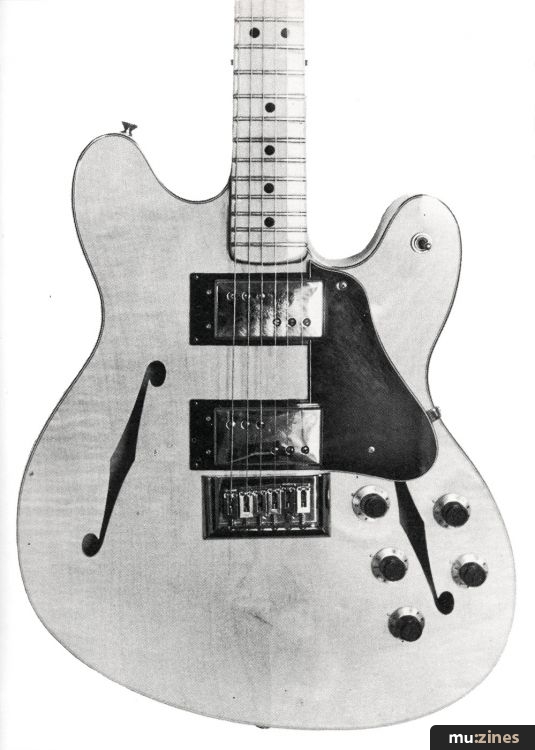
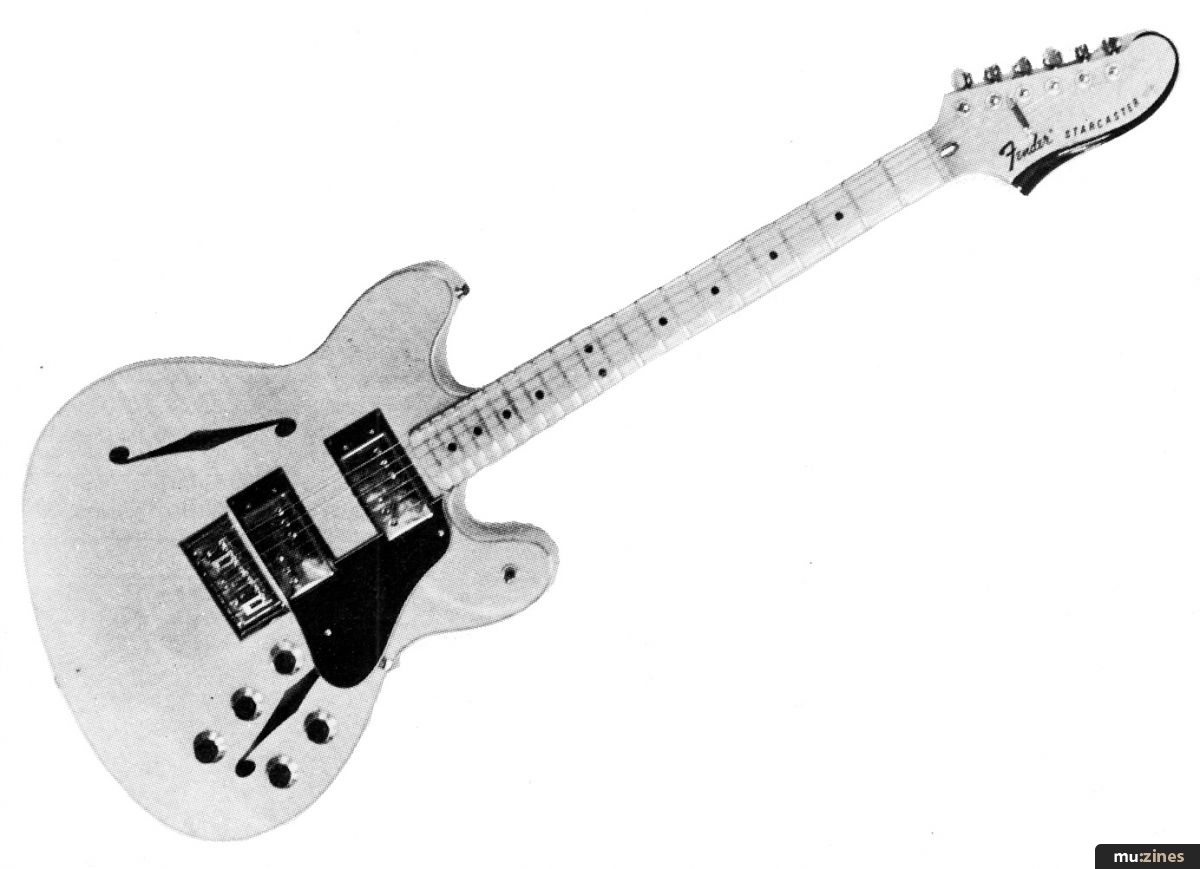
So let's take a look at the physical aspects of the animal: the Starcaster is a thin-body semi-acoustic guitar. At first glance, it even looks a bit like the Gibsons: big body, double cutaways, floating pickguard, and so on. But at second glance the great differences manifest themselves: the waist and bouts are offset and the head is an adaptation of the classic Fender flattened scroll, all machines on the upper edge, a string guide to give the upper four strings a correct angle and "pull" over the nut, and a slightly sculptured lower edge. The neck is a standard Fender bolt-on "Micro-Tilt" job — the Starcasters all feature solid maple necks in which the frets are let directly into the top surface of the neck, sans fretboard. The neck has the routed-in truss-rod terminating in a bullet-shaped adjustment nut cut for an Allen key. The neck joins the body in the usual Fender box joint at the 17th fret, and the treble-side cutaway leaves plenty of room to get at the highest 22nd fret — more room, in fact, than the Gibsons. But because of the offset body design, the bass-side cutaway finishes at the 19th fret. The scale length is slightly longer at 25½in than the Gibsons' 24¾in, which makes upper fret fingering easier but requires more stretch on the lower frets.
The body is laminated, with a maple skin. The sample I had was finished as natural maple, which harmonised nicely with the maple neck and contrasted well with the black laminated vinyl pickguard, black pickup surrounds, and chromed hardware. But other available finishes include Tobacco Sunburst, Walnut, Black, and White. The two pickups are Fender humbuckers with height adjustment (which necessitates removing the pickguard) and adjustable pole-pieces. The controls are fairly straightforward: a three-position pickup selector switch mounted on the upper treble-side bout, and a volume and a tone knob for each pickup mounted on the lower treble-side bout. Fender has made a useful departure by including a master volume knob nearest the bridge. The bridge itself is similar to the fixed Stratocaster unit, with through-the-body stringing and individual string saddles adjustable for intonation and action, by means of a very small Allen key (provided with the guitar, but easy to lose and difficult to replace) and a crosshead screwdriver. There are strap studs mounted on the point of the bass-side upper bout and on the foot of the body, both on the edge. Because of the offset body, the guitar tends to slide and fall if leant upright.
Onward. If the raison d'etre of musical instrument design is the production of a fine sound, the root of all design evil is ergonomics — the art/science of making things easy to use. The Starcaster sounds good; ergonomically, it is less than perfect, for the following reasons:
The Neck: As a satisfied Strat-owner, I am familiar with the Fender neck, and I am used to the narrow stringing at the nut. However, the Starcaster spec sheet boasts of a 'Moulded nut with hand-filed string notches'. In the case of this sample, the notches were badly cut so that the string slipped and jerked, causing tuning problems, and the nut itself was secured by such a liberal helping of adhesive that the lower E string buzzed against it. The neck was not secure in its joint and creaked whenever it was picked up. More tuning problems. The rear edge of the body is nicely purfled, but so, necessarily, is the back of the box joint. This makes the box quite sharp, unlike the gentler contours of the Strat; a fast slide up to the top frets can result in a dented hand. The machines themselves are excellent — although stamped 'Fender', they have that precision Schaller look about them. But they are normal hole-in-the-stem machines, and one of the great Fender features was the Kluson slot-and-drill machines which enabled a fast string-change — I'm not so much critical as wistful. And speaking of fast string-changes, the string guide is simply a metal block with four holes drilled for the strings, which means you have to thread each string through, as opposed to the quick tuck-under possible with the older Fenders. In an emergency, the re-use of an old and spiralled string would be near as dammit impossible (and more of this later). Finally, while the frets are very pleasant — of the wide type — and the maple fretboard delightful, the neck itself needed adjustment both on the truss-rod and the tilting neck joint.
The Bridge: Apart from my aforementioned carp about the tiny Allen key required for action adjustment, the Starcaster bridge has serious deficiencies. First, it is impossible to get the action right down because the saddles are set over three large dome-head screws which hold the bridge on. Had these been flat-head screws, all would have been well. But worst of all, re-stringing is one hell of a chore. Through-the-body stringing is all very well if the hole through which the string must be poked is in a solid lump of metal a la Strat; but the Starcaster is a semi-acoustic arch-top (and back), so the bridge block would have to be about 4in thick to go all the way through to the back. Instead, the string must be guided through surface-mounted restraining metal grommets, through the wooden central block, through the bridge, and up through the string saddle. In a well-lighted room and using a new string, this took me between two and five minutes per string. All the grommets were loose enough to fall out when not held in by string tension. I shudder to think what a muso might suffer on a darkened stage with a used string in the middle of a tune. The whole bridge assembly is a disaster and should be re-thought from the ground upwards. Why not a simple bridge and endpiece?
The neck and the bridge are the major areas for criticism, but there are other problems. While the pickups are quite sensitive and beautifully made, they are not suited to the string intervals on the Starcaster — the two outer strings, for instance, just barely pass over the edges of their pole-pieces on the rhythm pickup. While the string doesn't have to be directly over the pole-piece to excite the pickup, it helps. On the sample I had, the upper E-string level was so far below the middle strings that I had to wind the pole up so high to compensate that the string buzzed against it as I played the upper frets. And believe it or not, there was a stain on the back of the guitar — a circular imprint of greenish hue — under the lacquer. This means the stain happened at the factory before the lacquer was applied, in which case the instrument should never have passed through Quality Control, let alone getting into the showroom (I was told that this sample was meant for sale and was not a second or a reviewers' sample).
All in all, I cannot be optimistic about the Starcaster's chances in the market place — and this lack of optimism seems to be borne out by sales (or the lack thereof). At £586, even including the well-built case, the Starcaster is overpriced or under-quality, whichever. The Starcaster comes with manual, Allen keys for bridge and Micro-Tilt adjustments, cloth, lead, strap, and a one-year guarantee. This matter of the legal minimum guarantee on a five hundred quid instrument has been discussed in my last month's review, but I still feel that the customer is entitled to a better deal for his money — especially in this case, where the instrument itself will be hard put to establish itself against the competition.
rrp (with case) £586/$695
Dave Blake is an ex-session musician who has been writing on sound for several years.
Publisher: Sound International - Link House Publications
The current copyright owner/s of this content may differ from the originally published copyright notice.
More details on copyright ownership...

Sound International - Jul 1978
Donated & scanned by: Mike Gorman
Review by Dave Blake
Help Support The Things You Love
mu:zines is the result of thousands of hours of effort, and will require many thousands more going forward to reach our goals of getting all this content online.
If you value this resource, you can support this project - it really helps!
Donations for May 2026
Issues donated this month: 0
New issues that have been donated or scanned for us this month.
Funds donated this month: £0.00
All donations and support are gratefully appreciated - thank you.
Magazines Needed - Can You Help?
Do you have any of these magazine issues?
If so, and you can donate, lend or scan them to help complete our archive, please get in touch via the Contribute page - thanks!
Please Contribute to mu:zines by supplying magazines, scanning or donating funds. Thanks!
Monetary donations go towards site running costs, and the occasional coffee for me if there's anything left over!

 @mu_zines
 RSS Feed
 Blog
Blog