


Magazine Archive
Home -> Magazines -> Issues -> Articles in this issue -> View
From Necks To Nothing | |
Article from Making Music, April 1987 | |
Find out everything you need to know about life on and around the average guitar neck

Woody bits, metal bits, long ones and short ones, Adrian Legg's got them all. We join him on a voyage up and down the guitar neck. What does it do, how does it work, why is it whatever it is?
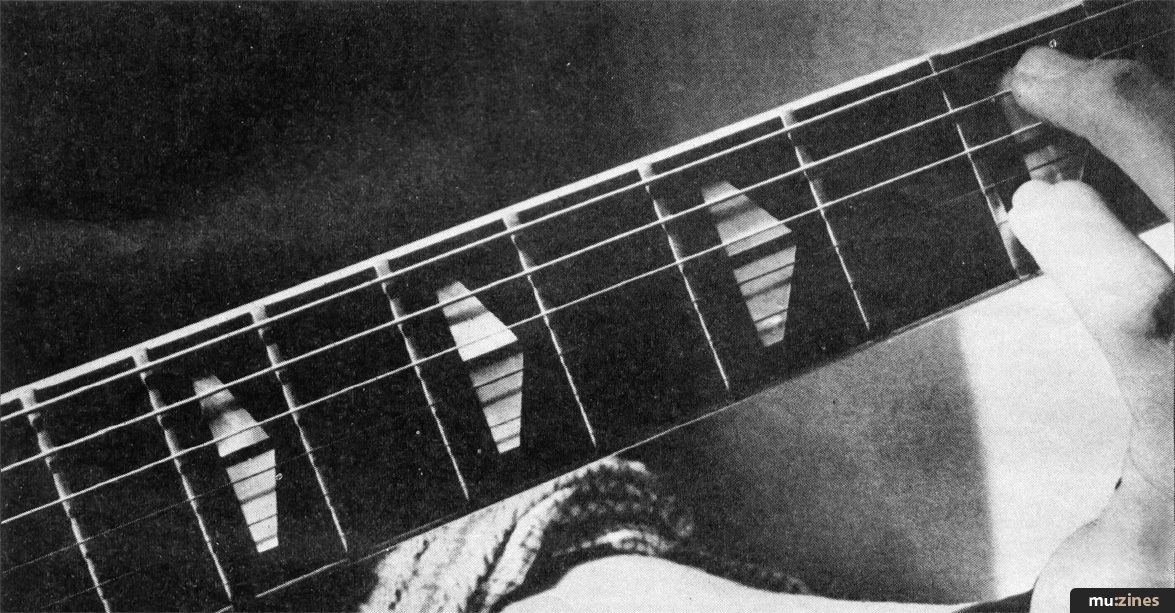
HEAVY metallers point it at you hopefully, experts peer down it to impress you, country types call it an 'arm', but you or I know it as... The Neck.
Myth and legend surround it, and the bits attached, but really it's only there to haul the strings out from the body and stop your guitar from being a zither. It has problems, practices and strange behaviours, and the following are some.
A GREAT RELIEF
If you place a thinnish piece of wood under permanent one-sided stress, it will usually bend, sooner or later. The neck of your guitar is a thinnish piece of wood in just that situation, I hear you shriek, but not all bends are bad. In fact a perfectly straight neck would be bad news. A small amount of forward curve is desirable, and is called 'relief.
Twang your thickest string hard and watch it vibrate. At the extremes of its movement it forms curves, and relief allows for this so that it doesn't crash into the frets killing sustain, or so you don't have to have the action too high for comfort. You can see the relief curve by holding the guitar normally and pressing down the sixth string at the first fret and at the 12th to 15th fret. The frets in the mid part of the fingerboard will be clear of the string if it is set correctly. Holding it up and sighting down the neck may deceive as the weight of the headstock or body can pull the relief out flat, or make it appear excessive, depending on how you support the guitar.
LAMINATE MATE
This thinnish piece of wood may want to twist sideways, and to get around that it may be made of two pieces with opposing grain direction fighting it out to stalemate stability. Before truss-rods, good quality banjos extended this principle and had necks made of laminates of different woods carefully selected for their stable qualities. Even since truss-rods, many makers will use three or four pieces to counter twist (not counting the fingerboard).
This may contribute to dead spots, as the more glue lines there are in a neck, the more likely it is that some frequencies will be defeated.
While we're at it, how many frets should your neck have? Twenty one is common, but some manufacturers make a fuss of 23 or 24 (the full two octaves). I don't know anyone who uses these for anything other than marking harmonics, and the best position for a front pick-up is smack under the 2nd octave harmonic (where the 24th fret would be). Here the tone is rich and sonorous, but move it back to allow for that fret 24 and it starts to get muddy. There's nothing wrong with a 21 fret neck that water-proof felt tip won't cure.
Before we go further, we must now touch briefly on the...
TRUSS ROD
At its simplest, it is a metal rod, threaded at one end, and with a lump or flange at the other to stop it twisting. A channel is routed out in the neck before the fingerboard is put on. (Where you see a strip of different wood inlaid up the back of the neck, it means that they didn't bother with a fingerboard, and bunged the rod in from the back instead.)
This channel is cut deeper at the heel and mid end of the neck than at the nut, so that when the rod is forced in and a fillet glued over it, it is formed into a gentle curve. In our example, we shall have the threaded end sticking out by the headstock in a little cut-out. Once the board is on, and the guitar put together, and strung up, then a nut and washer on the thread can be tightened to counteract the pull of the strings. There are many variations on this theme — straight ones set all deep, double ones, push-pull ones, etc. But the principle at its simplest is that the strings pull one way, the rod pulls the other. If this is new to you, let us know, and we can go into it in greater detail, but meanwhile, don't fiddle with it.
So, the function of laminates now is mainly to prevent twist, though they should only be necessary on the longest and thinnest of necks if good quality, well-seasoned and appropriate timber is used along with a good fingerboard rather than some of the veneers you might see about. The fingerboard can be extremely important, almost forming a fulcrum either side of which pull the strings and the rod. Prior to adjustable truss rods, fretting was a means of controlling relief. Thick tangs (the stem of the fret) in thin slots can force a neck back by wedging out the outside fingerboard grain. Nowadays, extra-light strings mean a maker can get away with a lot more.
SCALE LENGTH
But how long should this 'arm' be? An American friend tells me the word these days is 'play short, sound short'. The scale length of a guitar is the length of the string from nut to bridge, and the placement of frets in appropriately calculated places so you get in tune notes (nearly). A few years back the choice of scale lengths had narrowed to two on electrics — the Les Paul based 24¾in or the Tele and Strat 25½in. The longer of the two gave better high harmonics, but was tougher to play, gauge for gauge.
There were one or two wally Jap Strat copies that came out at 24¾in, but we'll let them pass. On an Ovation, it's 25¼in, or an Eko usually 25in. Martin make smaller acoustics at 24.9in, but the big D18, 28 and 35 at 25.4in. An electric exception which did manage to sound crisp was a maple/alder Westone at 24½in, but pick-up factors also had a bearing there.
At the moment, the bolt-on 25½in rules OK, and manufacturing simplicity probably has a lot to do with it. Who's seen the Peavey video featuring a cross between a Rotissomat and a chain-saw that chops out half a dozen necks at a time?
To add to the choice between play tough/sound tough on a Tele, or wizz round like a wimp on a Les Paul, Strats and Teles had thin, low profile frets, while Les Pauls and their imitators had nice thick stuff that was easy to hold the string behind. The Tele also required a Schwarzenegger approach because of something called camber. This is the curve that the fingerboard exhibits from edge to edge. Make it pronounced (like Teles) and any strings you bend around the middle of the neck will collide with this hillock somewhere else between your finger and the bridge. The answer is to jack up the action.
Les Pauls, on the other hand, had less of a gradient, but Travis Bean, bless him, made the best bender ever; fat frets and a flat fingerboard. And a 24½in scale, even though the UK catalogue of the time claimed a couple of other lengths incorrectly. The straight through aluminium billet on Travis' wonder cured the shorter scale length's loss of highs, albeit a bit of a chilly handful. I have one that has a classic country sound, but then price, weight, and worries about tuning stability due to metal expansion worked against it. A shame, I thought, it deserved more attention.
Soon enough, the custom parts suppliers sussed the camber and thin fret problem, and we got replacement bolt-ons that would bend at a bearable action height without choking, and the mass manufacturers followed on behind.
STRAIGHT THROUGH IT
At one time it looked as if neck joints might disappear altogether. A craze for straight through necks hit the trade as hard as an accordion boom. The theory was that if you had the nut and the bridge on the same billet of wood, you eliminated glue lines and bolt joins and got better sustain. Nearly true. We got guitars where the body was actually two separate bits like wings (a lot of Japanese oak showed up here, incidentally). They were glued onto a simple headstock-to-tail length. There were one or two cock-ups, however. One guitar I was involved with ended up with more glue lines than ever because the manufacturer (more recently heavily into portable shrines for Japanese businessmen, so the gossip goes) insisted on using extra strips of walnut inbetween the three lengths of maple to get an easier glue bond.
Naturally, the sustain was patchy with pronounced dead-spots. Worse was to come. Guitars showed up with straight through necks, but with bridge and tailpiece pillars actually mounted in the added wings, well clear of the central billet, and totally defeating the whole object of the exercise.
TAKE STOCK OF YOUR HEAD
So the straight-through craze died, having faded to prove anything, as much through lack of proper analysis and application as through any inherent inefficiency. It didn't help, either, that people were worried about what they did if they broke the headstock off. The only memorable oddity of the period was Stentor's straight-through bamboo (really) neck. A friend in the retail trade told me they were all eaten by starving Pandas, and a good job too.
I have seen an SG with a head-stock that's been on and off as often as my fishing hat. They just reglue the glue periodically. It sounded fine. Maker Richard Schneider, on the other hand, sank weights into his headstocks to stop them dissipating vibrations. Interesting, but difficult to evaluate as he was also heavily into Professor Kasha's non-strutting theories, another story. I heard one guitarist swear his electric sustained much better since he cracked the headstock badly behind the nut, and he wouldn't get it fixed.
This is the classic weak spot. Look for grain that flows through the angle, here. Beware too much end grain at the back, and a heavily routed-out truss rod access. Some Martins had a diamond shaped extra bulk here, which could feel pretty funny in low positions. Other makers have attempted variations with extra timber. A more traditional approach was to make the headstock separately from the neck billet, and joint it in at an angle — Mike Longworth says that this is where Martin's original diamond came from.
ONE SHAPE BEHIND
Profiles round the back have come in occasional crazes. One vintagey electric trick, harking back to elderly Martins, was to make a triangle of the back of the neck, which aimed at two birds with the same half-brick. The resulting ridge could give more timber behind the nut weak spot, and theoretically made it easier for throttle-chorders to get a thumb around to the bass strings by making it extremely uncomfortable to hold the neck any other way. Very much an acquired taste. Variations on the simple curve have included biasing it to give more wood on the bass side, again a help for a thumber, and if you go to a hand-maker, you may expect to have your hand measured and the neck made and profiled to suit you. American guitarist Guy Van Duser had this done, and said that his guitar was so embarrassingly easy to play he wouldn't let us see it.
But most of us have to put up with whatever gets through the manufacturing process fastest and cheapest, and so long as it's not a Hawaiian wharf post, we get by without too much trouble.
Publisher: Making Music - Track Record Publishing Ltd, Nexus Media Ltd.
The current copyright owner/s of this content may differ from the originally published copyright notice.
More details on copyright ownership...

Making Music - Apr 1987
Feature by Adrian Legg
Help Support The Things You Love
mu:zines is the result of thousands of hours of effort, and will require many thousands more going forward to reach our goals of getting all this content online.
If you value this resource, you can support this project - it really helps!
Donations for April 2026
Issues donated this month: 0
New issues that have been donated or scanned for us this month.
Funds donated this month: £0.00
All donations and support are gratefully appreciated - thank you.
Magazines Needed - Can You Help?
Do you have any of these magazine issues?
If so, and you can donate, lend or scan them to help complete our archive, please get in touch via the Contribute page - thanks!
Please Contribute to mu:zines by supplying magazines, scanning or donating funds. Thanks!
Monetary donations go towards site running costs, and the occasional coffee for me if there's anything left over!

 @mu_zines
 RSS Feed
 Blog
Blog