


Magazine Archive
Home -> Magazines -> Issues -> Articles in this issue -> View
Ian Anderson | |
Ian AndersonArticle from Home & Studio Recording, November 1983 | |
Jethro Tull’s leading light opens the door to his new ‘home studio’.
As the driving force behind Jethro Tull, the last few years has seen lan Anderson gradually taking on the responsibility of the producer's role. His involvement with every aspect of a Tull recording and reputation as a perfectionist are both well known throughout the industry.
Most recently he has been involved in setting up a studio in the barn of his sixteenth century home, to provide a more direct output for his creative talents. Here, he kindly throws open the doors of this new 'home studio' and casts a beacon of light upon his current recording activities and choice of equipment, whilst also managing to impart many words of wisdom on home recording in general.

"Towards the middle of last year, I decided that it was worth looking at the option of having some equipment at home with a view to just doing basic backing tracks and then going into the studio to do the more sophisticated bits and pieces, and the mixing. So I equipped myself at home with a Soundcraft 16-track machine running at 30 ips, using two-inch tape. I got a little Soundcraft mixer to go with it and made a couple of stabs at recording and really learning the engineering side from scratch because I realised how little I knew. I'd no idea how to patch up a patch bay, it was something I just never had to do, I had always relied on the engineers to do it!
I played around with that until about last Christmas and having then established that I was going to do a solo album this autumn, I decided that I would make a commitment, sell my studios in London, and buy rather more sophisticated equipment to use at home. So I sold the Maison Rouge Studios about March/April this year and I bought new Soundcraft equipment which I decided that I quite liked, mainly because from the mixer point of view I think it's a very accessible and easy kit to operate. If you're a musician as well as an engineer, producer, tape op. and tea maker (which you have to be if you're working on your own), you do want something that's easy to work, and having looked at all the in-line mixers, and bearing in mind that I was used to working on the biggest MCI desk ever made at Maison Rouge, it was fun to sit down with a simple, split console like this Soundcraft Series 2400.
Every little thing on this desk is as small as it can be and yet still allow you to turn the knob without grating your finger against the one next to it. You can't get smaller than this without going to multi-function buttons or switches, at which point you get into the land of ultimate confusion and I'm not a fan of multi-function buttons; I'm a fan of having everything clearly labelled and colour coded so that everything falls under your fingers.
Now for the engineer who spends all of his time engineering, the multi-function aspect is the way to go in as much as you can achieve compactness. You can achieve a variety of signal path options with a lot of multi-function to help you around it in a small space where one man can sit and operate a lot of hardware. But if you're a musician as well, if you're in a hurry, and you're trying to access some outboard effect and patch that in, and bring it up here, or send it there or whatever, then really this kind of set up is the way I prefer to have it. It is visual, you can always see at a glance what is happening and if you lose your signal, it is very easy to follow the signal path through and you're never confused for more than hopefully a few seconds before you say, 'goodness me... I've got something else plugged into that tie-line that's blocking the signal coming in'.
So you don't get confused very long on this sort of desk but, having said that, it's not a simple desk, it has all the options that you'd expect to find. There are six auxiliaries which is adequate and certainly the norm; few desks I know would have more than that, and it has the options in terms of the available line inputs - 52 or 56 line inputs on this desk in the remix mode should you want them. There's a terrific amount of scope and all for a price that certainly five years ago, to get the facilities of this desk, you would have had to have spent somewhere in the region of thirty to forty thousand pounds.
It's ironic that 24-track professional recording has now come down to the point where a recording console is less expensive than some of the musical instruments that are being played through it.
Metering
I use the VU meters on the desk most of the time because I'm used to VU, but if I had something of a particularly transient nature like a bass drum, I'll just check my transients using the PPMs so that I know I've got the headroom to spare on tape, because I'm going for as much level as I can squeeze on. I think that really some facility to read peaks is of paramount importance even if you're working on a Teac 8-track or something; you should really bother to have a look at those peaks because you are going to find quite a substantial difference.
There's about 6dB level difference between the VU and PPM reading when my bass drum is playing, so you've got to be careful, if that's your headroom on tape anyway. If you set your levels for zero VU reading, you're going to find that you're desperately close to clipping when it comes to what's actually going on tape.
Noise Reduction
I decided, having tried them, to go with the dbx units for multitracking. I find them more than adequate, although they're not Dolbys, but then they don't cost what Dolbys cost and even I am working to a budget in terms of operating a studio. On any equipment set up, whether you're working with the 'baby' Fostex through to perhaps an 8-track Soundcraft (which would be the Rolls Royce of home recording), it's best to get the machine running as fast as you can possibly get it to go, even if you have to turbo-charge your Teac. If you're running at 30 ips with dbx, noise shouldn't be too much of a problem.
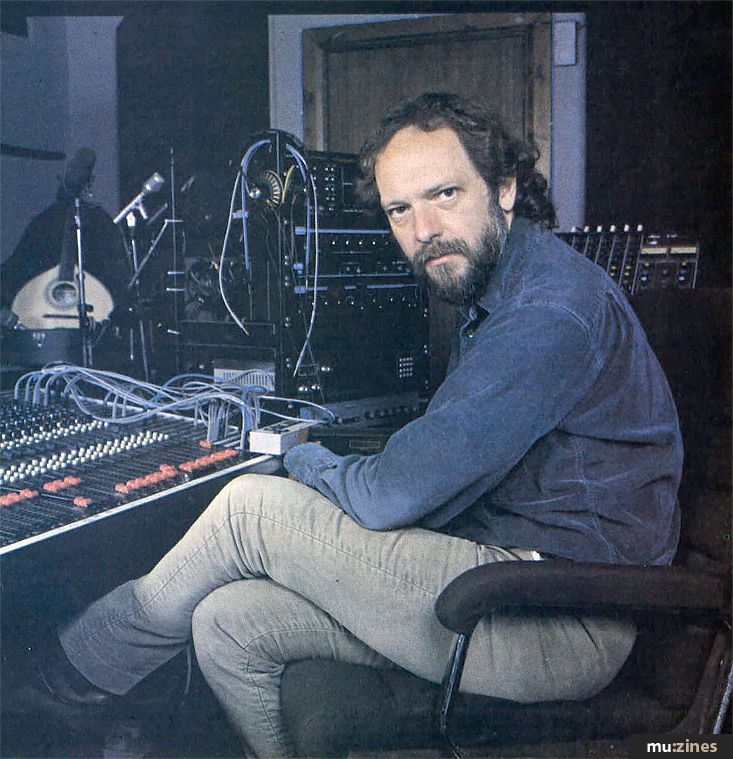
Monitoring
The Tannoy Super Reds are my main monitors. They're not bi-amped but they really ought to be. My reference speakers are the tiny Visonik David 6000s. I use a dbx 20/20 computerised equaliser/analyser to equalise the big speakers for loud monitoring, and the little speakers are before the dbx equaliser. Basically what that does is punch white noise out of the monitors, analyses the white noise and then via it's graphic equaliser, it will then computer adjust itself to so called 'flat sound'. But you don't really trust it, whatever it tells you, you sort of half trust it and use your ears a great deal! The aim is to get those big Tannoys to emotionally sound the same to you as those little Visoniks will at car stereo level. Obviously you don't get the bottom end bass response from the Visoniks.
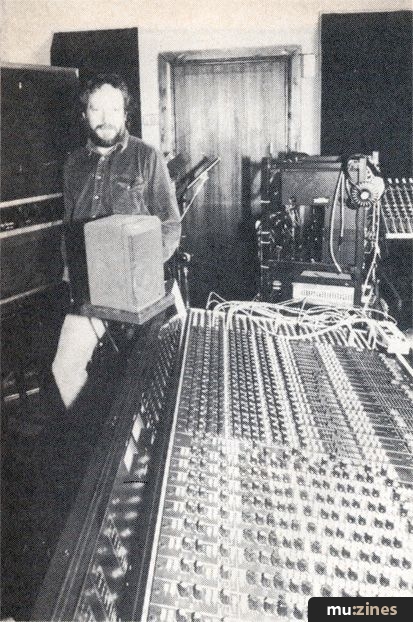
The studio.
To me Visoniks are baby Tannoys. They sound loud; they have a loud sound without actually making a lot of level in the room, but they are very good reference speakers indeed, and if I had to listen to all the music that I ever listened to using a pair of Visoniks, well I'd certainly be happy so long as I could sit close enough to them.
My own monitoring device is the trusty Sennheiser HD424 headphones, and the interesting thing is that if you listen to the Sennheisers, the Visonik speakers and the Tannoys, they are all incredibly beautifully matched right the way down the frequency range until you get to around the 200 Hz mark where the Visoniks have a bit of a lump in them. When you really get down low you'll find that the Visoniks and the Sennheisers are dropping off around the 60 Hz mark and you don't have what you really will hear on the big Tannoys. But that's really a question of arriving at a sensible monitor mix that will give you that extra 'thump-in-the-chest' bass on the big speakers but still a comfortable punchy sound at around the useful 100 Hz that you've got to consider as really being the limit of most domestic hi-fis. There's no point in creating a big, fat bass drum sound that's relying on a 50 Hz 'oomph' to knock you over, because you just ain't gonna hear that end of it on the average home hi-fi system or the average pair of earphones.
System Noise
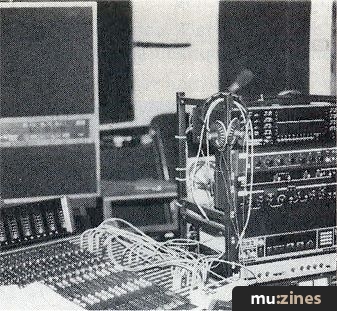
Effects Rack.
My effects rack contains a combination of equipment like MXR, that I found to be useful in the live performing context. Again within this budget range the MXR effects are really very good indeed, and you've got to go a long way to find a delay unit as good as they are doing with that kind of bandwidth, at the delay times they offer. It's not the quietest thing in the world, you've got to be careful of it, but then you've got to be careful of the AMS Digital Reverb. I mean, in spite of the specs you just have to be careful, otherwise you're going to hear that noise. So, although it's all very well removing tape hiss, the biggest offender in terms of general noisemaking in modern music is going to be the digital noise coming out of your Rhodes Chroma, your Emulator and your Linn Drum.
I use noise gates all the time on every DI recording. I just patch them in as I want them, but I record virtually everything using the noise gates because of this digital noise that is inevitable on a lot of today's equipment. When the signal is present you don't hear it, it's very much in the background, and probably most people would say 'I'm not bothered about that, I'll live with it', but it seems rather silly to me.
Your equipment has to match, there's no point in spending £50,000 on a mixer and then recording it onto the 8-track Teac or something... it's crazy. Similarly there's no point in buying your budget Allen & Heath mixer and dumping all that on to a Studer. You've got to match like for like and your eventual product will suffer because of the weakest link in the chain.
I've even laid on three-phase electricity to isolate the studio because I was so concerned about removing hums and noises. But getting back to your basic home set-up, whether you're the proud owner of your little Fostex or whatever it might be, these problems still remain.
Whatever end of the price spectrum you operate, you've still got to sort out what's the cleanest 13 amp socket you've got in the house and plug into it because of all these earth hums. If you've been unfortunate enough to have fitted any of your lights with dimmer switches and they're on the same circuit then you're going to get hums and noises off your dimmers and all these things are as important as buying the right piece of equipment to match everything together. Don't spend unnecessary amounts of money on something that is way beyond the rest of your kit, try and tie it all together so that you get the best out of a matched set-up.
Effects
Basically, all the stuff that I'm using is outboard equipment and I've tried to use as little as possible. I don't like lots of gadgets, I would rather just have the things that I use all the time like reverb.
I use a conventional reverb plate that is called Echo Plate to make life simple. That's the budget end of the echo plate, it's American. I wouldn't really recommend that unless you've just got to have a plate sound which I like. I prefer its sound to that of the AMS 'plate' program, but again it's rather noisy, you've got to be pretty careful how you use it. The AMS Digital Reverb is a general all-around tool, and I've tried other manufacturers' equipment in the digital reverb line and I think the AMS is the cleanest and most usable if you're only going to have one of those.
I use a time pre-delay sometimes to go with the snare drum beat which may just be pertinent to the one snare drum track, also a general echo setting if I'm looking for a hall-type reverb as opposed to a small room reverb or a plate reverb. I don't like really long reverb sounds for the majority of music, but I'm not a fan of the very short sort of New Wave 'tin box' room sounds, though occasionally it will sound nice on a snare drum or a voice.
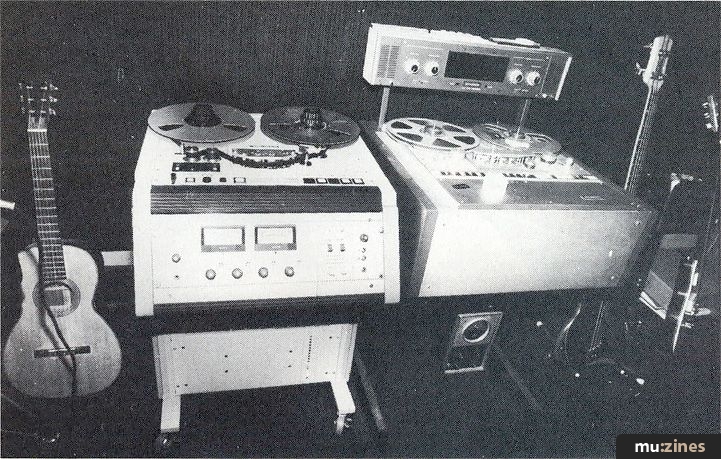
Otari and Studer recorders.
Demos
I've always been rather loathe to make demos at home and then have to go into a studio to try to recreate the magic because I don't think you ever do it better. All you do is record it more professionally. You get a better signal to noise ratio, you get better sophistication in terms of outboards and effects and so on; but that magic that was there on the demo, that's what I want to capture.
I'd much rather go for a master recording at home, so my philosophy is rather the opposite of the Fostex 16-track sort of future! In other words I'm not terribly interested in the idea of making multitrack demos, I would prefer to make 4-track masters than 16-track demos and I would take an awful lot of convincing that any 16-track on half inch or even one inch tape is going to be ultimately the way to go.
I thought very carefully when I established my home studio last year, before I went for the expense of a 16-track on two inch Soundcraft. That was the luxury package as far as I was concerned when I first decided to get some home equipment. I had thought about getting one of the 16-track on 1" packages and thought 'well it'll be perfectly good for making nice little tracks at home, and maybe if I decided that I want to release something as well, then it will probably be good enough'.
But then I thought 'wait a minute, this is ridiculous, why spend all this time working at home making recordings with a view to releasing as records, and knowing that you are at some kind of disadvantage for the sake of spending a few more thousands of pounds?' Obviously I can afford it, other people may not be able to. I would certainly say to anybody who wanted to do it professionally, and wanted to release a record, then go for the widest tape going.
If, however, you want to learn in a more semi-professional fashion the skills of engineering and the options open to you, then a Fostex will be a terrific thing because it'll teach you all the principles involved, give you the flexibility of multitrack to work on, and provided you choose the right kind of mixer to go with it, that's not too good or too poor for the Fostex, then you'll end up with some very tidy, sophisticated home demos."
More with this artist
 Ian Anderson (Ian Anderson) |
Publisher: Home & Studio Recording - Music Maker Publications (UK), Future Publishing.
The current copyright owner/s of this content may differ from the originally published copyright notice.
More details on copyright ownership...

Home & Studio Recording - Nov 1983
Donated & scanned by: Mike Gorman
Artist:
Ian Anderson
Role:
MusicianSingerSongwriterPerformerBrass / Wind Player
SingerSongwriterPerformerBrass / Wind Player
SongwriterPerformerBrass / Wind Player
PerformerBrass / Wind Player
Brass / Wind Player
Related Artists:
Jethro Tull
Interview
Help Support The Things You Love
mu:zines is the result of thousands of hours of effort, and will require many thousands more going forward to reach our goals of getting all this content online.
If you value this resource, you can support this project - it really helps!
Donations for May 2026
Issues donated this month: 0
New issues that have been donated or scanned for us this month.
Funds donated this month: £0.00
All donations and support are gratefully appreciated - thank you.
Magazines Needed - Can You Help?
Do you have any of these magazine issues?
If so, and you can donate, lend or scan them to help complete our archive, please get in touch via the Contribute page - thanks!
Please Contribute to mu:zines by supplying magazines, scanning or donating funds. Thanks!
Monetary donations go towards site running costs, and the occasional coffee for me if there's anything left over!

 @mu_zines
 RSS Feed
 Blog
Blog