


Magazine Archive
Home -> Magazines -> Issues -> Articles in this issue -> View
Ibanez Digital Delays | |
Article from One Two Testing, August 1984 | |
DM1100 and DM2000
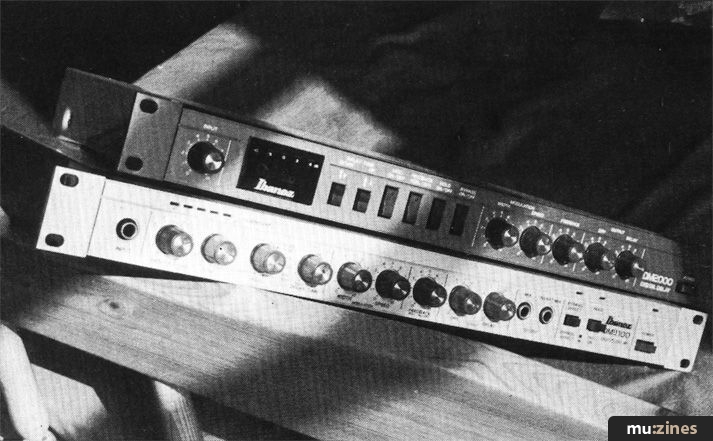
Meet two digital delay lines from one company using the same technology but to different ends. Question. Do you want it quick or do you want it quiet?
If it's fast, on-stage changes you're after, then Ibanez have the DM1100, but if your main concern is budget recording and the minimum of noise, then look to the DM2000.
It's becoming increasingly difficult to find anything new to say about digital delays. Three years ago they were ludicrously expensive and the province of professional studios. Today they're commonplace, and a reasonably equipped four or eight track home studio is almost certain to have one. As well as offering echo – at the moment, anything up to 4½ seconds – they also supply flanging, chorus, ADT, slapback and some form of reverb, though never a particularly convincing one. Excellent all purpose devices and real budget recording workhorses.
Some will have programmable memories to store echo times, modulation amounts, etc, but the DMs are more down to earth. Both are 19in, rack mountable jobs, no more than an inch and a half high. The 1100 has inputs and outputs at the back and front, the 2000 at the back only as it's meant to be permanently wired into a recording set up.
The major distinction between them is the way you select the echo time. The 1100 has an eight position rotary switch (14, 28, 56, 113, 225, 450, 900 and 1800ms) partnered by a fine tune control that will take each of those ranges steplessly from half to twice its front panel value. A calculation of brain staggering intensity will rocket you to the conclusion of a maximum 3600ms delay time.
The 2000 has a top wack of 1023ms but no knobs. Instead there are push buttons marked up and down. Press these lightly and the delay will increase (or decrease) a millisecond at a time as revealed by the matching four figure red LED display. Push harder and a clever, second touch arrangement sends the reading racing away. Even so, from 28ms to 3600ms on the 1100 is a split second twist of a knob. In top gear the 2000 speeds from 0000 to 1023ms in eight seconds. The advantage of the latter's readout is that you may want to recreate a favourite delayed sound to the millisecond – especially useful at the lower end of the scale for chorus and flanging effects. The 2000 supplies a precision reading. The 1100 is a well-I-think-the-knob-was-about-there job.
Other than that and a few cosmetic details, the facilities are virtually identical: modulation depth and speed controls, a feedback level (to determine how long the echo keeps going) and output volumes for the dry (original) and delayed halves of the signal. Usually you get just one balance control and I found the DM's system more convenient.
The modulation section continually changes the delay time rapidly or slowly, up and down, over a wide or narrow range depending on how you have the controls set. This section is the secret for all those chorus and flanging effects operating in the two to 20ms mark. A sweet chorus largely depends on a smooth, low frequency oscillator altering the delay time, and both the Ibanez were gentle and effective.
It's worth remembering that chorus is the result of changing delay times. You should get a chorus effect if you set the time to 10ms and use the modulation to swing that by 4ms in either direction – 6ms to 14ms. But you'll still get a chorus if you wander from 296ms to 304ms, but you'll hear a 300ms echo as well. So it is possible to get two effects out of one box at the same time, with careful juggling of the controls.
Bypass switches (to negate the echo effect) and hold (to keep it going forever) are also included, plus feedback inversion. Technically this reverses the phase of the echoed signal. If you studied the waveforms on an oscilloscope you'd find those of the original signal would be going up while the delayed ones were going down.
Acoustically it has the effect of making the two signals seem to stand apart from each other. It's recommended for use in flanging which relies on phase relationships to produce more unusual effects, but I always like it on reverb. To my ears the reverb imitations in digital delay lines always sound cluttered and messy. Feedback inversion gives a stronger impression of one original signal standing in the midst of many split second delays rather than being swamped by them.
At the rear all the normal footswitch sockets for stereo outs, hold and bypass are in evidence. The DM1100 has an additional, useful socket for turning on the modulation by a remote footswitch, while the DM2000 has the advantage of an input attenuator for line or mike signals, a wise addition considering its studio tendencies. And of course the 2000 is quieter and has a better frequency response (10Hz to 16KHz for a delayed signal compared to the 1100's 30Hz to 8KHz). There are improvements in the Total Harmonic Distortion as well.
The DM1100 (brand new) and the DM2000 (four or five months old) take an honourable place among the rest of the digital delay fraternity currently on our shelves. What intrigues me is what happens next. In the last 12 months companies have fought to include longer delay times, better displays, clearer headroom indicators and quieter electronics for ever lower prices. But now that's all been done.
The One Two bookmaker is taking bets that the next generation of digital delays to come out of Japan will double as sampling machines. With the inclusion of CV and gate sockets at the rear, or better still, MIDI connectors and circuitry, it should be possible to lock sounds into the hold section and play them back at the required pitch. Electro Harmonix have already done it with their Super Replay reviewed last month. As this feature was going to press, we were yet to vist the NAMM show in America where such devices may be waiting in van loads.
IBANEZ digital delays
DM1100: £336 DM2000: £471
Also featuring gear in this article

Ibanez DM1100 Digital Delay
(EMM Jul 84)

Ibanez DM2000 - Digital Delay
(EMM Jan 84)
Browse category: Studio/Rack FX > Ibanez
Publisher: One Two Testing - IPC Magazines Ltd, Northern & Shell Ltd.
The current copyright owner/s of this content may differ from the originally published copyright notice.
More details on copyright ownership...

One Two Testing - Aug 1984
Gear in this article:
Studio/Rack FX > Ibanez > DM1100
Studio/Rack FX > Ibanez > DM2000 Delay
Gear Tags:
Review by Paul Colbert
Ads for Gear in this article:


Previous article in this issue:
Next article in this issue:
Help Support The Things You Love
mu:zines is the result of thousands of hours of effort, and will require many thousands more going forward to reach our goals of getting all this content online.
If you value this resource, you can support this project - it really helps!
Donations for July 2026
Issues donated this month: 0
New issues that have been donated or scanned for us this month.
Funds donated this month: £0.00
All donations and support are gratefully appreciated - thank you.
Magazines Needed - Can You Help?
Do you have any of these magazine issues?
If so, and you can donate, lend or scan them to help complete our archive, please get in touch via the Contribute page - thanks!
If you're enjoying the site, please consider supporting me to help build this archive...
...with a one time Donation, or a recurring Donation of just £2 a month. It really helps - thank you!

 @mu_zines
 RSS Feed
 Blog
Blog