


Magazine Archive
Home -> Magazines -> Issues -> Articles in this issue -> View
In Concert | |
Article from Electronic Soundmaker & Computer Music, January 1984 | |
Light fantastic?
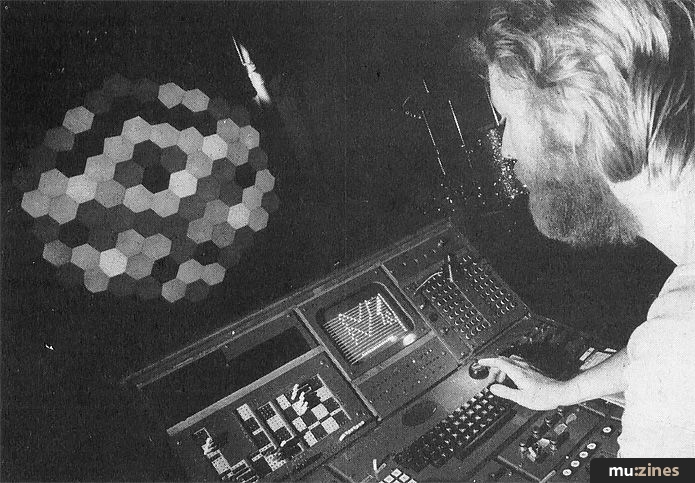
Ro Shannon and 'Christine'
Melodic Photons
New End Theatre, Hampstead
Synth music has a long history of connections with high-tech visual displays, from the early laser shows of Tim Blake and Hawkwind to the sophistication of Jean-Michel Jarre and Kraftwerk. Expense has always been a limiting factor though, particularly where lasers are involved, and so truly innovative marriages of music and visuals have been few and far between. One exception to this is the Melodic Photons show, masterminded by artist Ro Shannon and starring one light synthesizer, one hexagonal display screen, three musicians and a tape recorder. The present format of the show is a set of 'galactic poems', in fact patterns of light rather than sound, lasting just over an hour. Music is provided by Ryan Torrington (bass and Korg Poly 61), Patrice Bernard (congas) and Alan Priestley (guitar), in a variety of styles from the pastoral to the frenetic via a sort of mid-tempo Eastern-influenced rhythm.The light synthesizer, colloquially known as Christine Pristine Aurora, consists of a control unit designed by Toby Holland connected by multicore to 256 thyristors controlling sets of red, green and blue hand-tinted bulbs. Each 'cell' of the display is capable of producing any colour in the same way a TV screen does, with control over every cell by the built-in 8085 computer. Several analogue devices such as sequencers and routing patchbays serve to define the exact patterns appearing on the screen; it's difficult to describe the exact nature of the display, but "lava flows pulsating, waves scintillating on oceanic worlds, debris drifting in space and tesselated patterns taking shape" comes somewhere close! The music, although partly improvised, matches perfectly with the visuals, building to a climax and then settling back to the sedate pace of the opening.
It's an unusual and stimulating show, and one which deserves to gain more exposure. If you're interested in meeting Christine and experiencing the Melodic Photons concept for yourself, contact Ro Shannon at Intergalactic Art on (Contact Details).
Gil Evans Band
Royal Festival Hall
Jazz veteran Evans has influenced a whole generation of composers from Miles Davies onwards, yet nowadays in his seventies he's still up to date with the latest sounds of synthesizers and effects. His RFH show featured Evans himself on acoustic and Fender Rhodes pianos, together with John Surman on Juno 60 and keyboards and Stan Sultzman on sax. Keyboard lines swept over and through each other above a powerful horn section backing, with the good old 'odd harmonic' sounds of the Hammond organ programmed into the Juno. Stan Sultzman's solo spots showed that you don't have to use synthesizers to produce imaginative electronic music; his use of flowing melody lines over a strong repeat echo could be an inspiration to non-keyboard players everywhere.Sun Ra
The Venue
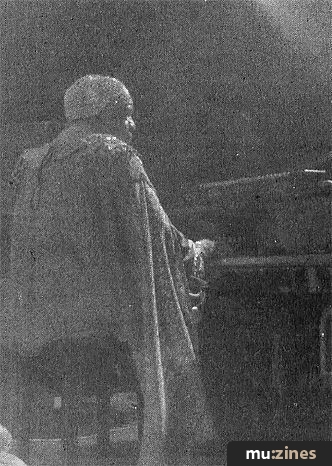
Sun Ra at The Venue
Some figures in electronic music remain legendary while the vast majority of listeners are unfamiliar with their music. One such is Sun Ra, the first jazz keyboardist to use synthesizers — and the first to give them up. In the sixties and early seventies Mr Ra (as he is known to his friends) experimented with all the instruments used by Terry Riley and the classical electronic musicians — Fender piano, Clavinet, electric harpsichord, Rocksichord and electric organs. The take-off point for his compositions was the vast and ever-changing Solar Myth Arkestra, slimmed down for the London dates to a mere dozen or so singers, horn and percussion players and dancers.
Ra's approach has always been electric, and the Venue concert covered almost all the styles he's been known to use on record. In other words — the opening was confusing, a morass of African percussion, tuneless trumpet solos and strange lilting vocals. The second phase was more accessible — powerful jazz with forceful-rhythms building up to the introduction of Ra himself, who proceeded to dominate the stage despite the presence of the whole Arkestra. Finally Ra sidled over to the piano and proceeded to blast out a series of blues and jazz riffs interspersed with an almost Big Band style from the other players, showing all the expression which convinced him that synthesizers have to be combined with acoustic instruments. Ra's only other keyboard on the night was a Crumar Synthaphone, which in addition to allowing keyboard control can have a breath input from a plastic tube plugged into the side panel — a sort of intermediate technology Yamaha CS-01.
The mythology which ties together all the strands of Ra's music, acoustic and electronic, is often impenetrable, but the effort of a little examination can be rewarded. Recently the band's first ever single 'Nuclear War' has been released, but there are many albums about on Y Records and Recommended Records such as Nuclear War, Strange Celestial Roads, Disco 3000 and Fate In Pleasant Mood. More information from Sue Skeats at Richard Robson Associates, (Contact Details).
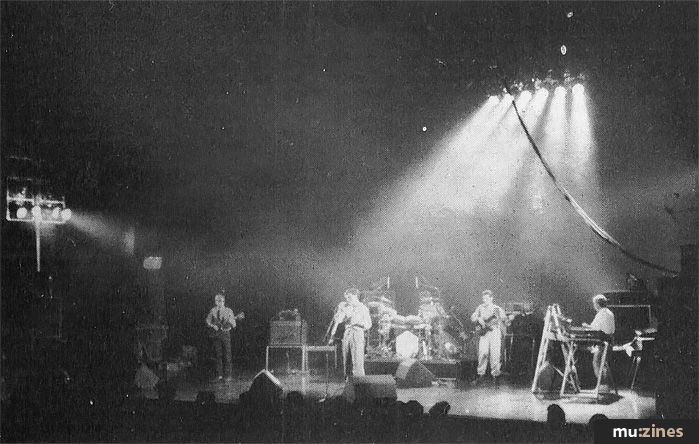
John Foxx and band at the Dominion
John Foxx
Dominion Theatre
At the time of our interview (September issue) John Foxx was still planning his recent tour, his first live performances since the days of Ultravox. Now the tour's over it seems to have been a great success, with the London date at the Dominion being an obvious high spot. John's put together a talented band capable of reproducing most of the subtleties of those parts of his recorded works that he's interested in playing live, and the addition of a very powerful and colourful light show together with lots of smoke and strobes for the spooky bits proved a welcome bonus. Much of the set was taken from the new album 'The Golden Section', opening with 'Running On Thin Ice With Tigers' and proceeding to speed through a selection of up-tempo numbers characterised by heavy Simmons percussion, Roland Vocoder strings and wailing guitar. John's vocal mike was sent partly to the vocoder input of the Roland keyboard with the result of a 'human host' of voices behind his every inflection. Then some older songs were introduced going as far back as 'The Quiet Men' and 'Slow Motion', then into a selection from 'The Garden' including the atmospheric title track.To some extent the audience must have been waiting for the first two hits, 'Underpass' and 'No-One Driving' to appear, and each time a hint of either appeared in another tune there was a rustle of anticipation. No such luck though, as John went back to the new stuff for the encores and continued to duck and sway about the stage as he had all night, giving the lie to the emotionless image of old. The days of 'Metamatic' are clearly long gone, but John Foxx is still with us and giving of his best.
Publisher: Electronic Soundmaker & Computer Music - Cover Publications Ltd, Northern & Shell Ltd.
The current copyright owner/s of this content may differ from the originally published copyright notice.
More details on copyright ownership...

Electronic Soundmaker - Jan 1984
Donated & scanned by: Mike Gorman
Music Review
Help Support The Things You Love
mu:zines is the result of thousands of hours of effort, and will require many thousands more going forward to reach our goals of getting all this content online.
If you value this resource, you can support this project - it really helps!
Donations for April 2026
Issues donated this month: 0
New issues that have been donated or scanned for us this month.
Funds donated this month: £0.00
All donations and support are gratefully appreciated - thank you.
Magazines Needed - Can You Help?
Do you have any of these magazine issues?
If so, and you can donate, lend or scan them to help complete our archive, please get in touch via the Contribute page - thanks!
Please Contribute to mu:zines by supplying magazines, scanning or donating funds. Thanks!
Monetary donations go towards site running costs, and the occasional coffee for me if there's anything left over!

 @mu_zines
 RSS Feed
 Blog
Blog