


Magazine Archive
Home -> Magazines -> Issues -> Articles in this issue -> View
Kitaro | |
Nature is of the Mind, and Music is of the Nature... | KitaroArticle from Electronics & Music Maker, August 1982 | |
An insight into the music of one of Japan’s leading synthesists on record.

On the other side of the world forty million people are watching a small man crouched over a huge battery of electronic instruments. The venue is a thatched cottage in a disused village in the mountains two hundred miles from Tokyo. The man is at home. Japanese national TV has chosen this bizarre scene as its way of ushering in the New Year. In sixteen million homes the sweeping sounds of synthesisers 'ring in the New!' No bells — just Korg, Roland and Yamaha.
Masanori Takashi (KITARO) until now has been the least heralded in the West of the top electro-musicians from Japan. To many ears, his work leaves the soul-less and raucous work of such derivative artists as Tomita and Y.M.O. for dead.
This twenty-eight year old first came to national prominence through his membership of the Far Eastern Family Band. The FEFB had a Japanese hit with 'Theory of Hollow Earth' in 1974 and enjoyed a cult following on the West Coast of the States. In the U.K. their champion was the then adventurous John Peel who droned lyrically about their talents. They were very good indeed and certainly showed up their English counterparts Pink Floyd, whose music by this time was starting to grow the aural equivalent of a beer gut. Like the early Pink Floyd, FEFB seemed to appeal to the ageing flower children.
As a rock musician Kitaro travelled a good deal and it was on a visit to Europe that he met the German musicians who were to have a profound influence upon him. Schulze and Deuter, for example, impressed Kitaro particularly and not for the most obvious reason. In essence, he discovered that these men interpreted their art in a spiritual way, and that their approach was one which instinctively struck a chord in him.
At about that time a poll in Japan had shown that in spite of the national religion of Shinto; the strong cultural presence of Zen Buddhism and the aggressive drive of Christianity in Southern Japan — that in spite of all this, an incredible ninety per cent of Japanese University students claimed to be atheists. Furthermore, they also claimed to be totally satisfied with a purely materialistic interpretation of life. So Kitaro's fascination with the complex nature of mysticism that makes up Shinto, and his study of Zen Buddhism was very unusual for a young Japanese intellectual. In Schulze and others he had found a Western reverence and enthusiasm for what was downright unfashionable amongst his own young countrymen. This led to the inevitable spiritual pilgrimage to India and Nepal. The unity behind the mind, the external world and the sound vibration organised into music is expressed by Kitaro as: 'Nature is of the mind, and music is of nature'.
These journeys led to a complete renunciation of the nightmarish quality of Japanese urban life. A short stay at the foot of Mount Fuji was followed by a period of intense meditation in a cave overlooking the Pacific. Until 1980 Kitaro stayed in a fishing village close to 'his' cave. The presence of electricity meant a ceaseless attempt to match the output of his synthesisers with the sounds and pulses of nature.
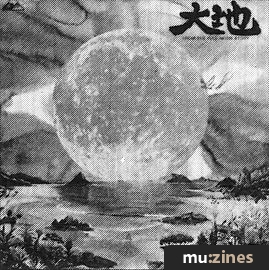
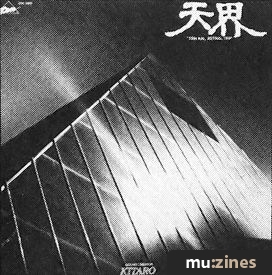
In 1978 'Tenkai' or 'Astral Trip' was released by Victor Records and already displayed a distinctive and natural compositional talent at work. Neither this or 'Daichi' released early in 1979 caused great ripples at the time. But by the end of 1979 a change of record labels (to Canyon) and the release of the phenomenally successful 'Oasis' had established him in the second biggest record market in the world.
With the flair of a good management company, Canyon had preceded the LP with a concert in August — several hundred people rapturously received that first major concert. At this stage a high percentage of Kitaro's fans were yoga students and trainee Buddhist monks — the auditorium at the concert had been dominated by the vast influx of saffron coloured monks' robes.
Early in 1980 he was commissioned by NHK TV to produce the soundtracks for their proposed epic series about the trade route from China to Rome...'Silk Road'. His music for the first three programmes was to become known on disc as 'Silk Roads Volume One'. To seek inspiration worthy of that commissioned work, Kitaro decided to travel once again. His itinerary included Asia and Europe — the Austrian and Swiss Alps proving particularly stimulating to his senses. Like many a creative artist before him, Kitaro finds in the transcendence of the mountains the inspiration of nature's power to move the heart.
On his return to Japan he discovered the atelier in the disused village. A quick decision to move there was made, and the now famous studio planned and built. Even from the first days in his new home Kitaro expressed his fundamental belief in unity by his insistence that all tilling of the soil; growing of the crops and practical maintenance should be done by him. That policy is still followed.
In September '80 Kitaro performed for three consecutive nights at the highly influential Parco Seibu Theatre. These highly successful concerts were recorded for posterity and subsequently released as 'Kitaro In Person'. This JVC digitally produced recording has just been released by Kuckuck Records in Europe and features Kitaro with four other musicians. Generally the album stands up very well as a live performance — though slight blemishes include an over obvious backing drum in places and a violinist with the faintest hint of a pitching problem. However, these are very minor criticisms and do nothing to diminish the achievement of this LP.
When 'Silk Road' was finally screened, the NHK telephone switchboard was jammed with enquiries about the music. Naturally enough Kitaro was asked to produce music for the rest of the series... hence Volumes 2 and 3 of 'Silk Road'.

Following up the great success of 'Silk Road', Kitaro was flown into England to record with the LSO. Just as Mike Oldfield had produced an orchestral 'Tubular Bells', so Kitaro was required to do the same for 'Silk Road'. On this record the numerous multi-tracks were replaced by fully orchestrated scores. To my ears nothing was added to the music by this expensive exercise; indeed there comes a point at which a subtle tone created by a synth is destroyed by the emphatic 'definiteness' of an oboe or violin. Too much is stated. In the main, the LSO rendition serves to show how strong the melodies really are, and even more markedly the similarities between the 'Silk Road' theme and Iain Sutherland's 'Sailing' — quite uncanny!
The music of Kitaro is not conceived in an intellectual way and nor should it be listened to in that way. The compositions come as an outpouring of a man's religious experience, and he makes it clear that his own inner condition plays a crucial role in the musical creativity: "My music is somewhat different from the sound of nature's movements for it has positive love added. Furthermore, there is no self oblivion or self-intoxication incorporated in my music, as is the case of Indian music as represented by the sitar."
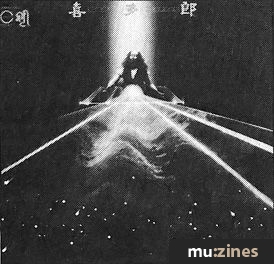
There is a feeling that the newest records produced by Kitaro are a reiteration of what has already been available from him and that he is falling into the trap of producing too much with too little new inspiration. Maybe with an artist like Kitaro we should not expect development or a continual stream of electronic novelty. After all, his creativity is not based upon an urge to sell a lot of records. Be that as it may, nobody with an interest in electro-music can afford not to pay the closest attention to 'Silk Road'; 'Oasis' and 'In Person'. All three of these records are now distributed in the U.K. by Making Waves Record Distribution so hopefully they will find their way into record shops up and down the land. The music of Kitaro could be massively popular in Britain... perhaps the BBC could follow up the success of 'The Water Margin' with 'Silk Road'.
Available in Europe
Ten Kai.
Silk Road Vol. 1 and 2.
In Person.
Oasis.
Available only as Japanese imports
Silk Road Vol. 3 Daichi.
Tao.
Ki.
If you have difficulty in obtaining these records, contact Making Waves, (Contact Details).
More with this artist
 Kitaro (Kitaro) |
Publisher: Electronics & Music Maker - Music Maker Publications (UK), Future Publishing.
The current copyright owner/s of this content may differ from the originally published copyright notice.
More details on copyright ownership...

Electronics & Music Maker - Aug 1982
Interview
Help Support The Things You Love
mu:zines is the result of thousands of hours of effort, and will require many thousands more going forward to reach our goals of getting all this content online.
If you value this resource, you can support this project - it really helps!
Donations for June 2026
Issues donated this month: 0
New issues that have been donated or scanned for us this month.
Funds donated this month: £0.00
All donations and support are gratefully appreciated - thank you.
Magazines Needed - Can You Help?
Do you have any of these magazine issues?
If so, and you can donate, lend or scan them to help complete our archive, please get in touch via the Contribute page - thanks!
Please Contribute to mu:zines by supplying magazines, scanning or donating funds. Thanks!
Monetary donations go towards site running costs, and the occasional coffee for me if there's anything left over!

 @mu_zines
 RSS Feed
 Blog
Blog