


Magazine Archive
Home -> Magazines -> Issues -> Articles in this issue -> View
MIDI Retrofits | |
Article from Sound On Sound, March 1989 | |
Tony Wride takes a stroll down nostalgia lane and discovers two companies that can turn your prized antique into a thoroughly modern MIDI instrument.
Soon after MIDI arrived and musicians discovered that they couldn't live without it, most people ditched their non-MIDI synths, drum machines and sequencers in favour of 'better' MIDI-equipped instruments. Today, those 'classic' machines are much sought after, and all it takes to bring them bang up to date is a MIDI retrofit. Tony Wride takes a stroll down nostalgia lane and discovers two companies that can turn your prized antique into a thoroughly modern MIDI instrument.
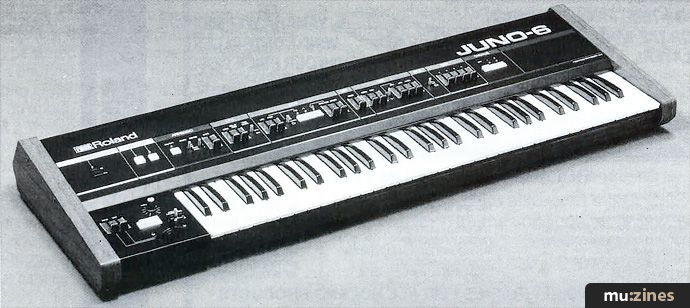
Several millennium ago, Robert Moog showed the world his first Voltage Controlled Synthesizer and everybody was stunned by the sounds that his box of tricks produced. In the ensuing years, more and more examples of what are now classed as 'analogue synthesizers' followed, and yet again stunned the ears of those who listened. I distinctly remember travelling to the Crystal Palace Bowl way back in 1974 to watch my all-time hero, Rick Wakeman, perform 'Journey To The Centre Of The Earth'. Although the London Symphony Orchestra sounded great, the highlights for me, and maybe several other 'synth freaks', were Rick's amazing MiniMoog solos. My contemporaries were getting high listening to the likes of Led Zeppelin overdriven guitar solos, but for me 'heaven' was listening to the sound of a MiniMoog.
In those days I couldn't afford to buy a synthesizer, so I built one, and vividly remember spending hours and hours soldering lots of resistors and transistors to numerous circuit boards before I was eventually able to switch the synth on and then start the even longer process of setting it up. Eventually, after spouting numerous words not found in the English Dictionary, the 'MiniSonic' was up and running. It wasn't a MiniMoog but it came close, and it only cost me about a tenth of the price.
The MiniMoog was (and still is) a classic instrument, as indeed are numerous other analogue synthesizers that followed in its wake. It wasn't long before the introduction of integrated circuits gave birth to polyphonic synthesizers and even more classics like the Sequential Circuits Prophet 5, Roland Jupiter 8, Yamaha CS80, Memory Moog, and Korg Trident.
Then, in 1983, came the 'Big Bang' - when the MIDI virus started to attack the music industry and digital technology found its leader in the form of the classic (but for somewhat different reasons) Yamaha DX7. Before long, all analogue classics which lacked the 'benefit' of MIDI were left out in the cold, as the technology explosion continued and just about everything began to sport a MIDI interface. (I'm still working on a MIDI-controlled lager dispenser!)
But now the classics are starting to strike back, as more and more people are returning to the warm, and often unpredictable, sounds of the old technology synthesizers and drum machines. Most recently, 'Acid House' records have made extensive use of old synths and drum machines, helping to spark interest even further.
Helping boost this revival, by providing MIDI retrofits and MIDI interfaces for various 'classic' instruments, are two small British companies: Groove Electronics in Wilton, Wiltshire; and Kenton Electronics in Kingston-upon-Thames, Surrey. Before giving details of the services these two companies provide, let me quickly refresh your memory of how the 'old', pre-MIDI, instruments worked.
MONOPHONIC SYNTHESIZERS
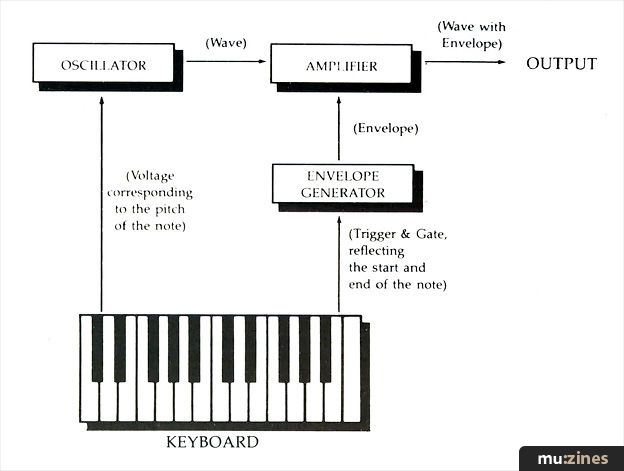
The early monophonic synths used Voltage Control throughout the sound generation process, including Voltage Controlled Oscillators (VCOs), Voltage Controlled Filters (VCFs), and Voltage Controlled Amplifiers (VCAs). The keyboard generated a variable voltage, normally following a 'one volt per octave' law (Yamaha synths used a Hertz per octave arrangement just to be different!), which was then fed to the VCOs to give the variation in pitch. The keyboard output voltage was often supplied to the VCF so that the Filter would track the keyboard, allowing the Filter frequency to vary with pitch. Most of the controls that affected the various parts of the synth sent adjusting voltages. This is true of the Envelope Generators (EGs), which could be routed to control either the VCF, providing the famous 'swept' filter effect; the VCA, to adjust the volume envelope; and/or the VCOs, to produce pitch shift effects.
The keyboard itself often consisted of a simple resistive chain (thereby producing the changing voltage), and a detection circuit which noticed each time a voltage was present and provided a trigger (normally called a Gate) pulse to the Envelope Generators. On most monosynths, input sockets were provided to allow sequencers to join the keyboard output - referred to as Gate In and Control Voltage In. The famous Jean-Michel Jarre sequences heard on Oxygene were produced by a simple sequencer providing an 8-note pattern of voltages and gate pulses, which were then fed to a synthesizer. Using the synth keyboard, an adjusting voltage could be applied which allowed the overall pitch to be varied so that you could effectively transpose the sequence up and down.
As integrated circuits (ICs) became available, these were used extensively to replace the often unstable transistors previously used in most analogue synths. The most well-known chips were those from Curtis Electromusic, which were used on a number of classic monosynths - including the Sequential Pro-One. Despite the introduction of ICs, and later on the digital scanning of the keyboard, most monosynths provided an input for Gate and Control Voltage. Some of the better monosynths allowed additional voltage inputs to control the VCF cutoff, as well as audio inputs which could be mixed with the output of the oscillators to create some amazing effects.
To utilise one of the old monophonic synths in the world of MIDI, you must convert the MIDI note signals into the two basic requirements of a Gate signal and a Control Voltage.
POLYPHONIC SYNTHESIZERS
Although several 'hybrid' analogue/digital polysynths were available before the advent of the integrated circuit, very few were built, and they were notorious for being unreliable. With the introduction of microprocessors and the Curtis Electromusic synthesizer chips, the mass production of affordable polysynths became possible. The subtle difference between monophonic and polyphonic synths (apart from the increased polyphony!) was that the keyboard had to be digitally 'scanned'. The resultant digital output was then passed through a Digital to Analogue Convertor (DAC) to provide an analogue voltage to control the VCOs, VCAs etc. Later on, Digitally Controlled Oscillators (DCOs) were used, which negated the need for the DAC.
In terms of being able to use these polysynths with external sequencers, some were given a single Gate and CV input, allowing only a monophonic sequence, whilst others had multiple Gate and CVs (eg. Oberheim), a Digital Control Bus (eg. Roland Juno 60, Jupiter 8A), or nothing at all! Since the majority of the better known pre-MIDI polysynths use a digital keyboard scan, converting them to work with MIDI normally involves introducing an interface which feeds into the keyboard output bus and converts the digital MIDI data into digital note data. Adding other features, like patch changing, means that you then have to start re-programming the synthesizer's own internal microprocessor.
DRUM MACHINES & SEQUENCERS
The method of producing sounds on early drum machines often varied, but they all had one important thing in common: a clock. The most popular clock format for synchronising drum machines and sequencers was Sync 24 (24 beats per quarter note, the same resolution as MIDI Clock), which appeared on all Roland gear — TB303 Bassline, MC202, TR808, TR606, etc - and on several other manufacturers' products.
To get the old drum machines and sequencers to work with MIDI involves converting the MIDI Clock to either Sync 24 or to some other Clock type, as appropriate. It is worth noting that with Sync 24 the clocking is continuous, with start and stop signals being sent on a separate line. With the simple Clock setup, the clock signal only becomes available once you start the machine and ends when you stop.
GROOVE ELECTRONICS
Having covered the technical aspects, let's now take a look at what Groove Electronics produce. I first got to know about Groove when I had my Roland Jupiter 8 fitted with one of their MIDI interfaces at the end of 1987. That particular JP8 now resides in Pete Waterman's studio in London, where I understand it gets extensive use, after I placed a free classified in Sound On Sound and received an offer I couldn't refuse! There are numerous occasions when I regret selling it - but that's another story.
Groove Electronics is run by Neil Naish and Patrick Shipsey, who have between them a very extensive knowledge of MIDI and how to link up the 'classics' to the MIDI environment. The first products that they produced were the MIDI retrofit kits for the Roland Juno 6/60 and Jupiter 8/8A. Apart from providing the usual MIDI In, Out and Thru sockets, these Groove retrofits went quite a bit further. For example, with the JP8 interface it is possible to assign MIDI velocity data to control the VCA and VCF, and have Pitch Bend, Modulation, and Aftertouch information individually assigned to one of eight destinations. It is even possible to assign separate MIDI channels to upper and lower parts, both on transmit and receive, which is great for separate bass and lead sounds.
Although Groove will gladly carry out the retrofit of a JP8 or Juno 6/60, you can purchase a kit and do it yourself - which saves on the cost of sending them your synth. However, unless you are reasonably technically minded and have a fair selection of tools, I recommend that you let Groove install the retrofit for you.
Other retrofits that they produce include one for the Yamaha PE10/15 pianos, which turns them into quite reasonable MIDI master keyboards, and another for the much sought after Roland TR808 drum machine. The TR808 retrofit is very clever, since apart from the obvious synchronisation ability you can also play the individual drum sounds via MIDI, complete with velocity just like any of the modern machines! Hook this little baby on to your Atari sequencer and those classic TR808 sounds take on a whole new dimension!
On the processor front. Groove Electronics produce the MIDI2CV (see side panel), a MIDI Merger, and a MIDI-to-Sync 24 convertor. Totally away from the old-tech world, they also produce add-on Hard Disk drives for the Roland S550 and Akai S950/1000 samplers.
Since you are probably wondering how much these retrofits cost, here is a quick list:
| Juno 6/60 retrofit: | Kit £85 | Installed £100 |
| Jupiter 8 retrofit: | Kit £100 | Installed £125 |
| PF10 retrofit: | Installed £110 | |
| PF15 retrofit: | Installed £125 | |
| TR808 retrofit: | Kit £75 | Installed £95 |
| MIDI2CV Processor: (See separate panel) | ||
| MIDI Sync 24 Convertor: | £75 | |
| MIDI Merge: | £95 | |
If you are interested in their products then give them a call. You may end up getting their 'groovy' (sorry about the pun!) answering machine, but make sure you leave a contact number and they will get back to you.
KENTON ELECTRONICS
Unfortunately, I have not yet had cause to have anything converted to MIDI by Kenton Electronics but this is about to change, as my recently purchased Korg Trident II will soon be winging its way to Kingston-upon-Thames. John Price is the man behind Kenton Electronics, and he specialises totally in MIDI retrofits. A complete list of what instruments John has converted so far is supplied in Table 1.
The cost of a retrofit depends on what features you choose to have implemented. For example, for mono or polysynths, £130 + VAT gets you In, Out, and Thru sockets, Note On/Off, Transpose, any MIDI Channel In and Out, and Program Change send (via the keyboard). For an additional £35 + VAT you can have Pitch Bend receive. Mod Wheel receive, Aftertouch receive, Velocity receive, and Sustain Pedal receive. A further £15 + VAT gets you Program Change receive.
Compared to the price of the Groove interfaces the Kenton retrofits seem expensive - but then Kenton do cover a far broader range of polysynths than Groove. The Cost of having a drum machine 'done' by them is £170 + VAT, compared to £95 to have the Groove TR808 interface fitted.
From what I have been able to glean, John has a great depth of knowledge about retrofits and has converted numerous instruments for various studios and famous artists, including Howard Jones, Pet Shop Boys, Johnny Hates Jazz, and Europe. He also advertises that he can make retrofit units to the customer's own specification.
If you have a synth, drum machine, or sequencer that you want to bring into the world of MIDI, then give John a call. If he doesn't already produce an interface then he will at least be able to tell you if the particular instrument you have can be retrofitted.
CONCLUSION
So there you have it. A brief look at what can be done, and who can do it, to bring your electro music antiques into the modern world. Whether it is more cost-effective to upgrade your old equipment than to buy something new is for you to decide. But for me, there is something about the sounds of the old 'classics' that I love, and can't do without.
FURTHER INFORMATION
Groove Electronics, (Contact Details).
Kenton Electronics, (Contact Details)
GROOVE ELECTRONICS MIDI2CV
The unit in its base form provides Trigger, Control Voltage, and a further voltage Level output, which can be used to control VCA/VCF output (provided your synth allows an external input to these parameters). The three commonly used Trigger types (Positive, Ground, and Negative) are available and trim pots are provided so that you can calibrate the CV output of the unit to your particular instrument, just in case it no longer obeys the originally set 1 Volt/Octave law.
A number of parameters can be adjusted using a combination of eight membrane switches and eight LEDs, which can be a bit of a chore since you need to study the manual carefully and develop an understanding of Binary.
For an additional charge extra features can be added to the MIDI2CV, including a second, completely independent, synth controller with identical features to the first; an S-Trigger (required for the old Moogs); a Wasp interface (remember the Wasp!?); a Sync 24 interface; an Arpeggiator Trigger; Battery-backed RAM (to store seven complete system setups); and finally, if both CV channels are fitted, six individual Trigger outputs can be provided to drive the likes of Simmons drum modules. Thus, within one unit you can have the capability to run two synths and clock a Roland TR808 drum machine, for instance.
The cost of the MIDI2CV with one synth controller is £95. Additional items are as follows:
| 2nd Synth Controller | £25 |
| S-Trigger | £15 |
| Wasp interface | £15 |
| Sync 24 (DIN Sync) | £25 |
| Arpeggiator Trigger | £15 |
| Battery RAM | £20 |
| 6 Trigger Outputs | £45 |
It is good that you can select what features you need, depending on what gear you have left from bygone days, but I would recommend that it is always worth including the Sync 24 option, just in case you pick up a cheap drum machine at a later date. Buying this in advance will save you having to return the unit for a further upgrade.
In fact, the MIDI2CV unit itself represents quite a saving - if you had to purchase three separate hardwired interfaces for two MiniMoogs and a TR808, it would cost you three times the price!
| SYNTH TYPE | Notes | Thru | Program Change | Pitch Bend | Mod Wheel | After Touch | Velocity Response | Sustain Pedal | ||
| In | Out | Skt | Send | Rcv | Rcv | Rcv | Rcv | Rcv | Rcv | |
| POLY SYNTHS: | ||||||||||
| Oberheim OBX, OBXa, OB8 | Y | Y | Y | Y | Y | Y | Y | Y | Y | |
| Prophet 5 Rev 2 & Rev 3 | Y | Y | Y | Y | Y | Y | Y | Y | Y | Y |
| PPG Wave | Y | Y | Y | Y | Y | Y | Y | Y | ||
| Korg Poly 6 | Y | Y | Y | Y | Y | Y | Y | Y | Y | |
| Korg Trident | Y | Y | Y | Y | Y | Y | ||||
| Memory Moog | Y | Y | Y | Y | Step | Y | Y | Y | Y | Y |
| Roland JP8 | Y | Y | Y | Y | Y | Y | Y | Y | Y | |
| Roland Juno 60 | Y | Y | Y | Y | Y | Y | Y | Y | Y | |
| Teisco | Y | Y | Y | Y | Y | Y | Y | Y | ||
| Yamaha PF10/15 | Y | Y | Sent | Sent | ||||||
MONO SYNTHS: | ||||||||||
| MiniMoog | Y | Y | Y | Y | Y | Y | Y | |||
| Oberheim OB1 | Y | Y | Y | Y | Y | Y | ||||
| ARP Odyssey | Y | Y | Y | Y | Y | Y | ||||
| Moog Prodigy | Y | Y | Y | Y | Y | Y | ||||
OTHER TYPES: | ||||||||||
| Roland Vocoder | Y | Y | ||||||||
| Korg CX3 Organ | Y | Y | Leslie Speed Change | |||||||
| Korg MS20 | Y | Y | Y | Y | Y | Y | Y | |||
| Moog Taurus & EKO Bass Pedals | Y | |||||||||
DRUM MACHINES: | ||||||||||
| LinnDrum | Y | Y | Y | Plus Clock In, Clock Out, Start & Stop In/Out | ||||||
| Oberheim DMX | Y | Y | Y | Plus Clock In, Clock Out, Start & Stop In/Out | ||||||
| Roland TR808 | Y | Y | Y | Plus Clock In, Clock Out, Start & Stop In/Out | ||||||
More from these topics
 Total recall - Doctor Beat - Vintage technology strikes back |
 Software Support - Hints, Tips & News From The World Of Music Software |
 Add Muting, Decay/Release Isolation and/or End of Cycle Triggering to Your 4740 |
 Interfacing The Line - Line Level (Part 1) |
 Studio Sound Techniques (Part 1) |
 Hands On: Moog MiniMoog |
 Instrument Repair |
 Analogue Lives! - The Enduring Appeal Of Classic Synths |
 MIDI and the Micro |
 Frequency Divider - Turns Gnome Into "Super-Gnome" |
 Resistance is Useless! - Impedance & Resistance Explained |
 The Value Of The Valve (Part 1) |
Browse by Topic:
Maintenance / Repair / Modification
MIDI
Vintage Instruments
Publisher: Sound On Sound - SOS Publications Ltd.
The contents of this magazine are re-published here with the kind permission of SOS Publications Ltd.
The current copyright owner/s of this content may differ from the originally published copyright notice.
More details on copyright ownership...

Sound On Sound - Mar 1989
Donated & scanned by: Mike Gorman
Feature by Tony Wride
Help Support The Things You Love
mu:zines is the result of thousands of hours of effort, and will require many thousands more going forward to reach our goals of getting all this content online.
If you value this resource, you can support this project - it really helps!
Donations for May 2026
Issues donated this month: 0
New issues that have been donated or scanned for us this month.
Funds donated this month: £0.00
All donations and support are gratefully appreciated - thank you.
Magazines Needed - Can You Help?
Do you have any of these magazine issues?
If so, and you can donate, lend or scan them to help complete our archive, please get in touch via the Contribute page - thanks!
If you're enjoying the site, please consider supporting me to help build this archive...
...with a one time Donation, or a recurring Donation of just £2 a month. It really helps - thank you!

 @mu_zines
 RSS Feed
 Blog
Blog