


Magazine Archive
Home -> Magazines -> Issues -> Articles in this issue -> View
Phonic PMC 240A Mixing Desk | |
Article from Recording Musician, May 1993 | |
This charming new mixer has a detachable bowl and three speed settings... what do you mean it's not that kind of mixer?
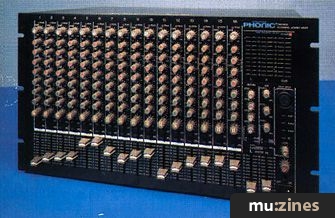
You don't often come across a mixer offering 24 channels for under £1000 — but that's exactly what's contained within the sleek black frame of the Phonic PMC 2402A. Derek Johnson sounds it out.

There comes a time in every studio owner's life when the number of inputs on his or her mixer is less than the number needed on a mix — leaving the choice of trading up to a bigger desk, possibly at a financial loss, or adding a submixer. A new range of mixers from Phonic gives you the choice of either option, offering conventional flatbed mixers and rack mixers of different sizes. While all the models are nominally stereo, the range does have one or two tricks up its collective sleeve that help facilitate multitrack recording, albeit with a little ingenuity.
The Phonic PMC 2402A under review provides 24 inputs for under a grand, making it a very attractive proposition, especially for those who are outgrowing the often less than ideal mixers found on most cassette-based multitrack systems. It is also ideally specified for those who record direct to stereo, or have more than two or three multitimbral sound sources. In addition, three stereo auxiliary returns make available a total of 30 inputs at mixdown.
Physically, the PMC is a very solidly built desk with a spacious layout, the downside of this solidity being that the desk is also quite heavy (21kg) — of more concern live than in the studio.
Ring For A Brochure!
This may be partly due to the very welcome internal power supply, but is mainly attributable to the rugged nature of the construction, fabricated from sheet steel in modules of four channels each. Rear mounted sockets help keep the cabling tidy, but make it more difficult to plug things in and out unless you work with a patchbay.
Let's take a brief look at the features available on the 2402. All the following, with the exception of number of input channels, holds true for the whole Phonic flatbed range, which comprises 8:2, 12:2, 16:2 and 24:2 mixers.
PMC 2402A Facilities
- 24 Inputs: All 24 inputs have both mic and line inputs, making this a very versatile mixer for live, home recording or MIDI studio use. The input gain is -60dB to -20dB with a switchable 30dB pad which affects both the mic and line inputs. There's also a peak LED on each channel which flashes 3dB below clipping.
- Three Auxiliary Sends: Three aux sends seems like a fair number, but note that aux three is hardwired prefader for use as a monitor or cue send. Aux 1 and 2 are dedicated post-fade sends for use with effects. Aux three could be used for limited sub-grouping, if needed, by turning the channel fader down and sending the signal to the Aux 3 output where it could be recorded to tape. Aux 3 is wired post EQ, so any channel EQ settings also apply to the Aux 3 signal.
- Three-band EQ on input channels: The Phonic's EQ features a swept mid, although this is not unexpected on desks in this price range. One nice touch is that the stereo returns also feature a three-band EQ, albeit without the sweep on the mid band, which is especially useful if they are being used as additional stereo line inputs to handle MIDI instruments and so on.
- Scribble Strip: Don't underestimate this feature. It allows you to keep track of what's going into the mixer, and with 24 channels, you'll need to keep track. The scribble strip is often left off mixers with a far more upmarket pedigree, forcing the user to make do with strips of 1-inch masking tape.
- Input Connections: Connections are available on balanced XLRs for mics, and unbalanced jacks for line level signals (synths, samplers and so on). Unusually at this price, XLR mic inputs are provided on all channels, unlike some mixers which offer them on only some of the input channels. This feature may well make the PMC attractive to live engineers on a budget who need to use a lot of mics at any given time.
- Insert Points: All input channels feature insert points, again unlike some other desks that might be seen as the Phonic's competition. Not only can insert points be used to treat the signal of each input individually (with compression, noise gating, effects), they can also provide a direct output for each channel, which would allow up to 24 channels of a multitrack tape recorder to be fed directly from the mixer. (To do this you'd need to use the channel input gain trim to set the record level.) Insert points are also to be found on the stereo master outputs, allowing the final mix to be compressed, gated, limited or what have you before being sent to a mastering machine or live PA.
- 48V Phantom Power: All mic inputs feature phantom power, for use with condenser microphones. This a global feature — it is either on for all channels or off. This could cause problems if you use a mixture of unbalanced dynamic and condenser mics, though dynamic mics wired for balanced use can cope with phantom power. Phantom power can also be used to power DI boxes in a live (or studio) situation.
- Talkback Facility: The PMC is unlikely to be used as the sole mixer in a studio with separate control room and recording area, so being able to plug in a talkback mic may not seem to be a useful feature. However, in a live (or live recording) situation, a talkback mic is extremely useful. An XLR mic input is provided for this purpose and can be routed to any of the auxiliary busses or the main stereo output.
- Cue: All inputs and aux returns feature a cue button which sends the pre-fader, post-EQ signal to either the headphones or the main stereo outputs. The Cue LED bargraph in the master section shows the pre-fade signal channel level, which makes it easy to optimise each channel's input trim setting for minimum noise and distortion.
- Sub Inputs: Amongst the other connections on the PMC's back panel are inputs for all three aux busses and the main stereo buss, which makes the PMC very easy to integrate into an existing setup with another desk. The buss access means that two desks could make use of the same set of effects processors, and that you only have to use one set of master stereo faders when mixing. However, the lack of a dedicated two-track facility means you have to be careful when using a mastering recorder, so that you don't create a feedback loop which connects the tape machine's inputs to its own outputs.
Shortcomings & Solutions
One of the PMC's shortcomings is its lack of subgroups for comfortable multitrack work; many budget stereo mixers offer an alternate stereo buss that allows simple sub-grouping of a sort to be achieved — so that you could, for example, mic up a drum kit and group the drums, in stereo, down to two channels of your tape recorder — and this isn't implemented on the Phonic. However, since aux three is actually pre-fader, it could be used to provide a mono off-tape monitor mix of what you want to subgroup simply by feeding the output of the multitrack into the appropriate number of input channels, and then setting up the cue balance using the Aux 3 channel controls. This might sound like a bit of a fiddle, but with a little ingenuity and the odd bit of repatching, you could happily use this desk with a multitrack tape machine.
Perhaps a more important omission is that channel mute switches have not been provided, making it impossible to simply mute a single drum part or bass part, for example, when balancing before a mix. Any muting will have to be done at your sequencer (if you use one) or by pulling the relevant faders down — not an elegant solution. However, channel muting can be added to desks without the facility quite cheaply these days, with an external MIDI controlled module (simply patch in via the insert points).
In Use
To get a better idea of the PMC's sound quality relative to another mixer, I played several pieces off DAT through the PMC and through my own mixer in parallel. As could be predicted by the Phonic's 20Hz-20kHz specified frequency response, compared to my desk's 20Hz-40kHz, the Phonic sounded warmer and slightly less transparent. However, subjectively its sound is still very pleasant.
On the EQ front, the Phonic's centre frequencies of 100Hz (low) and 10kHz (high) are conventionally chosen, though the 80Hz/12kHz used by my own mixer seems a little more flexible. The swept mid-range control makes the EQ quite versatile and the overall quality of the EQ is good as long as it is applied in moderation.
To see how well the PMC 2402A acquits itself in practice, I used it as sole mixer on a six-hour recording session. As expected, the pre-fade auxiliary came in very handy for putting guitars and vocals onto individual tape tracks and bouncing tracks — particularly groups of backing vocals. The inserts also added to the ease of the sessions, both for individual input or tape track compression and noise gating, and as direct outputs, since plugging a mono jack halfway in allows the inserts to be used in this way. I was able to assemble a relatively complex demo in a short period of time, and it sounded pretty good too.
The faders have a longish throw and seem a bit stiff at first, but in practice this firmness is reassuring, since it takes a really definite move to change their position. Also reassuring was finding the scribble strip above the faders, rather than immediately below where it's so easy for track notes to get wiped by stray forearms. Also on a practical level, the master LED bargraph meters are large and informative.
As is almost always the case with budget mixers, I found that distinguishing whether the cue buttons were in or out was a bit tricky since the buttons are black on a black background, and the desk lacks cue LED indicators. In other respects, it's friendly and easy to operate.
Electrically, I feel the PMC's crosstalk performance could be better — there is some breakthrough at various points in the signal path (when using the cue buss, for example), but not enough to be a serious concern; you need to be running pretty loud to actually notice it. Indeed, the noise contribution is adequately low and the majority of my noise problems during this session were digital hiss from synth modules, breaths, pops, unwanted chatter and so on. The PMC 2402A was a pleasure to use, and presented no insurmountable problems — a little thought and planning is all it takes. Even though this mixer isn't designed as a recording mixer, the session went smoothly and such workaround measures that had to be used didn't significantly inhibit the creative process. What's more, the desk actually has a very good basic sound; it's warm and musical with no obvious sonic vices. The mic amps were also a surprise for a budget desk: they are very quiet in operation and don't seem unduly prone to overloading on signal peaks, which implies that they are designed with adequate headroom.
Conclusion
Though it's not an unusual desk in terms of concept, the PCM 2402A offers an unusually good compromise between cost, features and overall flexibility. It is a general-purpose desk, which means that if you use it for recording there must be some compromises, but for the musician working with four or eight tracks, and wanting to record, mainly, one or two tracks at a time, it isn't as restrictive as you might think.
Phonic PMC 2402A Mixer
- Mic amps and insert points on all channels.
- Phantom power.
- Good overall sound quality.
CONS
- No mute switches
- Only two post-fader aux sends
PERFORMANCE 8/10
VALUE FOR MONEY 8.5/10
For the more active, gigging musician, or budding live engineer there is limited choice in this price range (I could mention similarly-specified desks from other manufacturers which sell for hundreds of pounds more than the PMC 2402A), which automatically puts the Phonic range near the top of the must-try list. The same goes for the MIDI-based musician who just wants to record straight to stereo or the band who want to record directly to DAT without going via multitrack. Hardly a revolution in console design, but good value — absolutely.
Further Information
PMC802A £425; PMC1202A £555: PMC1602A £675; PMC2402A £949. Prices include VAT.
Audio Awareness, (Contact Details).
Brief Specification
Crosstalk: -65dB (1kHz adjacent input channel); -65dB (1 kHz input to output)
Frequency Response: +1/-3dB 20Hz-20kHz (+4dB output into 600 Ohms)
Noise: -128dB Equivalent Input Noise
Full On Desk Hysteria
Do I Want One?
- Need more inputs for your cassette multitracker.
- Are happy with your existing desk but are running out of inputs.
- Want the maximum number of channels for minimum outlay and are happy to use a little ingenuity when multitracking.
- Are a MIDI musician with lots of sound sources, or a band, recording direct to DAT or cassette.
Publisher: Recording Musician - SOS Publications Ltd.
The contents of this magazine are re-published here with the kind permission of SOS Publications Ltd.
The current copyright owner/s of this content may differ from the originally published copyright notice.
More details on copyright ownership...

Recording Musician - May 1993
Review by Derek Johnson
Help Support The Things You Love
mu:zines is the result of thousands of hours of effort, and will require many thousands more going forward to reach our goals of getting all this content online.
If you value this resource, you can support this project - it really helps!
Donations for June 2026
Issues donated this month: 0
New issues that have been donated or scanned for us this month.
Funds donated this month: £0.00
All donations and support are gratefully appreciated - thank you.
Magazines Needed - Can You Help?
Do you have any of these magazine issues?
If so, and you can donate, lend or scan them to help complete our archive, please get in touch via the Contribute page - thanks!
If you're enjoying the site, please consider supporting me to help build this archive...
...with a one time Donation, or a recurring Donation of just £2 a month. It really helps - thank you!

 @mu_zines
 RSS Feed
 Blog
Blog