


Magazine Archive
Home -> Magazines -> Issues -> Articles in this issue -> View
Professional Monitor Company LB1 | |
Transmission Line MonitorArticle from Sound On Sound, September 1993 | |
Paul White looks at a diminutive transmission line monitor that is guaranteed to surprise you with its depth of sound and seamless stereo imaging.
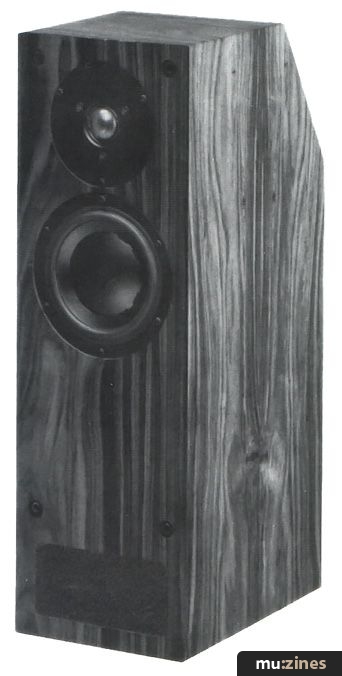
Although the Professional Monitor Company is not a household name, the two men behind the company, Adrian Loader and Pete Thomas, have worked in the pro audio industry for many years and have a wealth of monitor design experience between them. All their current models work on the transmission line principle — instead of a simple ported cabinet, the rear of the bass driver is loaded by a long, tapering labyrinth, terminating in a port. Their smaller designs use Dynaudio drivers, while their larger systems utilise LF drivers from Volt and ATC, with tweeters from Vifa.
Because of its transmission line construction, the LB1 is a little taller, compared to its width, than most two-way near-field monitors, although it is still deceptively small. Indeed, the makers claim it to be the smallest transmission line speaker in production. Considering the power handling and bass extension of this two-way system, the drivers, both made by Dynaudio, are incredibly small — the bass/mid unit measures under 4.5 inches (110mm), with a 3-inch (75mm) voice coil, while the high frequencies are handled by a 1.1 inch (28mm), soft dome tweeter featuring double chamber construction.
Interestingly, the bass driver is built using a slightly unorthodox magnetic system, where the charged pole is in the centre of the voice coil and the non-charged metalwork placed on the outside of the gap. This provides a high degree of natural magnetic shielding without the need to resort to compensating magnets, making the monitors highly suitable for use in a video post-production environment.
SENSITIVITY
The Professional Monitor Company have opted for a 12-element, 4th order passive crossover that provides a steep, 24dB per octave slope. Crossover frequency is 2.5kHz. Unlike many monitoring systems, where the phase of the tweeter drive signal is inverted to provide a smooth phase transition at the crossover point, both drivers are driven in phase. The quoted frequency response extends from 35Hz to 30kHz, which, considering that the cabinet measures just 7 x 21 x 10 inches, is impressive, given that the sensitivity is still a creditable 89dB for 1 Watt at 1 metre.
Input is via Speakon connector — removing its mounting plate exposes the crossover, which is connected to the drivers via tightly fitting spade connectors. Two unpluggable links convert the system for bi-wiring should this be necessary. The crossover circuit board is designed using Phillips capacitors and precision ferrite-cored inductors. Though these tend not to be fashionable in hi-fi circles, the designers have conducted extensive tests with both air-cored and their own ferrite-cored inductors and have been unable to measure or subjectively perceive any difference in performance. The use of this type of inductor has the advantage of allowing a crossover of this complexity to remain reasonably compact.
PERFORMANCE
With the speakers mounted on rigid stands in order to place the tweeters at head level, the performance of these units belies their physical size. Amplifier powers of up to 300 Watts a side are recommended, but an impressive SPL can be achieved even with amplifiers as low as 75 Watts per channel. The instantly recognisable strong points of these monitors are the seamless stereo imaging and the deep, but finely controlled bass performance. What you hear is genuine bass, right down to the organ pedal notes. Closer listening reveals a finely detailed, almost three-dimensional sound which allows each individual component of a mix to be scrutinised. Listening to a piece of music in the dark is an extraordinary experience as there is no clue as to where the sound is coming from — individual sound sources appear to hang in the air in front of you, quite independent of the monitor position.
Despite the highly detailed sound presented by these monitors, their performance is surprisingly smooth, the only tiny flaw being a minute degree of 'splashiness' somewhere in the 8kHz region. Apparently this is a characteristic of the Dynaudio soft-domed tweeter used in the system, but I must emphasise that the aberration is so slight that it is easily overshadowed by the tonal change that results when changing from one amplifier to another. Indeed, the artifact was only noticed when running the speakers from my Yamaha 2075 amplifier which, although a competent design, seems to emphasise high frequency harshness.
Another strong point of these monitors is that the stereo image doesn't fall apart as soon as you move from the ideal listening position. The overall tonality remains neutral, even when you move way off axis, which suggests that the dispersion characteristics are consistent over a wide angle.
SUMMARY
The LB1 has all the attributes required of a main monitoring system for small recording facilities or private project studios, whilst for larger studios, it provides exceptionally accurate near-field monitoring, with the proviso that the speakers are mounted on stands and not perched on the console's meter bridge. The fact that the LF drivers are magnetically shielded also means the speakers can be used in the vicinity of TV and computer monitors.
I am a self-confessed ATC devotee when it comes to monitors, but I must admit that these come very close, and what little they sacrifice in high frequency smoothness (and it is very little), is adequately compensated for by their overall quality, detail, and a bass extension that is out of all proportion to the size of the cabinet or the drivers. Though the Professional Monitor Company doesn't yet have a particularly high profile in the marketplace, I get the impression that everyone who listens to their speakers falls in love with them — and having heard them, I can understand why. While the LB1s cost just under £1000 a pair, they compare very favourably with any competition in the same price range; admittedly the alternatives may offer you a bigger box for your money, but it's the sound that comes out of the box that counts.
Raper and Wayman are the sole UK distributors at the time of writing, though a few selected hi-shops also carry the line. Should you want to audition these speakers in a properly appointed demo room, Raper and Wayman will be only too happy to oblige, but be warned - you'll be reaching for your credit card before the first track has finished playing!
Further Information
LB1 £998.75 inc VAT.
Raper and Wayman, (Contact Details).
LB1 SHORT SPECIFICATION
| Frequency Response: | 35Hz to 30kHz |
| Sensitivity: | 89dB (1 Watt at 1 metre) |
| Impedance: | 4 ohms nominal |
| Recommended Amp Power: | Up to 300 Watts per channel RMS |
| Dimensions: | 180 x 534 x 254 mm |
LB1 MONITORS £998.75
• Compact format.
• Wide frequency range.
• Exceptional stereo imaging.
• Accurate and detailed sound.
• Very efficient for their size.
• Magnetically shielded.
CONS
• Shape makes console bridge mounHng impractical.
SUMMARY
High quality wide range monitor suitable for applications where a very high SPL is not necessary. Recommended for revealing monitor work such as classical or acousHc music, though solid enough to handle pop music.
TRANSMISSION LINE SPEAKERS
Publisher: Sound On Sound - SOS Publications Ltd.
The contents of this magazine are re-published here with the kind permission of SOS Publications Ltd.
The current copyright owner/s of this content may differ from the originally published copyright notice.
More details on copyright ownership...

Sound On Sound - Sep 1993
Gear in this article:
Monitors/Speakers > PMC > LB1
Review by Paul White
Help Support The Things You Love
mu:zines is the result of thousands of hours of effort, and will require many thousands more going forward to reach our goals of getting all this content online.
If you value this resource, you can support this project - it really helps!
Donations for June 2026
Issues donated this month: 0
New issues that have been donated or scanned for us this month.
Funds donated this month: £0.00
All donations and support are gratefully appreciated - thank you.
Magazines Needed - Can You Help?
Do you have any of these magazine issues?
If so, and you can donate, lend or scan them to help complete our archive, please get in touch via the Contribute page - thanks!
If you're enjoying the site, please consider supporting me to help build this archive...
...with a one time Donation, or a recurring Donation of just £2 a month. It really helps - thank you!

 @mu_zines
 RSS Feed
 Blog
Blog