Get it out of your System - (The best that is) (Part 1)
Home Studio
(HSR Mar 86)


Magazine Archive
Home -> Magazines -> Issues -> Articles in this issue -> View
Readers' Systems | |
How to competeArticle from Home & Studio Recording, September 1986 | |
Robin Clarke discusses his choice of recording equipment whilst explaining how he stayed within his budget.
The second of this occasional series in which you are given the chance to describe exactly how you made the most of your money when equipping your studio.
Calling all those of 'straitened' means. Are you penniless? Are you feeling a little left out of current developments in synth and drum machine areas?
A couple of months ago as the owner of an SCI Pro 600, Roland Bass Line, TR808, Portastudio and DDL, pessimism set in as to the possibility of competing with the stylish, sophisticated music making systems described in the pages of magazines such as this one.
The problem was that my MIDI Pro 600, whilst an undeniably fine instrument could not be triggered by older Roland equipment such as the aforesaid TB303 and TR808 and vice versa.
Also, having used the same gear for two years or more, I was feeling the need for some kind of change, this being, as we all know, a refreshment and incentive in itself.
What to do
I felt that I needed some kind of sequencing and syncing system along the lines of those which I had read about so often. For our purposes let's assume you are in a position similar to mine as it was then. In other words you own an analogue synth and not much else.
The first step is to sell or auction as much of the 'and not much else' as seems reasonable, jettisoning anything liable to be of no use in a newer set-up, bear in mind that man cannot live by food, drink or music alone.
The first problem therefore is finance. Figuring that a sum of £1000 would be the minimum needed I advertised my TB303 and TR808 to provide a little floating income in case of earthquake, insolvency, dementia and so on. Then I read up, sought expert advice (shops, friends, contacts) and started to formulate my ideas. Finally, in the absence of anything else I made an appointment with a bank to put the situation to them.
The point is, the current day bank is far more sympathetic to this kind of scheme that some of you may think. It's not hard to figure out the reasons for this. The music industry is actually one of Britain's more fruitful concerns at the moment from an investors point of view. Whilst banks may not be leaping over themselves to pour in major sums, the chances of a small bank loan are good and a repayment rate of £10 per week is probably a fraction of what you might lay out for the likes of cigarettes, alcohol, entertainment. At some stage in this world you have to speculate to accumulate.
A well argued case, business-like and positive manner plus any type-written facts, figures will invariably help. Failing this, parents, savings and blackmail demands may work for you. Looking positively, the £1000 is already in your pocket. So what next?
I figured roughly £500 as my limit for the sequencing end, leaving the other half for the MIDI drum machine and additional synth to complement my Pro 600.
In this region there are a few possibilities for sequencing but I soon found that I was talking computers. So far a home computer and software seems to beat anything Roland and Yamaha (or anyone else) have thrown at it. Accordingly I plumped for the Steinberg Pro 16 allied to the Commodore 64 computer.
The result was 16 glorious polyphonic tracks of MIDI sequencing suitable for the most professional of applications. And the cost?
C64: £140
Disk Drive: £145
Interface: £135
Steinberg Software: £90
Total: £510
Ten pounds over budget but well worth it I can assure you. Connect all this spanking new gear to your TV set and you are really in business.
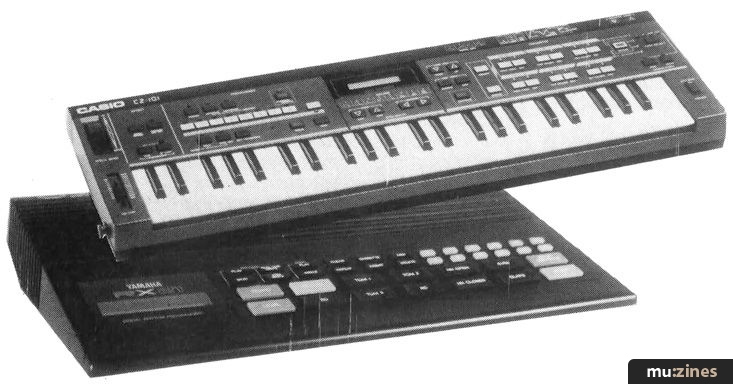
Now for your MIDI drum machine. Bearing in mind that you only have £490 left it's a pretty straightforward choice between Yamaha's RX21 and the Roland TR505. At the time I went for the RX21 since it was in the shops (the Roland wasn't) but now the TR505 seems to represent incredible value (16 PCM voices!). Both these units are limited only by their lack of individual outputs and tape sync, but I wasn't too worried by this since the whole beauty of a sequencing set-up is that in the studio, having safely stored your songs and rhythm parts on disk you can trigger any MIDI synth or drumbox to hand via MIDI. Your material can be updated or altered at any time and played back on borrowed, hired or new equipment. What is important is that you have the instruments to compose on. Anyway my RX21 set me back £220 having hunted out the best deal I could find. So with your sequencer and drum unit combined adding up to roughly £730 you are left with money to play with.
As an alternative to a Club 18-30 holiday I would suggest the Casio CZ101 synth, available at around £200 if you really shop around. This little cracker gives you four monophonic voices all playing different sounds or acts as a completely normal eight or four voice polyphonic keyboard. For this kind of money it really is an unbeatable bargain. Furthermore it's particularly suited to bright percussive sequence lines, bass sounds and percussive effects.
Also for us analogue synth owners it's phase distortion system gives you wide coverage of the FM/Wave type colours that work so well mixed with older analogue sounds.
So there you are. Your old instruments supplemented or replaced by a state of the art fully professional, flexible and above all simple and rewarding to use system, and with the utmost capacity for expansion into sampling, MIDI effects, expanders on receipt of your first recording advance.
More with this topic
 |
 Getting into Video (Part 1) |
 Home Studio Recordist |
 Home Taping - Steve Waye |
 At Home In The Studio - Adam Asiz |
 At Home in the Studio - Living Dangerously with 'Doors' |
 Readers' Systems - From SOS to 8-track |
 Getting Your Priorities Right |
 At Home In The Studio - Zsa Zsa |
 Home Taping - Is Skill In Music |
 Studio Layout |
 At Home in the Studio - Recording on a Budget |
Browse by Topic:
Home Studio
Publisher: Home & Studio Recording - Music Maker Publications (UK), Future Publishing.
The current copyright owner/s of this content may differ from the originally published copyright notice.
More details on copyright ownership...

Home & Studio Recording - Sep 1986
Donated & scanned by: Mike Gorman
Feature by Robin Clarke
Help Support The Things You Love
mu:zines is the result of thousands of hours of effort, and will require many thousands more going forward to reach our goals of getting all this content online.
If you value this resource, you can support this project - it really helps!
Donations for October 2026
Issues donated this month: 0
New issues that have been donated or scanned for us this month.
Funds donated this month: £0.00
All donations and support are gratefully appreciated - thank you.
Magazines Needed - Can You Help?
Do you have any of these magazine issues?
If so, and you can donate, lend or scan them to help complete our archive, please get in touch via the Contribute page - thanks!
If you're enjoying the site, please consider supporting me to help build this archive...
...with a one time Donation, or a recurring Donation of just £2 a month. It really helps - thank you!

 @mu_zines
 RSS Feed
 Blog
Blog