
Roland R8M - Total Percussion Sound Module
(MT Apr 90)


Magazine Archive
Home -> Magazines -> Issues -> Articles in this issue -> View
Roland R8M | |
Total Percussion Sound ModuleArticle from Sound On Sound, April 1990 | |
Sequencer owners rejoice! Roland have taken the 16-bit PCM sounds from their popular R8 drum machine, put them in a convenient rackmount case, and added extra slots for ROM and RAM cards to produce a beat-box par excellence. David Brenton reports.

I've been buying Roland drum machines for about 10 years, starting with the CR78. Anyone remember that? I went through the Drumatix and the TR808, and I even had a TR909 for a couple of months before I switched to Yamaha in search of something better. Things certainly improved as the years went by, and once I started using C-Lab's Notator at the end of 1988 instead of a QX1 sequencer, the programming side of things took a positive turn in the right direction. Now Notator is on software version 2.2 and I can get it to play just about any drum part, with any feel I want, and I know I'm not alone in choosing this way of working. However, I've always been dissatisfied with aspects of each of my drum sound sources.
I've had a great deal of admiration for Roland's R8 drum machine since it was released over a year ago, and have been very close to buying one on more than a couple of occasions. But what I really wanted was a unit I could put in a 19" rack and take to work without having to unplug it from the mixer at home, reconnect it at the gig, and then rewire it once I got home so that it would be ready for work the next morning. (This might sound like nit-picking, but doing this five or so times a week soon adds up to a lot of wasted time, not to mention wear and tear.) I felt sure some manufacturer would come up with something suitable that I could rack up and leave wired in, but apart from Akai's XE8 drum expander (16-bit, 8-voice, £299) nothing came close to what I wanted. I considered an Akai S900 sampler (8-note polyphonic; 32 notes resident in memory) but it didn't cover everything I wanted it to do - specifically, it took about 40 seconds to load a new disk.
I had all but given up hope when, one morning in late February, I was on the point of parting with my hard-earned cash and adding an R8 to my system - simply in order to use its sounds - when I heard the first whispers of the Roland R8M rackmount drum module. There were promises of post-Frankfurt delivery, which I'm sure we've all heard too many times to take seriously any more, but I thought I'd check it out all the same. You've got to be a bit of an optimist to survive in this business, so I rang Roland UK tentatively hopeful but quite prepared for my hopes to be dashed. Wonders never cease: the existence of the R8M was confirmed, and to top it all Roland had already sent a few units out to dealers.
A couple of phone calls and a demonstration later, and I was convinced. I heard it, I bought it, and I put it in my rack. By early evening I'd wired the R8M into the multicore, made space for it in my MIDI patchbay, and I was happy. After 10 years of buying Roland drum units, they've finally made the one I wanted in the first place - and what a clever thing it is, too. Let me say now that it isn't a drum machine at all, only a sound source with a few special features. But those sounds and features are, I suspect, the very ones a lot of musicians will want to get their hands on and ears around.
HARDWARE
The R8M is housed in a 1U rackmount box reminiscent of the U110/D110, although having fewer buttons on the front panel - something necessitated by the lack of space due to the four card slots. There's a Volume control situated between a Phones input socket and the two-line/32-character backlit LCD, the contrast of which can be altered to suit the angle of view. To the right of the front panel are the four card slots (for PCM cards 1-3 and RAM card), the Power on/off pushbutton, and a MIDI message indicator - something included on most Roland gear but lacking on my GR50 guitar synth interface, and there have been a couple of occasions when I would have been glad of its inclusion.
On the back panel are the stereo output jacks, six 'multi-out' jacks, plus MIDI In, Out, and Thru sockets. Unlike the R8, the power supply is not a separate item, which means it's one less thing to worry about. For those of you contemplating adding the R8M to an existing 19" rack, it weighs 4.5kg and its power consumption is 15W.
SOUNDS
Sounds are what the R8M is really all about and there are 68 of them, all 16-bit/44.1 kHz PCM samples, held in internal memory. These include nine kick (bass) drums; 14 snares; three sets of four toms and the excellent 'doom tom'; open, closed, and pedal hi-hats; and an assortment of cymbals, congas, and percussion. One of the many ways in which the R8M scores over the R8 as a sound source is in its ability to access three of Roland's ROM cards simultaneously, thereby increasing the number of sounds available at any one time to 146 (each card contains 26 sounds). The R8 and R8M share the same internal sounds but the R8 can only access one card at a time, and while the 68 internal sounds are on the whole excellent, there are certain drum sounds 'missing' from the basic selection.
At present there are six R8 Sound Library ROM cards available, and by combining the internal sounds with those from three cards the range of sounds available should cover most eventualities (depending on the style of music). For example, in making up a percussion track I find that I like to use sounds from both the 'Contemporary Percussion' and the 'Ethnic Percussion' cards as a complement to the internal sounds. For a dance track I like to use sounds from both the 'Electronic' and 'Sound Effect' cards. For a jazz track, both the 'Jazz' and 'Jazz Brush' cards would be almost essential in order to have access to all the sounds of a jazz drum kit - and if things developed into a Latin mood, I'd want to use the 'Contemporary Percussion' card as well.
There is also an excellent acoustic bass fiddle, a fretless bass, and a synthesizer bass available on the 'Jazz Brush', 'Jazz', and 'Electronic' cards respectively. A reliable source at Roland assures me that there will be more cards appearing this year, and while more sounds will no doubt be a bonus, they will be no more than icing on what is already a very tasty cake.
I expect this strikes a familiar chord in the hearts of those who already own an R8 and have often wished they could access two or more cards at once, rather than having to run a track more than once in order to get all the drum sounds they want down on tape. When performing live with an R8, there has hitherto been no alternative but to compromise on the sounds available or to use more than one machine. But with the R8M in your armoury, it would be quite possible to get through the whole gig without having to change ROM cards once.
MANIPULATING THE SOUNDS
The pitch of each PCM sample can be altered to differing degrees over a span of four octaves. Each sound can be assigned to the stereo outputs, with seven panoramic positions to choose from, or it can be routed to any one of the six multi-outs. The output level can also be set independently for each sound. By judicious use of the Nuance, Decay, and Velocity Curve parameters, most of the sounds can be tonally altered to make a very realistic facsimile of the different sounds a drum/cymbal makes, depending on where or how hard they are hit.
Roland have also included a feature they call Assign Type, which is split into Poly (allows sounds to continue decaying 'naturally' once triggered), Mono (cuts off previously triggered sounds when a new sound is triggered), and Excl-8 (Exclusive 1-8). The latter is a very well thought out option, since it allows sounds to be assigned to one of eight groups and instruments sharing the same Exclusive number will not sound together. An obvious example of this is assigning an open and closed hi-hat to the same group, so that while the rest of the kit goes on decaying au naturel, the hi-hats will interactively cut each other off to give a sense of realism to the part. Internal sound 68 is actually a musical rest (silence), so using it in conjunction with the Assign Type parameters can provide gated drum effects and muted toms and cymbals.
"After 10 years of buying Roland drum units, they've finally made the one I wanted in the first place - and what a clever thing it is, too."
Once a sound has been tweaked to exactly the right degree, it can then be assigned to any MIDI note from 21 (A0) to 108 (C8). Sounds can also be layered by assigning two or more of them to the same MIDI note. This function alone brings into play a whole new range of sonic possibilities, and while I can't imagine anyone but the most pedantic programmer finding it a problem, it should be remembered that the R8M is 12-note polyphonic. Roland have even provided something for the person who has everything and wants more: two or more R8Ms can be 'stacked' in order to increase polyphony and the number of accessible cards.
ARRANGING SOUNDS INTO KITS
Groups of sounds can be arranged into Patches. A Patch, in this instance, is a way of combining a variety of sounds from both the internal memory and any of the three (optionally) inserted ROM cards into compatible groups. The sounds are stored in a Patch along with their parameter settings and note assignments. It doesn't take a very big stretch of the imagination to see the possibility of making up exactly the right kit for each individual song, storing it as a Patch in one of the 32 internal memory locations or in one of the 32 memory locations available on the optional RAM card, and recalling it whenever it is needed again.

MIDI MATTERS
Roland have really gone to town on the MIDI spec of the R8M. It has obviously been designed with the sequencer user very much in mind and the range of programmability and MIDI functions is extremely comprehensive. It is possible to be quite specific about how MIDI information controls a variety of features on the R8M.
As well as being able to set a basic MIDI control channel for the whole system, it is also possible to set up to four independent receive channels. This makes it possible, say, for the fretless bass on the 'Jazz' card to be assigned to one channel, some congas to another (making possible different tuning effects of similar or the same sounds), a basic five-piece kit to a third channel, and a ride cymbal with different Nuance settings (to simulate how it's hit, remember?) could be assigned to a channel all of its own, so that different parameter settings of the same cymbal could be played from different keys or pads. Pitch Bend, Modulation, Key Follow, and Note-Off messages can also be made to contribute to the flexibility and sonic capabilities of the R8M.
System Exclusive transmission and reception of all the important memory functions is also possible (and easy to understand), and this could be stored/recalled at the start of each sequencer track, as part of the song, without any difficulty at all. Since the basic sounds themselves are resident in the machine and on the cards, the amount of SysEx information that has to be sent down the MIDI cable is kept to a minimum. (No, you can't dump the PCM sounds themselves to disk and avoid the additional purchase of the cards!)
FEEL FUNCTION
This is the facility on the R8 which prompted Roland to subtitle their top-of-the-line drum machine a 'MIDI Human Rhythm Composer', and they've wisely included it in the R8M. There are two types of Feel function: 'Regular' and 'Random'. They can be programmed to interact with incoming sequence data to add variations to the tone, velocity, pitch, and decay of the sounds, thus mimicking the variations made by a drummer or percussionist who naturally hits the instruments at subtly different places and with varying degrees of a heavy or light hand/stick/mallet.
The various parameters for the Feel function together make up a Feel Patch, and these can be stored in 16 dedicated memory locations (twice as many as on the R8), allowing 16 different ways of altering the dynamic feel of your music in this time-saving and effective way. There is space on a RAM card for storing 16 extra Feel Patches and, as if you haven't guessed already, Feel Patches can also be transmitted and saved (to a sequencer, data recorder, etc) as System Exclusive data.
The R8M's Feel function is an excellent tool to add to your arsenal of rhythm programming techniques, and although it won't make a poor rhythm track sparkle, it will certainly make it less monotonous. Using the Feel function well on a good track can only enhance it and may even add that last little bit of something that makes the difference between "Wow!" and "Yeah, that's good. Who's making the coffee?".
R8 OR R8M?
For me there was no choice between the R8 and the R8M, since I do all my rhythm programming with C-Lab's Notator sequencing package and use a velocity-sensitive keyboard instead of drum pads when the situation dictates it. I don't need the tape sync facility of the R8, as I have the C-Lab Unitor that works with the sequencer. The R8M wins hands down on MIDI functions, memory locations, sound access, convenience and portability. True, it doesn't have the Flam/Roll function found on the R8 - but I can live without it, and with sensible programming can even get around it.
"Roland have obviously spotted the gap in the market that's existed for some time now, and have filled it with a product that's going to be hard to beat."
If you like working with a drum machine, despite having a good sequencer package, I suggest you weigh up the advantages of the R8M against the disadvantages of learning a new way of working. It wouldn't take long to make a switch which, on the face of it, may appear time-consuming but in practice would have other advantages built in. If your time is worth a lot of money, why not consider buying both? (The R8M's sounds are fully compatible with the R8.)
If you own neither drum machine nor sequencer, it will have to be the R8 if you want these drum/percussion sounds, since the R8M has no internal sequencing facilities of its own. You can't construct patterns or rhythm tracks with the R8M alone, since it is no more than its title states: a Total Percussion Sound Module.
VERDICT
For what it offers, at £599 I don't think the R8M is unduly expensive - but then I remember paying more five years ago for a Yamaha RX11 than I just paid for the R8M and three ROM cards (and no, I didn't get any special concessionary price). Roland have obviously spotted the gap in the market that's existed for some time now, and have filled it with a product that's going to be hard to beat.
Using the R8M to its full capacity, with three PCM cards installed and a little time spent acquainting oneself with the operating system, you have 146 basic sounds to work with - and that's before you start creating variations of your own!
The R8M may have been a long time coming, but it's been worth the wait. You don't have to take my word for it either... just listen to the sounds.
FURTHER INFORMATION
£599 inc VAT.
Roland (UK) Ltd, (Contact Details).
ROLAND R8M
- 68 internal PCM drum samples.
- Further 78 sounds accessible from three optional ROM cards (26 per card).
- 16-bit, 44.1 kFiz PCM samples.
- 12-note polyphony.
- 32 Patch memories; additional 32 on optional RAM card.
- Real-time control of Feel and Nuance parameters for 'humanisation' effects.
- Stereo outputs (jack), plus 6 separate outs.
- MIDI In, Out, Thru.
- Compatible with SN-R8 Sound Library cards.
- £599 inc VAT.
- Further 78 sounds accessible from three optional ROM cards (26 per card).
- 16-bit, 44.1 kFiz PCM samples.
- 12-note polyphony.
- 32 Patch memories; additional 32 on optional RAM card.
- Real-time control of Feel and Nuance parameters for 'humanisation' effects.
- Stereo outputs (jack), plus 6 separate outs.
- MIDI In, Out, Thru.
- Compatible with SN-R8 Sound Library cards.
- £599 inc VAT.
Also featuring gear in this article
Featuring related gear
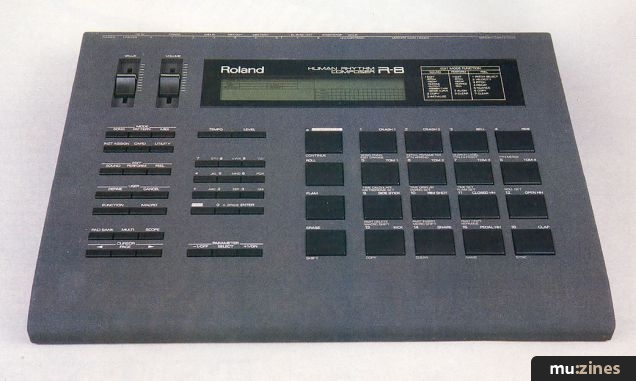
Roland R8 - Human Rhythm Composer
(MT Feb 89)

Roland R8
(HSR Mar 89)
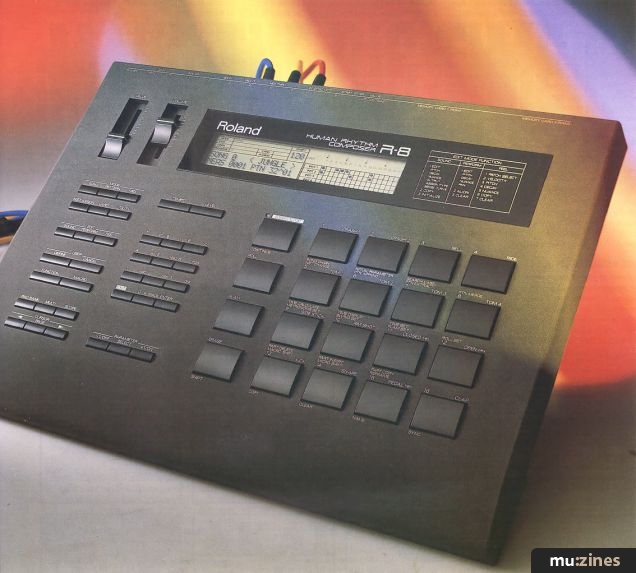
Roland R8 Rhythm Composer
(SOS Feb 89)
Browse category: Drum Machine > Roland
Publisher: Sound On Sound - SOS Publications Ltd.
The contents of this magazine are re-published here with the kind permission of SOS Publications Ltd.
The current copyright owner/s of this content may differ from the originally published copyright notice.
More details on copyright ownership...

Sound On Sound - Apr 1990
Donated by: Bert Jansch / Adam Jansch
Review by David Brenton
Previous article in this issue:
Next article in this issue:
Help Support The Things You Love
mu:zines is the result of thousands of hours of effort, and will require many thousands more going forward to reach our goals of getting all this content online.
If you value this resource, you can support this project - it really helps!
Donations for August 2026
Issues donated this month: 0
New issues that have been donated or scanned for us this month.
Funds donated this month: £0.00
All donations and support are gratefully appreciated - thank you.
Magazines Needed - Can You Help?
Do you have any of these magazine issues?
If so, and you can donate, lend or scan them to help complete our archive, please get in touch via the Contribute page - thanks!
If you're enjoying the site, please consider supporting me to help build this archive...
...with a one time Donation, or a recurring Donation of just £2 a month. It really helps - thank you!

 @mu_zines
 RSS Feed
 Blog
Blog