

Magazine Archive
Home -> Magazines -> Issues -> Articles in this issue -> View
Seiko MR1000 Sequencer | |
Article from Music Technology, February 1991 | |
Sequencing has never been this cheap: can a dedicated sequencer that only costs 40 quid actually work? Debbie Poyser goes sequencing on a shoestring.

Image credit: James Cumpsty
IN THESE INFLATIONARY times, 40 quid will buy you precious little; a couple of bottles of Moet, perhaps, the merest sniff of Giorgio - heady pleasures, but sadly transitory. If you want something more enduring, however, that same 40 quid will buy you a compact, unpretentious MIDI sequencer going under the unlikely banner of 'Seiko'. Don't be deterred by the fact that they've made your wristwatch - Casio started out making calculators.
The MR1000 isn't new by any means - the date in its slim but informative manual explains that 1985 was the year of its birth, but since a particular retail outlet is currently selling a quantity of these sequencers at the jaw-dropping price of £39 including VAT, you ought to know what this baby can do.
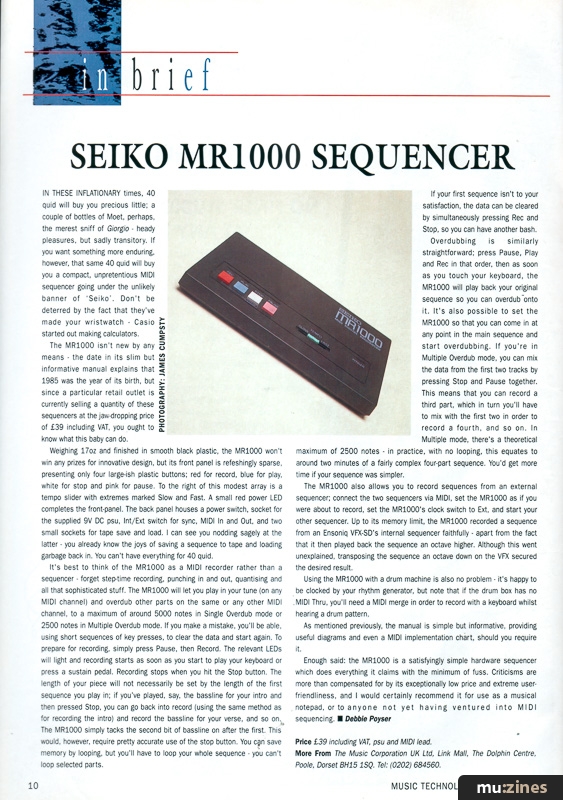
Weighing 17oz and finished in smooth black plastic, the MR1000 won't win any prizes for innovative design, but its front panel is refreshingly sparse, presenting only four large-ish plastic buttons; red for record, blue for play, white for stop and pink for pause. To the right of this modest array is a tempo slider with extremes marked Slow and Fast. A small red power LED completes the front-panel. The back panel houses a power switch, socket for the supplied 9V DC psu, Int/Ext switch for sync, MIDI In and Out, and two small sockets for tape save and load. I can see you nodding sagely at the latter - you already know the joys of saving a sequence to tape and loading garbage back in. You can't have everything for 40 quid.
It's best to think of the MR1000 as a MIDI recorder rather than a sequencer - forget step-time recording, punching in and out, quantising and all that sophisticated stuff. The MR1000 will let you play in your tune (on any MIDI channel) and overdub other parts on the same or any other MIDI channel, to a maximum of around 5000 notes in Single Overdub mode or 2500 notes in Multiple Overdub mode. If you make a mistake, you'll be able, using short sequences of key presses, to clear the data and start again. To prepare for recording, simply press Pause, then Record. The relevant LEDs will light and recording starts as soon as you start to play your keyboard or press a sustain pedal. Recording stops when you hit the Stop button. The length of your piece will not necessarily be set by the length of the first sequence you play in; if you've played, say, the bassline for your intro and then pressed Stop, you can go back into record (using the same method as for recording the intro) and record the bassline for your verse, and so on. The MR1000 simply tacks the second bit of bassline on after the first. This would, however, require pretty accurate use of the stop button. You can save memory by looping, but you'll have to loop your whole sequence - you can't loop selected parts.
If your first sequence isn't to your satisfaction, the data can be cleared by simultaneously pressing Rec and Stop, so you can have another bash.
Overdubbing is similarly straightforward; press Pause, Play and Rec in that order, then as soon as you touch your keyboard, the MR1000 will play back your original sequence so you can overdub onto it. It's also possible to set the MR1000 so that you can come in at any point in the main sequence and start overdubbing. If you're in Multiple Overdub mode, you can mix the data from the first two tracks by pressing Stop and Pause together. This means that you can record a third part, which in turn you'll have to mix with the first two in order to record a fourth, and so on. In Multiple mode, there's a theoretical maximum of 2500 notes - in practice, with no looping, this equates to around two minutes of a fairly complex four-part sequence. You'd get more time if your sequence was simpler.
The MR1000 also allows you to record sequences from an external sequencer; connect the two sequencers via MIDI, set the MR1000 as if you were about to record, set the MR1000's clock switch to Ext, and start your other sequencer. Up to its memory limit, the MR1000 recorded a sequence from an Ensoniq VFX-SD's internal sequencer faithfully - apart from the fact that it then played back the sequence an octave higher. Although this went unexplained, transposing the sequence an octave down on the VFX secured the desired result.
Using the MR1000 with a drum machine is also no problem - it's happy to be clocked by your rhythm generator, but note that if the drum box has no MIDI Thru, you'll need a MIDI merge in order to record with a keyboard whilst hearing a drum pattern.
As mentioned previously, the manual is simple but informative, providing useful diagrams and even a MIDI implementation chart, should you require it.
Enough said: the MR1000 is a satisfyingly simple hardware sequencer which does everything it claims with the minimum of fuss. Criticisms are more than compensated for by its exceptionally low price and extreme user-friendliness, and I would certainly recommend it for use as a musical notepad, or to anyone not yet having ventured into MIDI sequencing.
Price £39 including VAT, psu and MIDI lead.
More From The Music Corporation UK Ltd, (Contact Details).
Publisher: Music Technology - Music Maker Publications (UK), Future Publishing.
The current copyright owner/s of this content may differ from the originally published copyright notice.
More details on copyright ownership...

Music Technology - Feb 1991
Review by Debbie Poyser
Ads for Gear in this article:

Help Support The Things You Love
mu:zines is the result of thousands of hours of effort, and will require many thousands more going forward to reach our goals of getting all this content online.
If you value this resource, you can support this project - it really helps!
Donations for August 2026
Issues donated this month: 0
New issues that have been donated or scanned for us this month.
Funds donated this month: £0.00
All donations and support are gratefully appreciated - thank you.
Magazines Needed - Can You Help?
Do you have any of these magazine issues?
If so, and you can donate, lend or scan them to help complete our archive, please get in touch via the Contribute page - thanks!
If you're enjoying the site, please consider supporting me to help build this archive...
...with a one time Donation, or a recurring Donation of just £2 a month. It really helps - thank you!

 @mu_zines
 RSS Feed
 Blog
Blog