


Magazine Archive
Home -> Magazines -> Issues -> Articles in this issue -> View
Soundcraft Series 200 8-4-2 Mixer | |
Article from Home & Studio Recording, February 1984 | |

The name of Soundcraft is synonymous with high quality mixing consoles designed for the professional studio and broadcast markets. It therefore comes as a welcome surprise to find a similarly high quality, well-designed mixer, aimed at the home recording and audio-visual markets, bearing the same company's name and at a price below £1000.
The Series 200 mixer reviewed here has already proved to be a winner with audio-visual production companies, having only been available for some eight months. It is a compact, portable stereo mixer available in 8, 16 or 24 input channel configurations, and in its 8/4/2 format is ideally suited to the home recordist looking for a versatile, top quality unit to match his/her 4-track tape recorder, as we shall see.
Modular
The Series 200 range offers a modular construction that allows the user to purchase only the number of channels he requires, whilst leaving him with the option of adding further inputs when money permits and as necessary.
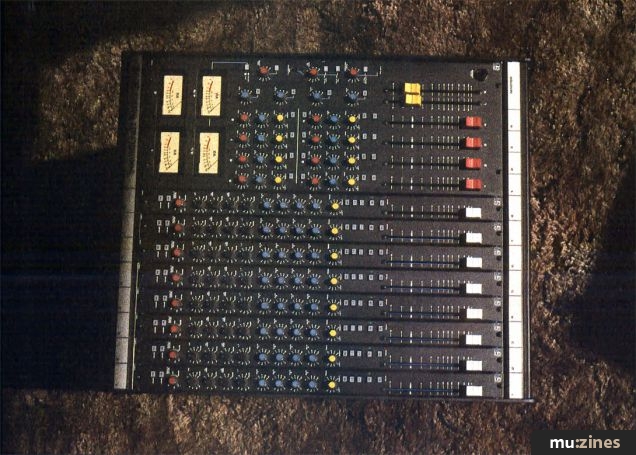
The 8/4/2 version is a mere 19 inches wide and can fit into a standard rack if need be. It is well constructed from a steel chassis with a black satin finished case and brown front panel. All connections are on the rear panel, electronically balanced with ¼" jack and Neutrik connectors. A separate external power supply connects via a screw lock connector to the rear panel, both cutting down the possibility of hum generation and enabling the mixer to remain compact and thus extremely portable.
The front panel has black nylon strips with wipe clean plastic insets for channel identification, running the full width of the mixer both top and bottom. This means you can identify channel input sources or alternatively whatever is connected to the Insert jack on every input or output, making life a lot easier when 'problem' noises start appearing, say, and you wish to trace what is connected the what.
The panel layout from left to right is inputs 1 to 8, group outputs 1-4 and master Left and Right mix outputs. Four large VU meters, which could do with being angled more towards the user, indicate the group outputs, tape return inputs and monitor outputs depending upon the selection of certain buttons.
Inputs
Each of the eight channels has a 20dB pad selector to attenuate excessively high microphone signals, and a mic/line switch with variable input gain pot. Signals then pass to the four band equalisation section whose controls all have a centre detent for flat response (full marks Soundcraft) and which give a generous 15dB of cut or boost in the HF and LF regions, with 12dB for the Hi and Lo Mid controls. Normally I dislike fixed frequency EQ such as this, but the well chosen turnover frequencies of 12kHz, 5kHz, 250Hz and 60Hz are ideally placed to handle most requirements. I don't know what it is about Soundcraft mixers, but their EQ is so smooth-acting, not vicious as with other makes, that it produces a very 'musical' end result. No EQ on/off button is provided but then you'd hardly expect it on a mixer in this price bracket.
Outputs
Down the right edge of the mixer are located the four master Auxiliary Send level controls, each with an associated AFL (after-fade listen) pushbutton that lets you hear the auxiliary only in the headphones, so that you can optimise your signal level feeding into your monitor amps or echo units, so preventing overload.
A button labelled MTR switches the lowest two VU meters over to monitor source, which can come from either the master stereo mix, the PFL or the playback signals from a stereo recorder.
The bottom rotary control governs the level of signals heard in the 200 ohm or more stereo headphones that are plugged into the ¼" jack socket, nicely located at the bottom right corner of the front panel. If the outposts of the mixer are feeding a stereo tape recorder, which will normally be the case during mixdown of a multitrack tape, the off-tape signal can be played back into the headphones by switching over the 2-track Replay button. Doing so whilst actually recording onto tape will enable a comparison to be made between the original (source) input and the recorded signal for quality check purposes. This is known as 'A/B testing'.

What you also wouldn't expect to see would be four auxiliary sends, but these are what you get! Most newcomers to recording fail to realise the importance of having as many auxiliaries as possible, but they are the clue to flexible mixing. Auxiliaries 1 and 2 are dedicated pre-fade sends, which means you can send your input to monitor speakers via the auxiliaries without having your master fader pushed up. In a live situation or for broadcast purposes this means you have some way of cueing sounds. These sends are also suited as foldback sends for onstage or in the studio monitoring.
The last two auxiliaries logically enough are fixed post-fade and will generally serve as echo and effects send level controls. In a crude way, stereo foldback or echo send can be obtained using two auxiliaries per channel, panned hard left and right. This can often be beneficial when doing overdubs too.
The final knob as always is the Pan control which determines the balance of input signal sent to the group outputs. Unfortunately, due mostly to cost considerations, the Series 200 has limited input routing facilities. You can only assign your input to groups 1 and 2 or 3 and 4; not to both and not at all directly to the stereo master outputs.
This is not as limiting as it may first appear, as generally speaking, most people are unlikely to be recording one input signal onto all four tracks of their multitrack. However, what they may wish to do is record a rough stereo mix at the same time as laying the multitrack parts, which is currently only possible by routing to the group pair and then routing the groups to the master mix; but you can live with it.
A 'bonus' channel on/off switch with green status LED indicator; a peak overload LED (red), and a prefade listen (PFL) facility completes the input channel apart from the extremely smooth, long throw (100mm) Alps fader. The beauty of a long fader, for the uninitiated, is the degree of fine level control it provides, for you have a greater distance over which to move the fader for the same change in volume.
All faders are colour-coded allowing immediate recognition of inputs (white) groups (red) and masters (yellow). The latter two are closely spaced so that only one fingertip will move both faders equally - an important consideration when trying to fade out a stereo recording whilst twiddling with some effect unit's controls, for example.
Because PFL cuts all other inputs apart from that selected, some form of indication of whether this has been done is required. The red Solo LED below the headphone level provides this facility, and is a simple but necessary device. A 1kHz test tone is built into the Series 200 which is automatically routed to all group and master outputs upon depression of the Slate button, and thus to the inputs of the attached tape machines for calibration and line-up purposes. There's little point in having VU meters on devices if you can't rely upon them, so both sets of meters (on the mixer and tape recorder) need to be set to read the same levels identically. This is achieved using the test tone which is of a very pure frequency stable.
Monitors
The remaining controls govern the group output and monitoring facilities available on the Series 200. The four groups are usually connected to their respective track on the multitrack recorder, and the record level set by the fader amount. Although there are only four groups, a full 8-track monitoring system is provided with individual level, auxiliary send, pan and PFL controls. The 4 or 8-track monitoring is possible by connecting the tape return signals to the eight Return jack sockets on the rear panel. These sockets also act as input returns for the auxiliaries if required, as no separate echo return is provided.
Returning to the front panel monitor section, the lower four channels feature a button labelled RET which assigns the playback signal from your multitrack recorder to the monitor channel instead of the normal group output. The very final button, labelled SUB, lets you route the group directly into the master stereo output mix set by the faders whilst simultaneously assigning control of that respective monitor channel level to the group fader (now designated a subgroup). This operation is similar to the 'fader reverse' function on the Soundtracs 16/8/16 reviewed last month, and means that you can fade out a group of several instruments combined with any effects returns just on one fader instead of several.
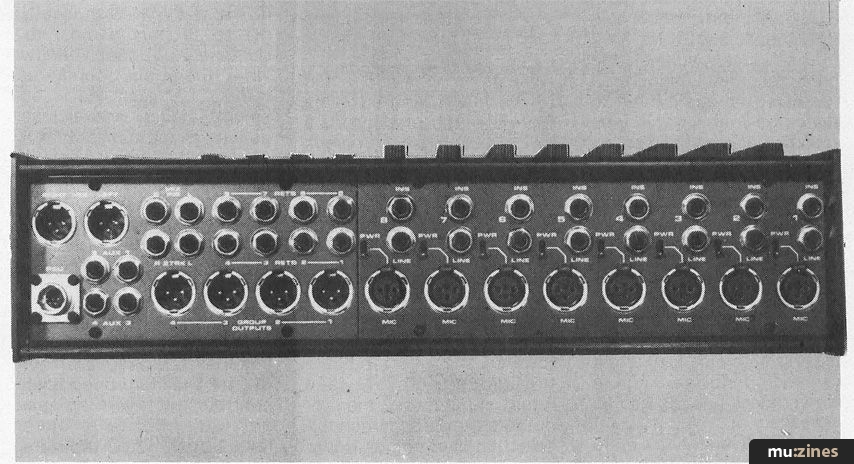
Rear Connections
The rear panel is neatly laid out, giving balanced, latching XLR connections for mic inputs and line inputs on standard jacks. 48 volt phantom powering is switchable at the rear and comes standard on every model.
A really useful bonus on the Series 200 is the inclusion of an Insert send/return on stereo jacks, for all eight inputs as well as the Left and Right mix channels. These provide individual connection opportunities for effects devices, so that only that input will be effected. This increases flexibility and maximises resources, as it means the auxiliary echo send facilities are still available for 'overall' treatments such as reverb, with proportionate amounts possible on each input using the Aux Send amount control to determine the mix of 'dry' and treated signals.
Group and master stereo outputs are by XLR male sockets whilst jack connections for the four Auxiliary outputs and 2-track tape return complete the rear panel. However, no mention has yet been made of the monitor outputs that are usually provided to feed the control room speakers. The reason for this is because there aren't any! You have to either do without; feed them from the main stereo mix outputs (which means you can't do a rough stereo mix unless you use split leads to feed both speakers and tape machine inputs), or take an output from the headphone socket (the most likely one).
Connections
My overall impression of this mixer is a good one. It is compact, lightweight and very well laid out with everything at hand and just where it should be. The colour coding makes sense for once and the wipe clean dual strip is such a thoughtful inclusion. It's these little touches that quickly tell you that the designer(s) of this mixer actually know what's required. The ultra-smooth faders are exemplary, and add a touch of class to the unit (although they do lack dust covers in their grooves). The pots are small, but large enough to utilise conveniently, whilst the beige on brown legending is easy to read with no glare from the panel face.
Criticisms of the mixer would include the disappointing input routing facilities and the oversight on monitor outputs. Set these against the extremely low inherent noise level, the nonexistent channel crosstalk and virtual lack of distortion and you begin to build up an image of a superb mixer. I almost neglected to emphasise that superlative equalisation once again, which I found so comfortable and satisfying to work with.
Considering the onboard bonus features (and despite the lack of some basic ones) the Soundcraft Series 200 represents excellent value for money. Soundcraft have recently celebrated their first ten years as a company; if they go on building and designing mixers like the Series 200 then they'll still be around to celebrate the next ten!
The 8/4/2 sells for £1092.50 inc VAT and power supply.
Details from Soundcraft, (Contact Details).
Featuring related gear
Sound Craftmanship
(HSR Jan 86)

Soundcraft 200B Mixing Console - Studio Test
(IM Jan 86)

Soundcraft Series 200B
(SOS Nov 85)
Browse category: Mixer > Soundcraft
Publisher: Home & Studio Recording - Music Maker Publications (UK), Future Publishing.
The current copyright owner/s of this content may differ from the originally published copyright notice.
More details on copyright ownership...

Home & Studio Recording - Feb 1984
Donated & scanned by: Mike Gorman
Gear in this article:
Review by Ian Gilby
Ads for Gear in this article:


Help Support The Things You Love
mu:zines is the result of thousands of hours of effort, and will require many thousands more going forward to reach our goals of getting all this content online.
If you value this resource, you can support this project - it really helps!
Donations for April 2026
Issues donated this month: 0
New issues that have been donated or scanned for us this month.
Funds donated this month: £0.00
All donations and support are gratefully appreciated - thank you.
Magazines Needed - Can You Help?
Do you have any of these magazine issues?
If so, and you can donate, lend or scan them to help complete our archive, please get in touch via the Contribute page - thanks!
If you're enjoying the site, please consider supporting me to help build this archive...
...with a one time Donation, or a recurring Donation of just £2 a month. It really helps - thank you!

 @mu_zines
 RSS Feed
 Blog
Blog