


Magazine Archive
Home -> Magazines -> Issues -> Articles in this issue -> View
Stand & Deliver | |
Peavey Bandit 112 Guitar ComboArticle from Sound On Stage, February 1997 | |
Redesigned to include Peavey's TransTube vacuum tube simulation, the Bandit 112 combo is capable of delivering up to 80 Watts RMS into its 8 Ohm speaker. John Harris plunders its features to find out whether it's a steal.
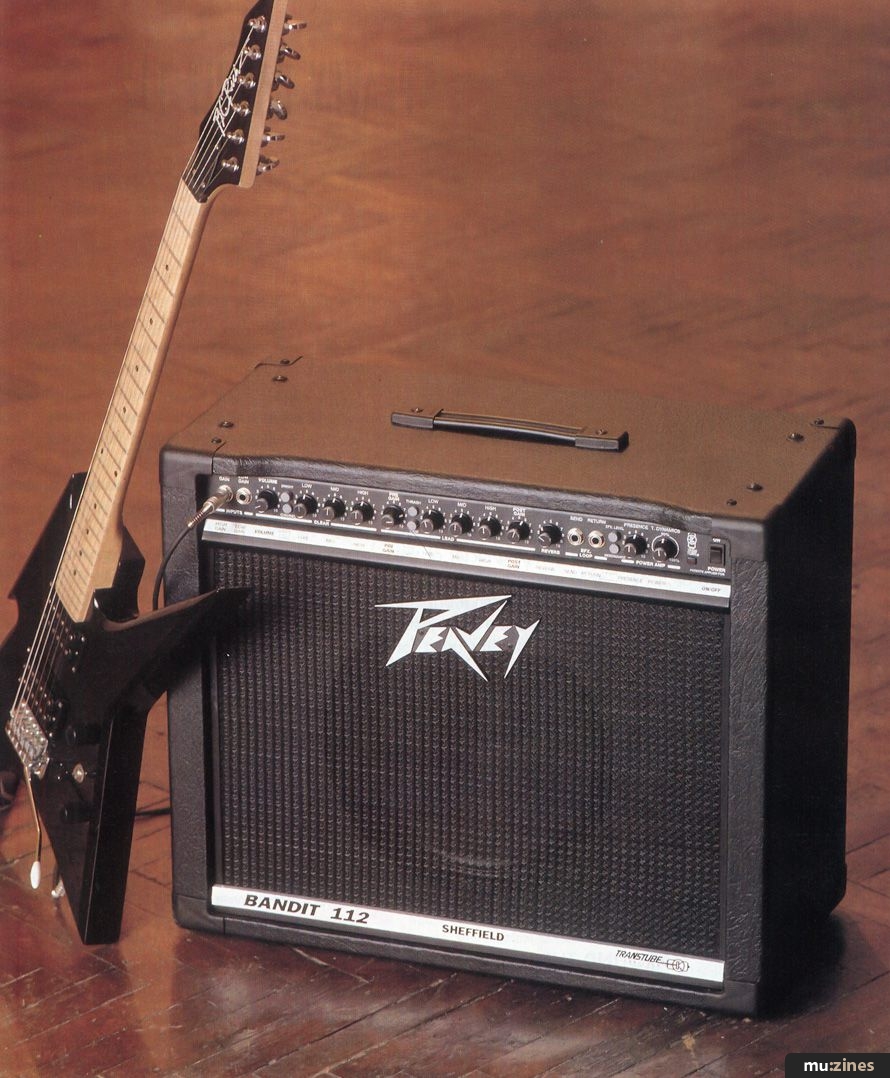
Peavey seem to be one of the most hard working companies when it comes to developing new products and improving older ones. Such is the case with the new Bandit 112 combo, delivering up to 80 Watts RMS into its single 8 Ohm speaker. This medium-sized package has been totally redesigned to include Peavey's TransTube vacuum tube simulation.
Why another transistor amp that attempts to copy the characteristics of a valve amp? Apparently, the world's guitarists demand the sound of valves without the hassle that often goes with them, not to mention the difference in amplifier weight! And there is a big difference for those, like myself, who are used to carting around valve combos and amp heads. The Bandit weighs 46.5lbs, even though the combo is above average size for a 1 by 12 and will fit into the back of a car quite easily.
For the TransTube design philosophy, Peavey have opted to try and re-create the compression effects of a valve amp power stage. Consequently, the Tube simulation circuitry is located at the power stage of the amp, while its dynamic effect on the power stage can be varied on the front control panel. Add to this some clever low frequency resonance EQ and Presence, and you have what Peavey claim to be the closest tube amp simulation to date.
THRASH AND GAIN
The Bandit is based around a standard twin design of clean and dirty channels but has some additional extra gain and EQ features thrown in for good measure. Two inputs are provided for high and low gain signals; both revert to low gain if two instruments are plugged in.
Moving directly to the Overdrive channel, as you do, the first control that springs to attention is the Pre Gain. Having given the amp a sound going over, I can report that in practice there's more than enough overdrive available to move from a Blues style hint of edge to full on screaming lead guitar. You're not going to find it all using the Pre Gain alone though. This starts to kick in at a relatively high 6 on a scale of 10 for Blues guitar drive moving to a respectable lead sound with some bite and clarity on 10 — but this amp has the ability to go that bit further!
For overdrive maniacs, the Gain switch on the overdrive channel boosts the overall system gain into a creamy overdrive, which also provides even more sustain. With the amp cranked up, but by no means flat out, controlled feedback effects are easy to get and the sound is rich in harmonics — all of which can be governed in level by the Post Gain. It's a shame that there is no added footswitch control of the extra gain boost. If you want to move straight from the clean to the overdrive and gain channel, it needs to be permanently selected. Even so, basic channel switching (with the footswitch provided) can be preset using the Post Gain level to give you plenty of lift when moving from rhythm guitar to lead. This is extremely useful when playing at smaller venues when the guitar isn't miked up through a PA system. For times when you want to practice your best licks and riffs at home, the extra gain switch will probably be left on permanently.
This amp's ability to produce treble is going to endear it to Funk, Country and Western, and Thrash guitarists, but it can occasionally lead to some fizz in the top end of the distortion, especially when using a typical Strat sound. However, you can deal with this and most other problems by using the passive low, mid, and high EQ controls. A treble and mid cut, plus a slight bass boost, seems to do the trick, whereas for guitars fitted with humbucking pick-ups, it's not really necessary to cut the treble. You may be surprised that I mentioned using a mid cut for the Strat, but in actual fact, to my ears, the frequency of the mid control seems to be fairly high and can have an active role in the upper mid-range when sounds get a bit sharp.
If rock guitar is your taste, don't think that this amp is not for you. The cunning Thrash switch cuts in a severe notch filter effect of -20dB at 1 kHz. This effectively gives you a more familiar classic heavy rock sound. Combined with a little more wide band cut, using the passive mid control, the sound has plenty of string attack on the bass notes for riffing. For both riff and lead playing, I'd recommend using the extra gain switch — as indeed Peavey do in their short manual.
"Versatility is the name of the game here..."
CLEAN AND BRIGHT
The Clean channel features a single volume control, low, mid, and high EQ, a bright switch, and a channel switch. It's worth pointing out that the channel change footswitch won't work until the lead channel is selected on this front panel switch. Of course, if I'd read the manual, I wouldn't have spent two minutes trying fruitlessly to change from clean to overdrive! My advice: read the manual beforehand!
The low frequency control on its own is something of a disappointment. Even at full boost it was merely adequate; it didn't seem to be enough to make the combo sound bigger. The rest of the EQ, which is basically well thought out, covers the needs of most guitars. For example, I've already mentioned the abundance of treble, which is well suited to Country guitar, especially when out-of-phase or coil-tapped pick-up selections are used. In addition, the Bright switch is useful for giving a tough, brittle edge to a rosewood fretboard, making it sound more like a maple one for funk grooves with some attack. At high volume levels, the treble is more pronounced. For the single coil pick-ups of a Strat, it hardly seems worth having the bright channel for clean guitar, unless you've got the oldest strings in the world with a field of potatoes hanging off the underneath of each one! However, the Gibson I tried sounded wonderful with this extra 6dB of treble boost at 2kHz. This is positive, because it means that the Bandit isn't just suitable for one sort of guitar style in the way some other amps can be. At lower listening levels, some brightness is nice, but Jazz guitar, for example, benefitted from some bass boost and treble cut.
The mid frequency seemed to be centred a little higher than I expected but was nevertheless useful. Boosted for Blues and cut for nearly everything else, I was able to get a wide range of sounds, and with slight modifications, the settings suggested in the manual worked out well.
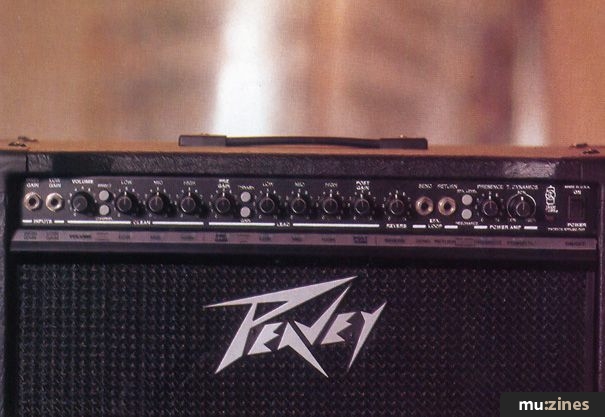
The Bandit even has an extra row of angled legend just below the front panel so that you can identify controls quickly from above in a gig situation.
All the above examples, whether clean or overdriven, benefitted in some way from the TransTube technology.
TUBE DYNAMICS AND EXTREMES
The Tube Simulation Dynamics control is designed to work by adjusting the power level of the amplifier between 100 and 10% power. This doesn't mean that the actual level of the amp is greatly altered, but at lower settings, the power compression simulation should be much more pronounced. In layman's terms, it should sound like hot power valves coping with plenty of signal, smoothing out and fattening the sound with some valve compression. I was quite surprised at the subtlety of the effect at low listening levels, believing that it was going to be quite extreme at a 10% power setting. I venture to suggest that to the untrained ear it might just seem that some of the treble is being lost. The effect is more noticeable at extreme overdrive settings, where the guitar sounds outlined above were distinctly improved. Cranked up to a more extreme gig or rehearsal level, where the power amp has to work harder, the effect comes into its own. The more I tried the amp, the more I warmed (if you'll pardon the pun) to the sound. The compression effect becomes more obvious, and there is a clear drop in output level at extreme settings, so some care needs to be taken when choosing a setting. I found that at between 70 and 40% the Tube Dynamic yielded the best results.
Undoubtedly, the Resonance control plays a big part in convincing the listener that they are listening, not to a wimpy 1 by 12, but to a much bigger cab! It can add up to +6dB in lower frequency cabinet resonance by varying the damping factor of the amp. To be honest, once you've heard it, you're hooked and you won't want to switch it off. The metal sounds become full bodied and chunky, the clean sounds brilliant for pop, and it's great for Blues too. The amount of effect didn't seem to alter whether the Tube Dynamics were set low or high.
The Presence control is less necessary in this business of creating a valve amp illusion. Personally I think it's replacing what may be cut when the Tube Dynamics control is used at its most extreme. Yet old valve amps never had vast amounts of treble anyway so for the most part, I found it redundant, especially when trying to create blues and R'n'B style sounds. For more modern sounds, the +6dB boost at 5kHz is effective when used in small quantities.
"As a guitarist who uses both valve and transistor amps, I wouldn't hesitate to use it for medium to small size venues and recording..."
AROUND THE BACK
Unlike its American counterpart, the British Bandit does not feature a ground lift switch. It does, however, have quarter-inch jack sockets for preamp out, power amp in, remote switching, and external speaker.
The preamp out can be used as a feed to the live PA or for a recording console. As the output level will be determined by the amp on some desks, you may need a pad switch on the input stage to deal with the levels that are likely to come out of this amp when it's run hard. My Spirit Folio seemed to cope with the Bandit close to flat out, and that's a pretty standard measure. As usual, clean guitar sounds pretty good, but overdriven guitar is fizzy, without the filtering action of a speaker to cut the bandwidth! Most guitarists, studio and PA engineers will opt for a microphone on the speaker, although the preamp signal can provide a bright alternative in the recording environment. Speaking of which, it's nice to see an external speaker output (100W into 8 Ohms) and easy disconnection of the Peavey's own Sheffield 1230 12-inch speaker. This makes it easy to use a bigger cab with the amp for larger venues, or something like a speaker simulator in the studio.
Versatility is the name of the game here, and the power amp input sees the Bandit opening up its TransTube power amp section to all comers. The power amp input accepts a high impedance signal, which could potentially come from the preamp section of another amp without the benefit of Tube simulation, or even from a guitar preamp unit.
EFFECTS
I've mentioned the channel changing footswitch but paid scant attention to the fact that another switch on the same pedal operates as an effects loop bypass. The effects loop itself can operate at -10dBV or 0dBV, adjustable by a front panel switch. I didn't experience any incompatibility problems here, but you may have to be careful when moving from clean to loud overdrive. The send level is post-EQ and gain.
The internal spring reverb sounds surprisingly good and is easily up to the job for live gigs and basic recording. It's sometimes nice to have a footswitch available for reverb on and off, but for that level of sophistication, Peavey offer the use of a reverb on your effects send and return. This can be bypassed on the supplied footswitch.
CONCLUSION
I could get a lot of good, varied sounds out of the Bandit from smooth Jazz to raucous heavy rock, and for the latter, the resonance EQ would certainly turn heads at a gig. As a guitarist who uses both valve and transistor amps, I wouldn't hesitate to use it for medium to small size venues and recording, but there are some pay offs. While the Tube compression is subjectively better at louder amp levels, this also brings out the harshness of the combo. The answer, of course, is to assess how it sounds at the venue and EQ accordingly.
The Bandit is not the world's most elegant looking amp, but what it lacks in classy looks, it makes up for in extra features, like easy channel switching, useful EQ options on both channels (so many combos have just one set of EQ making it impossible to get both a good lead and clean sound), and a simulated tube compression effect. It even has an extra row of angled legend just below the front panel so that you can identify controls quickly from above in a gig situation. And yes, it can compete with a drum kit, but it would have to be miked up at larger venues. In fact, smaller Peavey amps always sound at their best to me when they're driven hard. One of the best Blues sounds I had from the Bandit was by plugging into the low gain input with a high gain output guitar, running the clean channel gain at maximum, and using the resonance control. This mighty sound was achieved with the Tube dynamic at 100%, which only goes to prove that if the amp sounds good already, you sometimes don't need tube simulation at all.
Bandit 112 £349 inc VAT.
Peavey Electronics Limited, (Contact Details)
pros & cons
pros
- Reasonable tube simulation.
- Separate EQ and level control for clean and overdrive channels.
- Cab resonance control gives extra punch.
- Effects loop bypass footswitch.
- Versatile sounds.
cons
- Slow footswitch action.
- No ground lift.
- No separate DI volume control or DI speaker simulator.
- No footswitch for the extra gain on the overdrive channel.
- Can sound a bit harsh at high levels.
summary
The Peavey Bandit is a versatile combo, suitable for small to medium-sized gigs and recording. Independent EQ and level controls on the clean and overdrive channels are great for gigging, and the resonance EQ gives it a larger than life sound.
Publisher: Sound On Stage - SOS Publications Ltd.
The contents of this magazine are re-published here with the kind permission of SOS Publications Ltd.
The current copyright owner/s of this content may differ from the originally published copyright notice.
More details on copyright ownership...

Sound On Stage - Feb 1997
Review by John Harris
Help Support The Things You Love
mu:zines is the result of thousands of hours of effort, and will require many thousands more going forward to reach our goals of getting all this content online.
If you value this resource, you can support this project - it really helps!
Donations for June 2026
Issues donated this month: 0
New issues that have been donated or scanned for us this month.
Funds donated this month: £0.00
All donations and support are gratefully appreciated - thank you.
Magazines Needed - Can You Help?
Do you have any of these magazine issues?
If so, and you can donate, lend or scan them to help complete our archive, please get in touch via the Contribute page - thanks!
If you're enjoying the site, please consider supporting me to help build this archive...
...with a one time Donation, or a recurring Donation of just £2 a month. It really helps - thank you!

 @mu_zines
 RSS Feed
 Blog
Blog