


Magazine Archive
Home -> Magazines -> Issues -> Articles in this issue -> View
Article Group: | |
The feelgood factor | |
Roland XP-50Article from The Mix, May 1995 | |
Well-equipped new workstation
Roland's XP50 workstation combines the formidable sound source of the JV-1080 with a highly spec'd MC-type sequencer. Danny McAleer forsakes his Atari long enough to appreciate life with one box...

Technological things have always tended towards miniaturisation; compare for instance the epic proportions of the Babbage's 19th century computer with a modern lap-top which practically reorganises your life. With compactness comes complexity and functionality, and the new Roland XP50 has all of these in abundance. It combines powerful synthesis with a comprehensive sequencer, all in the same box; and it doesn't fill up the entire room either.
First impressions
Its top panel is littered with buttons, all logically arranged around a backlit orange-coloured LCD display, and a protruding 3.5" disk drive. The surrounding plastic is moulded in such a way that three disks can be lined up on the disk drive (all ready for your next set), with no fear of them falling into your pint. The modulation/pitch-bend, and three sliders sit underneath the disk drive: volume control, plus two software configurable sliders. These can be assigned to anything from amplitude and filtering levels of individual tones, through to effects levels for the whole patch. Perfect for a spot of live synthesis.
What is really frustrating is that the XP50 offers sixty-four notes of blisteringly good sounds, only to have them all crammed into one pair of stereo outputs. If ever there was an argument for lane widening, this is it. With an extra set of audio outputs, it might then have been possible also to pan the metronome, so that it doesn't appear in the main L/R outputs. This would have made it ideal for live piano playing. Never mind. Other connections include the standard set of MIDI ports (in, out and thru), plus 1/4" sockets for a damper pedal, plus two other user-definable data pedals.
Sequencing
The XP50 features quite a comprehensive on-board sequencer, with which to compose a potential masterpiece. Up to 20,000 events can be recorded over its sixteen tracks, with a maximum length of 9,998 bars. You can either record a song using the GM mode (by switching to it before entering the sequencer), or using a performance patch. Whilst the latter does offer a great deal more in the way of choice timbres, it isn't compatible with the GM program map, and some MIDI files might sound a bit strange. When using a Performance patch in the sequencer it is worth bearing in mind that it must be of the single, rather than the layer variety. Single mode ensures that only one part plays per channel. Selecting a user location is better than a preset, in that any changes made to the patch selection will be made permanent.
Recording is activated by first selecting the appropriate part, and then pushing the record button. This activates the 'record standby', where you can select the record mode from a choice of replace or mix. The start measure can also be chosen in this page, as can the count-in, which can be set to either zero, one, or two bars, or to begin recording when you start playing. It is possible to record more than one part on the same track, so you have to set the destination for your doodle before you begin.
Once or twice during the review, I forgot this, and recorded over some parts (much to my annoyance). It is theoretically possible to record a whole song with up to 16 parts/channels on the same track, though I dare say you might be sorry you did so, when it comes to editing it afterwards. The best use for this might be in getting around the one-song-in-memory limitation. By squashing all the songs on to a track each, and then muting all the other tracks, it would be possible to load in sixteen at a time.
There are quite a few settings for the quantisation of parts. Lurking amongst the usual eighths, sixteenths, triplet and dotted values (and so forth), are ninety, 'groove' templates. These include quantisation settings for rhythms as diverse as 16 beat, shuffle, swing, and samba, as well as specific templates for, 'humanising' parts.
As well as the sixteen normal or rather 'phrase' tracks, the XP50 also has an additional pattern track. This works as a sort of paste clipboard, with a capacity of a hundred patterns, allowing you to copy or cut ideas, and then insert them onto other tracks. This is a fantastic idea, as now you don't have to give up a track for scratch pad purposes. If only the editing was a little less fiddly, and there was a visual representation of parts, sequencing on the XP50 would be a breeze. For more accurate editing of parts, you can use the scope function. This is much like the List edit on computer sequencers, where all the events of a track are listed sequentially. These events can be moved around, deleted, or new ones inserted.
Songs can be saved on disk (up to 99 per disk) in either the SMRC pro format, or as SMF 0 or 1 formats; either that, or dumped via MIDI to a computer sequencer. For this, you'll need to set the XP50's sequencer clock to slave synchronisation. This can also be done in reverse, allowing you to perform edits of the songs on a graphic computer display, before dumping it back again.
More usefully, the disks the XP50 uses are the same format as MS-DOS, which means that you can swap between the XP50 and ST or PC very easily. The drive is compatible with either double density (up to 90,000 events can be stored) or high density disks (180,000 events), the latter having the obvious space advantages, though not being accessible to the standard ST.
The XP50 also has its own proprietary format, which can be played directly from disk, obviating the need to load the song into RAM. Only one song can be stored in RAM at any one time, yet up to 99 songs can be stored on a disk (dependent on the individual size of the files and the disk capacity). Whilst playing from disk has the obvious advantages of faster file access, only songs loaded into RAM can be edited or added to.
Synthesis
The sounds are arranged into four banks of 64 sounds; one user, three preset, plus an additional 128 sound GM configured bank. Each sound, like the LA synthesis method used by the D-series synths, consists of up to four parts or 'tones', which can be layered, velocity crossfaded, or assigned different key ranges to form a composite voice. Each tone can be switched on or off (either temporarily or permanently), its activity status denoted by the corresponding LED on the numeric buttons below the LCD.
Global parameters (where each change affects all tones), are on the first page: These include the patch level and pan, plus an interesting function called 'analogue feel'. What this does is to create a seemingly random (although in reality it is based upon the mathematical modulation ratio 1/f) pitch and amplitude fluctuations. Also here, is an option for changing the clock for functions like the LFO. Stretch places a tuning 'curve', across the sound, allowing the uppermost notes of a chord to be accentuated (making them sharper, whilst flattening the lower notes), giving a richer timbrality to chords.
"It is now possible to individually process sounds internally, rather than a wad of reverb over the whole mix"
The structure menu is divided into two sections; for tone 1 and 2, and for tone 3 and 4. There are ten preset algorithms to choose from, each with varying configurations (see diagram). The most basic of all is algorithm #1: tone 1 and 2 run completely in parallel, each having their own WG (or sample), filter and amplitude envelopes, and aren't mixed at all.
Algorithm #10, by contrast, has a winding path of elements, adding in a ring modulator just for good measures. The ring modulator can be used very effectively to create clanging and metallic noises like bells and other untuned percussion. Ring Modulation works by multiplying the two incoming waveforms together, thus producing new frequencies (or unharmonic overtones), in addition to the existing ones in the resultant waveform. For adding that extra bit of graininess to a sound, the XP50 also has a boost function. This amplifies the incoming signal gain, and when used with the tones' individual amplitude parameters, caused some nasty sounding distortion to occur. Marvellous.
Effects are, whether you like it or not, becoming an integral part of synthesis. With faster and better computer processing, it is now possible to individually process sounds internally, rather than crudely slapping a wad of reverb over the whole mix. With the XP50 it is possible to assign different levels of reverb and chorus, as well as a third definable effect type to each tone. This is an incredibly flexible and expressive system, although these effects parameters do not extend to multi-timbral modes. In these cases, each patch uses the performance's own effects parameters. In the case of algorithms #2 to # 10 where tones re combined, effects can only be applied to groups of tones (1 and 2, 3 and 4), rather than individually.
Sample sources
As is the case with the majority of new synthesisers, the XP50 uses PCM samples as the basis for its sound creation. Up to four different samples can be combined (using the four tones), to make one patch. There are two banks of samples, the first contains 255 sounds: Pianos, guitars, basses, vocals, and other acoustic instruments. Bank B has all the more interesting samples (all 193 of them), with searing synth sounds, raw waveforms like pulses (in varying percentages), sawtooth, square, and sine, plus a huge batch of percussion sounds and drums.
Each sample has its own gain control, which you can either use to merely emphasise certain timbres in a rich patch, or create savage amounts of distortion with. Additional harmonics can be added to the PCMs using Frequency Cross Modulation: The XP50 has parameters for adjusting colour and depth for this, and experimentation can achieve some fantastic results. Tones can also be delayed with respect to key on/off triggers, or by using random or clock times. Using delays on all four partials sequentially, it is possible to effectively create a pseudowave sequence-type sound.
After sample selection comes modulation, courtesy of some variable waveform low frequency oscillators. Each tone has two LFOs, (that's up to eight in total!), which can be used to control pitch, amplitude, pan, and cut off frequency. By setting both of the oscillator values for opposing positive and negative depth values with the TVF settings, you can create some particularly stunning burbling noises.
Transposition of tones within ±4 octaves is possible, as is the detuning of samples by ±50 cents, which is ideal for creating thicker sounds like orchestral ensembles, or analogue synth pads. In addition to these coarse settings, each tone has its own pitch envelope for altering the sound over time. A situation where this might be useful is when creating an ethnic flute sound, where the pitch varies considerably during the attack portion of the envelope. As well as envelopes for pitch, there are EGs for TVF (cut off frequency), and TVA (amplitude). Other functions in the TVF group include resonance, the cut off frequency filter master level, and the type of filter applicable. A choice of High Pass, Band Bass, Low Pass, and Peaking (where the frequencies around the cut off point are emphasised), can be picked from. Also, quite usefully, you can opt to bypass the filter section completely, switching the filter selection to off. The filter can also be made to follow the key range (becoming brighter or duller around a definable centre key), and also made to be velocity dependent. Programming of these parameters properly will create a very expressive, and true-to-life piano patch.
In the TVA group menu, each tone can have its individual volume adjusted, as well as be assigned a position in the stereo bandwidth. Pan can also be made to follow the key pitch, travelling from left to right in the audio field, as the instrument travels upwards in pitch (negative values having a reverse effect). Other rather daft functions include random and alternate panning, which are strictly for the fruitcakes.
Obviously, the challenge with sample-based instruments is not really emulation of workaday instruments (there are plenty of those in the presets), but rather in the creation of off-the-wall abstract patches. Fortunately, the XP50 has a broad range of synthesis options, ensuring that the resultant sound doesn't end up sounding exactly like the PCM it was created from.
But not only are these synthesis functions applicable to patches; the drum sounds too can be synthesised. And unlike some other keyboards that perform these changes on the entire kit, the XP50 can individually edit extensively each drum sound. You can even replace the percussion PCM with an instrument, thus creating a kit that could possibly only be used by someone like the Art of Noise.
Verdict
The XP50 does have an epic amount of good PCMs with which to create sounds; with the added means available to synthesise, it is all the more baffling why Roland decided to give the XP50 just 64 user patches, and so many presets. Why is it that manufacturers insist on having read-only memory locations, when it would be far more useful (and creatively inspiring), if all the patches were write-enabled?! Having said that, the majority of the presets are good. Only on the GM patches, where presumably only one tone is used per instrument, do composite sounds like brass and strings ensembles sound weedy.
Other noteworthy points about the XP50 include the much improved modulation control. It certainly beats the less-than subtle effort on the old D-series synths (where it was a case of modulation on, modulation off), but still isn't as good as a wheel, or the joystick used by the Korg synths. The keyboard itself is of the plastic variety, and some of the more ardent pianists may find it offensive. Personally, I think it's wonderful, and having a software-adjustable sensitivity makes it all the more user-friendly.

The sequencer is nowhere near as easy to use as it was intended; a real shame, considering the advantages of the MS-DOS format drive, its ability to load MIDI files, and the distinct benefit to 'live' performers of playing songs directly from disk. The paltry-sized screen is constantly a hindrance, especially when it comes to editing data, even if it is agreeably coloured orange. But despite all these shortcomings, and a distinct lack of originality in the synthesis technique employed, the XP50 is a keyboard one could get along with nicely, given time. Well endowed with some cracking sounds (particularly the strings, and some of the bizarre synth patches), it's reasonably easy to get something decent out it within a few minutes. The controllability, both in terms of hardware (with aftertouch, and the two user-definable sliders), and software (via MIDI control of patch parameters) are second to none.
The essentials...
Spec check
| Maximum polyphony | 64 notes (or partials)Multi-timbrality, 16 part |
| Keyboard | 61 keys, channel aftertouch, velocity sensitive (adjustable) |
| Disk drive | MS-DOS format 3.5" drive 720k (DD) and 1.44Mb (HD) capacity |
| File formats supported | MRC Pro (proprietary format), SMF 0 and 1, S-MRC (ML series sequencer format) |
| Display | 40x2 backlit display |
| Dimensions (WxHxD) | 1,023 x 348 x 97mm |
| Weight | 9.3Kg |
| Connections | |
| Audio | 1x Stereo pair 1/4" jacks, 1x Headphone socket |
| MIDI | In, 1 Out, 1 Thru Damper pedal, and two assignable footswitch connections |
On the RE:MIX CD

Just to prove that the sequencer does perform miracles given a bit of hard work, here's a demo written entirely on it, which doesn't sound like a herd of rampaging bulls.
Also featuring gear in this article

Publisher: The Mix - Music Maker Publications (UK), Future Publishing.
The current copyright owner/s of this content may differ from the originally published copyright notice.
More details on copyright ownership...
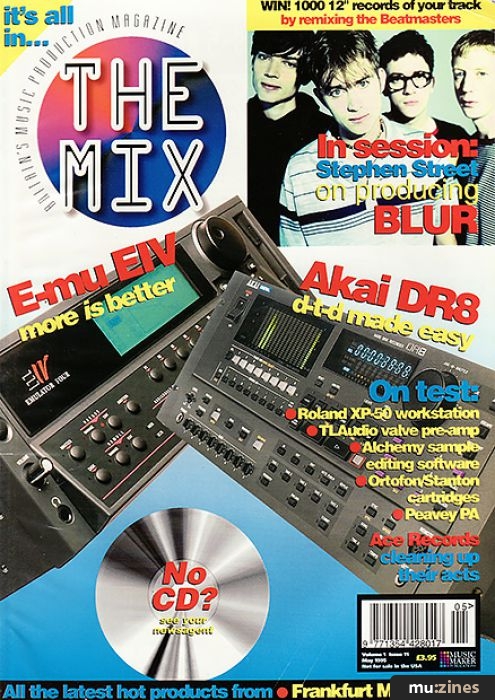
The Mix - May 1995
Donated by: Colin Potter
Coverdisc: Nathan Ramsden
Control Room
Gear in this article:
Synthesizer > Roland > XP-50

Re:Mix #11 Tracklisting:
22 Roland XP50 demo - 1 23 Roland XP50 demo - 2
This disk has been archived in full and disk images and further downloads are available at Archive.org - Re:Mix #11.
Review by Danny McAleer
Ads for Gear in this article:


Help Support The Things You Love
mu:zines is the result of thousands of hours of effort, and will require many thousands more going forward to reach our goals of getting all this content online.
If you value this resource, you can support this project - it really helps!
Donations for June 2026
Issues donated this month: 0
New issues that have been donated or scanned for us this month.
Funds donated this month: £0.00
All donations and support are gratefully appreciated - thank you.
Magazines Needed - Can You Help?
Do you have any of these magazine issues?
If so, and you can donate, lend or scan them to help complete our archive, please get in touch via the Contribute page - thanks!
If you're enjoying the site, please consider supporting me to help build this archive...
...with a one time Donation, or a recurring Donation of just £2 a month. It really helps - thank you!

 @mu_zines
 RSS Feed
 Blog
Blog