


Magazine Archive
Home -> Magazines -> Issues -> Articles in this issue -> View
The Innovator | |
Roland JX8PArticle from Electronic Soundmaker & Computer Music, March 1985 | |
Roland's JX8P poly has a number of innovatory features and sounds great. Too good to be true?
Jim Betteridge examines Roland's new poly synth.

Roland recently entered the touch-sensitive market with their Mother Keyboard and its modular siblings. The JX8P is the next logical step, in that it presents this new touch technology in a complete, self-contained package.
The title, JX8P, is perhaps a little misleading in a couple of ways: contrary to the inclusion of the suggestive '8', this is only a 6-note polyphonic instrument, and if another of you're immediate deductions is that it's probably an improved, touch-sensitive JX3P — you can take yourself off the case; it's more or less a completely new instrument. At £1250 it is £175 more than the '3P, which isn't a great deal considering the extra expressive power it offers.
What might have added weight to your case is the fact that one of the Mother Keyboard's modules, the Planet 30, was described as being basically the innards of a JX3P with touch response; but this new instrument is far from being simply a Planet 30 with its own keyboard.
The '3P' in JX3P apparently relates to the fact that it is Preset/Programmable and Polyphonic. The precise explanation of the '8' would appear to be beyond the ken of the average westener, but apparently there are five extra facilities included that begin with the letter 'P'. Can you spot them, readers?
Beyond Unison
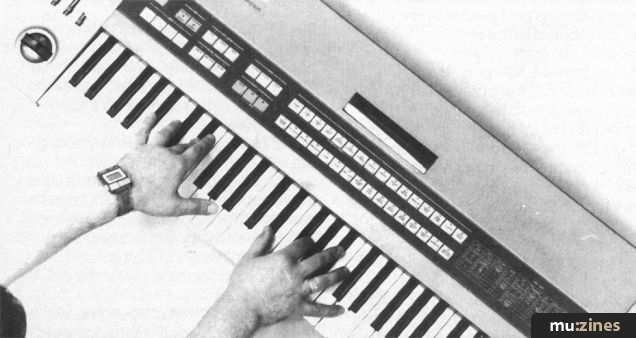
The 5-octave, plastic keyboard is unfortunately non-splittable but includes both velocity and pressure sensitivity. In addition to the standard 'Poly', 'Solo' and 'Unison' modes, pushing the unison button twice puts you into 'Octave Unison', whereby one of the 6 oscillators in each of the two banks operates one octave below the other five, acting rather like an extra sub oscillator.
Each of the two banks of DCO's can produce sawtooth, pulse and square waves plus noise. The pulse wave width can not be modulated and in fact it is not adjustable. DCO's have been criticised in the past for being rather clinical, and with this in mind Roland have, once again, built in an effective chorus unit, this time with two settings. Very effective in creating rich, sweeping textures is the facility to phase-lock either oscillator to the other making possible those rich sounding lead line voicings.
The LFO can create sine, square or random modulation waveforms, and includes delay, rate and depth controls. As with all recent Roland synths, left-right movement of a single performance control lever provides pitch bend, whilst pushing the same lever forward triggers the LFO.
The MIDI implementation is fairly comprehensive and includes Omni and Poly modes. A local on/off switch is included with remote operation of other keyboards in mind. It allows the 8P's voice circuitry to be muted whilst still being able to control remote keyboards, or conversely, it mutes all remote keyboard voices, leaving only its own sounding.
The internal memory includes 64 factory STATIC presets, ie they can't be changed or overwritten, although they can be used as the basis for creating other sounds. An extra 32 internal memories come complete with factory voicings, but they can also be used to store your own sounds, thereby overwriting the factory's presets. There is a standard tape dump facility enabling you to record the complete memory contents on to a standard C format cassette, thereby allowing a complete library of sounds to be built up. This may be a little slow for live, real-time use, however, and so if you need more sounds on stage you can purchase a RAM cartridge that plugs into a slot on the control panel of the synth, into which an extra 32 voices can be stored. It's a substantially more expensive means of storage, but it's fast, reliable and reasonably robust.
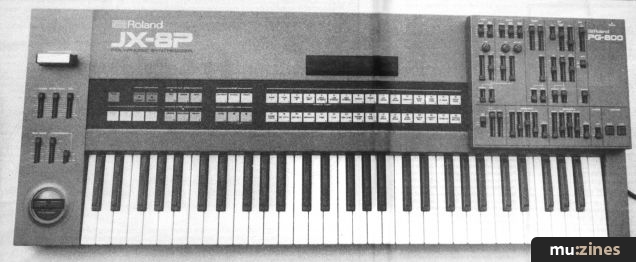
32 membrane buttons are used in 4 different bank modes to select any one of the 128 voicings. The names of the first 32 voicings are written on the buttons, but in order to locate the remaining 96 possibilities some alternative record must be kept. Assistance is at hand in the form of an LCD window in the centre of the control panel displaying various information including the given name of the current voicing. The name of the 64 non-static voices can be changed at will by using a combination of the tone, bank, key mode and after-touch selection buttons in the edit mode, to type in the desired alphanumeric name, up to a maximum of 10 characters.
Cheap or easy?
As with the JX3P, the '8P offers the choice of cost effectiveness and laborious editing, or a little extra expense for the extra control knobs and an easier life: in its basic form, it presents the user with the clumsiness of a centralised digital access control editing system. Each of the control variables is allotted a number between 11 and 95, and a table printed to the right of the control panel gives the relevant details. Adjustment of a variable is achieved in the edit mode by first looking up its number, entering it via tone selection buttons 1 to 9, and then adjusting its value via the centralised incrementor. The LCD display also usefully reminds you of the parameter selected and the current settings etc, even when working on cartridge voice. But like most such digital access systems it's still a bit slow and ungainly for live adjustments.
For a little extra money you can make life easier by purchasing the optional PG-800 programmer unit which magnetically clamps on to the surface of the synth, over where the parameter table is. It is to the '8P much as the PG-200 is to the '3P and offers the direct simplicity of one-control-per-variable editing.
Editing
For the sake of explanation it is easier to refer to the PG-800, although obviously all edit adjustments can be made via the integral digital access system.
There are four main sections on the PG-800: DCO's, VCF, VCA and less commonly, Mixer. The keyboard's velocity sensitivity is applied to each of these sections via a 4-position switch marked 'Dynamics', giving Off, and three degrees of sensitivity — 1, 2 and 3. 'Off' gives a static effect (non-touch sensitive) whilst the other three positions get progressively more sensitive. This is an unusually coarse means of depth control especially considering that one of the complaints with earlier digitally controlled synths was that the control resolution wasn't fine enough, and precluded any of the fine tuning of variables possible by analogue means. Whether this arrangement makes it simpler for the less experienced operator is arguable both ways, but it will possibly appear rather lumpy to anyone used to analogue means or even a more standard 0-99 digital graduation.
The application of after-touch is also somewhat simplified. It can be switched in or out to effect any one of three variables: vibrato, brilliance of volume (LFO, VCF or VCA). Note that it is not possible to bring it to bear on more than one of these at a time which is a bit of shame as VCA and VCF would be a very commonly useful combination. An intensity slider adjusts the amount by which the aftertouch pressure effects the four sections.
A variable key follow facility allows the cutoff frequency of the VCF to alter with the pitch of the note being played. Thus as you play higher up the keyboard, the notes become progressively brighter as is often the case with acoustic instruments. This allows lead and melody lines to cut through left-hand parts clearly.
Mixer
This mixer is in addition to the two normal DCO level slider controls and centres on effecting DCO 2. It provides a means of giving DCO 2 a different dynamic envelope shape by applying either one of the JX8P's two EG's to it. A separate slider then controls the amount of the altered DCO 2 signal that is mixed in with the normal sound.
In practice this can be used to obtain more percussive sounds, especially when applying the keyboard dynamics to control the effective position of the mixer control. A new and useful device.
The voicings still suffer a little from the nasally tendencies of the JX3P, but in general they were definitely much improved, and of course the extra dimension of keyboard sensitivity allowed more precise control. This was one of those 'review at the factory' jobs where we only get an afternoon to find out all. My feeling was that there was probably a lot more to be had from the JX8P after becoming more accustomed to its slightly unusual controls. A whole range of full string sounds and solo bowed voicings could make for impressive multitrack arrangements, with the combination of the touch and pressure sensitivity making it possibly to genuinely articulate different parts, avoiding the trap of the standard 'wash of strings'.
The mixer's facility to apply different envelopes to the two DCO's definitely made a difference to the percussive voicings which were notably strong for such an analogue machine. With a good sequencer the tomtoms, bell and percussion sounds could be used very effectively as parts of a drum/percussion arrangement. A new inclusion is that of choir and voice sounds, which though not too life-like, could make a nice textural addition.
Patch Work
Once you have created your sounds, eight of the more commonly used ones can be stored in what Roland term the 'Patch Chain' which offers certain operational advantages: the contents of the 128 standard memories cannot contain performance control settings such as key mode, after touch, bender range, portamento on/off and portamento time, so that in performance these may have to be reset with each new voicings. The Patch Chain allows up to 8 voicings to be stored in any order, including all performance control details, and then via a pair of forward/backward nudge buttons they can be sequenced through in either direction. A definite plus for stage work.
Overall the JX8P is a strong new instrument from Roland offering some innovative ideas and sounds at a very reasonable price. I don't know about all those P's though.
Also featuring gear in this article
JX-8P: A Player's Guide
(IM Jun 85)

Roland JX8P
(12T Mar 85)

Roland JX8P - Synthcheck
(IM Mar 85)
Roland JX8P
(IT Jun 85)


Sense & Sensitivity - The JX-8P
(IM Feb 85)

Showstopper
(IM Apr 85)


The JX-8P - Creative Synthesis Lives!
(IM Mar 85)

Patchwork
(MT Nov 86)

Patchwork
(MT Mar 87)
...and 1 more Patchwork articles... (Show these)

Program Notes
(MM Jul 86)

Program Notes
(MM Oct 87)
Browse category: Synthesizer > Roland
Featuring related gear

Return of the Big Synth - Roland JX10 Polysynth
(EMM Jun 86)

Roland JX-10 - SynthCheck
(IM Jun 86)

Roland JX-10
(12T Jul 86)

Super JX
(SOS Jun 86)

Patchwork
(MT Jun 92)
Browse category: Synthesizer > Roland
Publisher: Electronic Soundmaker & Computer Music - Cover Publications Ltd, Northern & Shell Ltd.
The current copyright owner/s of this content may differ from the originally published copyright notice.
More details on copyright ownership...

Electronic Soundmaker - Mar 1985
Donated & scanned by: Mike Gorman
Review by Jim Betteridge
Ads for Gear in this article:

Help Support The Things You Love
mu:zines is the result of thousands of hours of effort, and will require many thousands more going forward to reach our goals of getting all this content online.
If you value this resource, you can support this project - it really helps!
Donations for June 2026
Issues donated this month: 0
New issues that have been donated or scanned for us this month.
Funds donated this month: £0.00
All donations and support are gratefully appreciated - thank you.
Magazines Needed - Can You Help?
Do you have any of these magazine issues?
If so, and you can donate, lend or scan them to help complete our archive, please get in touch via the Contribute page - thanks!
Please Contribute to mu:zines by supplying magazines, scanning or donating funds. Thanks!
Monetary donations go towards site running costs, and the occasional coffee for me if there's anything left over!

 @mu_zines
 RSS Feed
 Blog
Blog