


Magazine Archive
Home -> Magazines -> Issues -> Articles in this issue -> View
The Time Machine | |
Time Machine Rack SeriesArticle from Home & Studio Recording, June 1986 | |
Three signal processors that are available either in kit form or ready built.
Three budget signal processors which are available either in kit form or as ready built units.
Time machine are a small British firm whose designs have previously appeared in ETI magazine. Now they have gone into business building and selling the finished product. With the exception of the MicroAmp, all these units require an external ±15v power supply from which to operate and this again can be supplied by Time Machine.
The three products reviewed here are the first offerings from the company but there are already plans to extend the range and we will try to keep you up to date with developments as and when they happen. Instead of going for the popular but expensive 19" rack mounting format, the units are built into rather utilitarian steel boxes measuring 214mm x 44mm x 160mm and finished in a chocolate brown enamel that you'll either love or hate... I nearly said love or eat. Anyhow, without further procrastination, let's kick off with the first contestant.
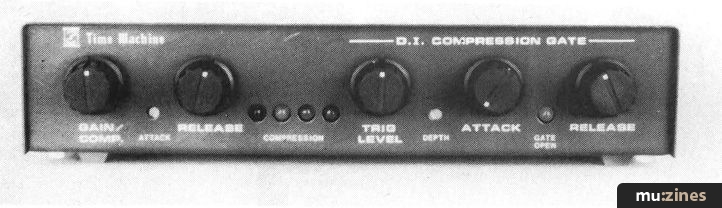
DI Compression Gate
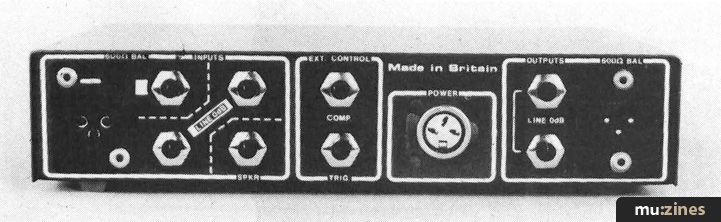
This is a bit of an all rounder in that it offers both compression and gating (mono) whilst allowing the user the option of line, speaker or balanced 600Ω mic inputs on jack or XLR. Similarly, the outputs are well catered for with a choice of balanced and unbalanced, again on both jacks and XLR. Further connections are fitted so that the side chain circuitry may be externally controlled and these comprise a trigger for the gate and access to the compressor enabling an equaliser to be patched into the side chain for de-essing and the like.
The front panel controls are fairly basic in that the compressor has a variable threshold and release time but everything else is fixed. It is however possible to change the attack time by means of front panel screwdriver preset. A simple LED indicator shows how much compression is being applied and the gate section has a bi-colour red and green LED to show when the gate is open. The gate itself has attack and release time controls as well as an adjustable threshold and the depth of attenuation may be varied by means of a preset visible through a hole in the front panel. When the trigger level control is turned fully anticlockwise, the gate is switched off leaving only the compressor in circuit.
If you have ever used a compressor or gate you will find this machine easy to operate though I found that the compressor tended to sound distorted if short release times were set. The gate though had no such vices and worked well. By using the compressor and gate together, the noise between sections of music is eliminated and this can be a great help when levelling vocals.
This unit is probably aimed at the Portastudio section of the market where it will be useful for treating individual tracks but it is too obtrusive in use to compress complete mixes as any bass notes cause the overall level to pump. A useful piece of general purpose budget gear but I can't see the justification for offering balanced inputs and outputs on what is decidedly a budget unit. This only adds to the price which is already quite high for a single channel unit of this quality. You could buy a fully professional modular compressor for this price (though you wouldn't of course get the gate thrown in).
Prices: Kit - £68.70. Ready built - £97.39
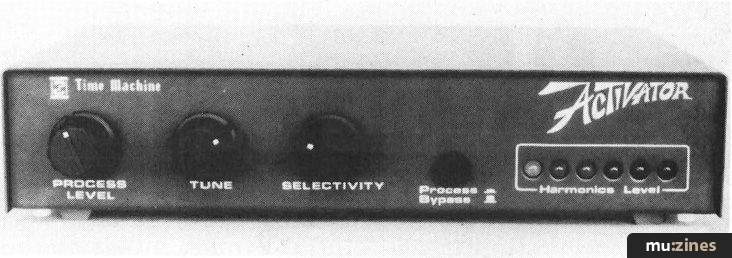
Activator
This little beast is a stereo enhancer though it does work in a slightly different way to the Aphex C Aural Exciter and the Scintillator. The original Aphex concept was to add harmonics to programme material in proportions which varied according to the level and dynamic nature of the material. What the Activator does is to add an equal proportion of harmonics to the signal regardless but the aim is the same; to restore missing upper harmonics.
The portion of the signal to be treated is selected using the Tune control which in reality controls a high pass filter and furthermore, the Selectivity control allows the response of this signal to be peaked up so that it's possible to focus in on a narrow part of the frequency spectrum. This signal is then harmonically enriched and mixed back with the original in much the same way in the Aphex unit. Because of the rather clever circuit design, there is only a single Process control to regulate the intensity of the effect which makes setting up a bit easier than with the usual Drive/Effect system.
A bypass switch is fitted which is a sensible inclusion and a six section LED display shows just how much harmonic enrichment is taking place.
When applied to a full mix, the Activator was very successful in restoring the brightness to dull cassettes and, if the original is hopelessly dull, the result is probably more dramatic than that which can be achieved using an Aphex unit. However, because the added harmonics are always at a constant level, the result is not quite as natural. The Aural Exciter emphasises transient sounds and low level detail which somehow is more readily interpreted by the listener as being authentic. This is more evident when treating a sound which is already basically good unless Activation is applied very sparingly but on the positive side, the filter controls do give the user a lot of scope for selecting instruments within a mix. Obviously you can't treat only a single instrument without affecting something else to some extent but the system is surprisingly effective.
Because of the fixed amount of harmonic enrichment I would recommend it more strongly for corrective use than for creative use (and indeed it is useful for spicing up old tapes) but at its low selling price, the home user could reap substantial benefits by using it for either purpose if restraint is exercised. It is all too easy to over use any type of harmonic enhancer as your ears soon adjust to the effect. Also those whose cassette multitrackers suffer from the side effects of DBX noise reduction could find salvation in this box.
Prices: Kit £75.65. Ready built £113.04.
MicroAmp
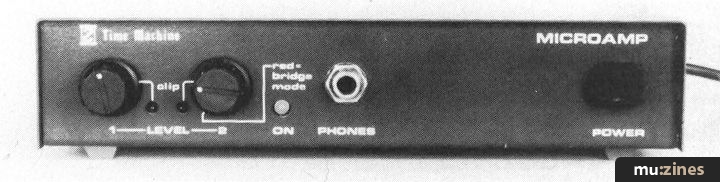
This tiny stereo power amplifier is entirely self-contained and will deliver a continuous 26W per channel into an 8Ω load. The amplifier may also be used in bridge mode (indicated by a front panel LED) as a 75W mono amplifier. In keeping with its studio application, a stereo headphone socket is fitted to the front panel and this will match phones with a wide range of impedances.
The amplifier uses MOSFETs to realise a rugged design with a hi-fi specification and furthermore, a pair of LEDs let you know when the signal is in danger of clipping by monitoring the difference between the waveform peaks and the supply rails. Another novel feature is the 'soft clip' facility which reduces the gain of the amplifier when clipping is imminent by increasing the negative feedback and the distortion thus generated is far preferable to hard clipping from the subjective point of view.
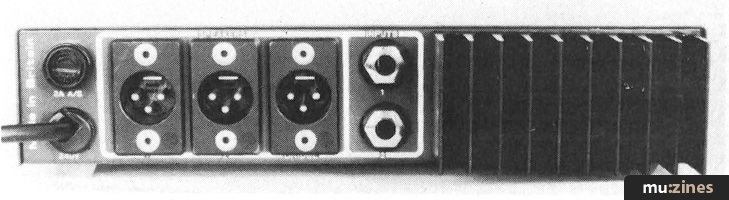
The use of a toroidal transformer not only makes the slim design possible but it also keeps the level of induced hum to an absolute minimum. The speaker outputs are on XLRs.
This amplifier is designed to run either small desk top monitors or a pair of hi-fi type speakers in a home recording environment and it performs both of these tasks admirably. But it does seem on the face of it to be a little costly when you consider that you can buy a stereo hi-fi amp of around the same power with all the trimmings for the same price or less. True, this model may turn in a better performance than a budget stereo hi-fi amp but ultimate finesse is not vital when you take into account the fact that the main job of desk top monitors is to give you some idea how your music will sound over a less than perfect domestic system.
This is a well made amplifier with generously rated components that should ensure reliability as well as good sound quality. The power output though is a little low for use on a main monitoring system, even at home, and you could drive your desk-top speakers from virtually any old hi-fi amp if you are trying to suss out how your mix sounds on a ghetto blaster.
No complaints about the amplifier then except to see exactly where it fits into the scheme of things. 26W per channel is an odd kind of rating for studio use. As always, you know how much money you have to spend and how much power you need so, if it fits your bill, give it a try.
Prices: Kit £104.35. Ready built £134.78.
Overview
All these units are well made and employ some innovative circuit design though the external appearance is a little uninspiring. Any criticisms I may have are not of the quality of the units but of how well their requirements have been though out. It certainly makes more sense to buy these units in kit form if you are capable of building them yourself because that way you can save an appreciable amount of money.
It's gratifying however to see that here is another British firm aside from Tantek and Accessit who are fighting to give recording enthusiasts something that they can actually afford and for this they should most certainly be commended.
All prices *exclude* VAT. Further details may be obtained from; Time Machine, (Contact Details).
Publisher: Home & Studio Recording - Music Maker Publications (UK), Future Publishing.
The current copyright owner/s of this content may differ from the originally published copyright notice.
More details on copyright ownership...

Home & Studio Recording - Jun 1986
Donated & scanned by: Mike Gorman
Gear in this article:
Studio/Rack FX > Time Machine > DI Compression Gate
Studio/Rack FX > Time Machine > Activator
Amplifier > Time Machine > MicroAmp
Gear Tags:
Review by Paul White
Ads for Gear in this article:

Help Support The Things You Love
mu:zines is the result of thousands of hours of effort, and will require many thousands more going forward to reach our goals of getting all this content online.
If you value this resource, you can support this project - it really helps!
Donations for May 2026
Issues donated this month: 0
New issues that have been donated or scanned for us this month.
Funds donated this month: £0.00
All donations and support are gratefully appreciated - thank you.
Magazines Needed - Can You Help?
Do you have any of these magazine issues?
If so, and you can donate, lend or scan them to help complete our archive, please get in touch via the Contribute page - thanks!
Please Contribute to mu:zines by supplying magazines, scanning or donating funds. Thanks!
Monetary donations go towards site running costs, and the occasional coffee for me if there's anything left over!

 @mu_zines
 RSS Feed
 Blog
Blog