


Magazine Archive
Home -> Magazines -> Issues -> Articles in this issue -> View
Think Big | |
Alesis BRC Big Remote Control for ADATArticle from Sound On Sound, August 1993 | |
Does the BRC make multiple ADAT working a real joy? Read our in-depth test to find out...
The arrival of the Alesis BRC was heralded by almost as much hype and excitement as ADAT itself. Can what is essentially an accessory justify this amount of attention? Paul White puts his ADATs under BRC control to find out.

The Alesis ADAT digital 8-track tape recorder has been available for just about a year now, and already it seems to have become a part of the establishment. During that time, many users have capitalised on the low cost of the format to set up modular multitrack studios based on multiple ADATs. Even without the BRC (Big Remote Control), up to 16 ADATs can be sync'ed together to provide a maximum of 128 tracks of sample-accurate multitrack. One machine acts as a master, with the slaves taking just a few seconds to lock up, and while the short wait can be frustrating, the quality and flexibility of the system is undeniable, especially when the price is taken into consideration.
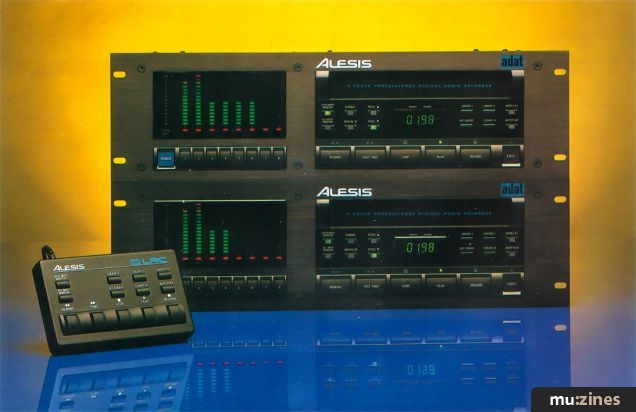
Elegant though the ADAT concept is, the front panel controls aren't always conveniently accessible, and while the LRC remote which comes as standard with ADAT provides remote control over the main transport features, it doesn't provide access to track record status, it has no additional autolocate facilities, and to be honest, it looks tragically non-serious. The BRC changes all that, with capabilities extending far beyond those of a traditional autolocator/remote control. With the addition of the BRC, the ADAT system can be integrated into virtually any audio or post production environment; it can generate MTC and can read and write all six SMPTE formats, all without losing an audio track to time code. And its location features are drift-free, as locate points are referenced to the tape's format sub-code. The ability of a BRC-based ADAT system to lock to external SMPTE code puts a whole new complexion on low-budget sound for picture work.
In a MIDI sequencing environment, BRC can generate MIDI Clock, the rate of which is determined by a user-programmable tempo map — useful for musicians who want to look at their recordings in terms of beats and bars rather than as numbers on a tape counter or SMPTE frames. This brings up the concept of Songs, something you don't usually associate with tape machine control systems. Essentially, a song is a collection of BRC parameters including any locate points used, pre and post roll settings, any auto punch-in or loop points that may have been stored, track delays and offsets, tempo map and timecode details, and sync settings. Songs may be used to store this information for more than one recording on the same tape, and the BRC can store data for up to 20 songs in its internal memory, which adds up to a maximum of 400 locate points per tape. Songs may be named and song data may be copied, as may be required when creating several versions of the same song. The starts of specific songs may then be located using the Locate Song Button, and at the end of a session, the settings for the 20 possible songs in the BRC's memory can be stored in the data section at the header of all ADAT cassettes via the Save Setup to Tape button. This data may be recovered at a future date by pressing Load Setup from Tape. It is important to maintain a degree of organisation when using this facility, especially in the case of a session that is continuing over a long period of time. The same data may also be saved to a MIDI storage device via SysEx dump, giving an added degree of security.
Other sync options include the ability to lock to an external 48kHz clock, the provision of a 48kHz clock output and a video sync input that can recognise both composite video and black burst. The only caveat here, according to Alesis, is that the BRC doesn't always work reliably with the composite video signals generated by some domestic video machines running in long play mode, but then I can't imagine that long play would be used for any serious project.
As it stands, the BRC has four sets of record status buttons which may be switched in four banks to access up to 16 ADATs. A rather nice (but not exactly cheap) option is the RMB meter bridge which duplicates the metering of four ADATs and again, this responds to bank switching, allowing any connected machine to be monitored. I think this is a marketing ploy because if, like me, you only have two ADATs, you start feeling guilty about the two unused meter sections and then you start trying to find reasons to justify buying two more ADATs to make them light up!
By making use of the optical digital links between ADATs, the BRC allows tracks to be bounced entirely in the digital domain, and by using the 'copy and paste' facilities provided, a system comprising two or more ADATs can emulate many of the editing tricks normally restricted to random access systems such as hard disk recorders. For example, a good vocal chorus can be copied to a different tape track and used to replace every chorus in the song, the only proviso being that the source track has to be on one ADAT and the destination track has to be on another. Bouncing in this way really means copying sections from one track to another — there is no provision for, say, mixing two tracks down to one as those of us brought up on analogue machines might infer from the term. There's also the facility to delay individual audio tracks by up to 170mS, either to adjust the feel of a part or to create a limited range of delay effects such as ADT (Automatic Double Tracking).
Enhanced transport functions possible with the BRC include auto punch-in and out (with variable pre and post roll), rehearse, and various forms of loop recording, including the ability to record successive takes of the same part onto different tape tracks, all automatically. And for the benefit of those recording long live sessions, there's the continuous record and play function which allows two ADATs (or stacks of ADATs) to record indefinitely by switching seamlessly from one machine to the other — you just have to ensure that all the tapes are correctly labelled.
The fact that the BRC also functions as a sophisticated autolocator is almost taken for granted amongst the wealth of features and facilities provided, but just as much thought has gone into this area as any other. The BRC provides up to 20 locate points per song (in addition to Zero Return and two further locations, 21 and 22, for punch-in, punch-out). As with the stand-alone ADAT, the zero point may be set anywhere on the tape by pressing Reset Zero, and the BRC offers the option of viewing the tape position as conventional elapsed time or as a SMPTE location.
The tape will normally stop once a location point has been reached, unless Auto play is selected, in which case the machines will go straight into play mode. Locate points may be stored on the fly or with the machine in Stop, and the BRC automatically gives the locate point the next free locate number. Locate points can also be edited to a high degree of accuracy; they may be named, should you wish to take the trouble, and the locate points may be used to specify tape machine offsets and punch-in/punch-out points as an alternative to SMPTE location.
The BRC duplicates all ADAT's front panel functions, including tape formatting and speed control, but also includes a few extra options, such as the ability to select between four different crossfade rates for punching in and out. Tracks may also be set to 'All Safe' to prevent accidental recording during a mixing session. What I would have liked to see is a way of making selected tracks safe, to prevent accidents when overdubbing. Having got used to computers and the way in which files can be locked, it would be very nice to have the same facility for tape tracks. Maybe the software is open-ended enough for Alesis to consider this as an option for a future update — I certainly hope so.
CONNECTING UP

The first ADAT in the system has its Sync In socket connected to the BRC, while its Sync Out is linked to the Sync In of the next ADAT in line and so on, in the usual daisy-chain fashion. Similarly, the optical connectors used to carry the digital audio are linked from the output of one machine to the input of the next, the output of the last machine in the chain being linked back to the input of the first. In very large systems, this may necessitate a longer optical cable than the ones provided, but there should be no problem in setting up a four-ADAT stack. At power up, the BRC checks the ADATs to see how many are connected and in what order, and then assigns them ID numbers on that basis. This involves turning the BRC on last, so if you have a master studio switch, it may be necessary to turn the BRC off and then back on in order that the ADATs are correctly interrogated. At the same time, the BRC looks at any footswitches to see whether they are normally open or normally closed and sets itself up accordingly. For this reason, you shouldn't power up the unit while standing on any of your foot switches or the BRC will get the wrong idea!
IN USE
Initially, the various functions are best checked out with the manual close at hand, at least until the operating logic becomes apparent. Most of the setting up is done by hitting the Edit button followed by the button pertaining to the function that needs editing. This reveals a parameter system similar to that used on Alesis effects units and drum machines, where the appropriate page is selected and then the cursor keys used to underline whichever parameter in the window needs editing. The values may then be changed using either the up/down buttons or the numeric keypad, after which Edit is hit again to complete the edit and exit edit mode. Once set up, the various functions are invoked directly by selecting their button, which will light up to show that the function is active.
Even when performing as a simple remote/autolocator, the BRC gives the ADAT system quite a new 'feel', and having 20 locate points for each song is a luxury that even many top-end multitrack systems don't enjoy. Alesis thoughtfully provide a choice of default titles you can give to the locate points, such as chorus, verse, bridge and so on, or you can enter your own names, which helps to keep track of things during a complex or long project. Of course, the Song Locate points don't have to be used strictly to mark the beginnings of songs — you could decide to use several 'songs' throughout the course of a single piece of music to provide more locate points if required. The lack of locate point drift opens up whole new editing possibilities, and the rehearse mode means that you can always check that something is going to sound right before you commit yourself.
The illuminated transport buttons are quite positive, and are certainly easier to use than the ones on the ADAT front panel. The SMPTE output is available at both +4dB and -10dB levels or may be switched off, and an offset may be entered. At the -10dB setting, I had no trouble getting my C-Lab Creator/Unitor system to follow the code generated by the BRC. Similarly, the BRC locks up comfortably to the code generated by the Unitor. One proviso when sync'ing to external code is that if drop frame is being used, the BRC needs to be told which of the two formats is being used, as the frequencies are too close together to identify automatically. All other formats are recognised with no prompting from the user. External SMPTE lock may be continuous or used purely to locate the tape machine to the correct start point. This latter facility is useful in some video environments where it may be necessary to use SMPTE to line things up and then use a video signal to maintain lock.
The MTC output of the BRC is referenced to the start of each song, starting at time zero. This means that starting the tape before the song start position results in the MTC code rolling back past midnight, which can fool some sequencers into thinking they should be at bar number nine grillion or something, but once you're aware of this potential problem, it ceases to become serious.
One of the most powerful features of the system is the ability to copy and paste sections of a song from one machine to another, several tracks at a time if necessary. I found the easiest way to do this was by setting up the locator markers 'on the fly' and then setting the offset between the two tape machines in terms of markers rather than as absolute time code. Once the machine offset is entered, auto punch-in and out can be used to copy the required section to the desired track on the second machine. Rehearse allows the accuracy of the edit points to be checked, and if adjustments are needed, the locate points can be moved in fine increments, right down to single sample accuracy. The system isn't limited to bouncing one track at a time: it handles as many as you like with no problem, and because the bouncing is in the digital domain over the optical link, there is no loss in sound quality. Though the process is fairly straightforward, you have to keep your wits about you and I strongly recommend writing down the locations and track destinations before doing anything irrecoverable. Also, check the result in Rehearse mode first, even though you might be convinced that everything is OK.
While I discovered no faults not attributable to my misreading the manual during the course of this review, on a software-based device such as this I can't promise that there isn't some combination of values or facilities that will reveal the odd bug or two. Even so, Alesis seem very much on the case as regards software updates. In truth, there is very little I can honestly say I didn't like about this machine, though I've always thought that life was too short to get involved with anything to do with tempo maps — that way lies insanity! Perhaps a tap tempo function would have been useful for those bent on this particular course of mental self-destruction, and certainly some system for creating a tempo map automatically from an incoming MIDI sequence would make life much easier, but in most other respects, the BRC has more well-considered options than can reasonably be expected for the price. It covers all the conventional linear SMPTE formats and its MTC capability is very valuable now that more and more sequencer packages are starting to support MTC. MMC is also being taken seriously and certainly streamlines the working environment by allowing more operations to be controlled from a central location.
The video sync'ing facilities, combined with the ability to lock to external SMPTE, means that serious sound for picture work can be carried out on a very modest budget; however, VITC isn't supported and, according to a spokesman for Alesis, there are no plans to add it. How important this is depends on the type of post production work intended and on the working method of the user. As most pro video systems output continuous linear time code, even when playing very slowly, perhaps this omission isn't as serious as it might first appear.
SUMMARY
The BRC is far more than simply a big remote controller, though it certainly doesn't sacrifice anything in the autolocator and control department to accommodate its extra features. The ability of the machine to both generate and lock to all formats of SMPTE, without the need to use up a tape track for time code is impressive, as is the copy and paste digital dubbing, which really sets the ADAT/BRC system apart from conventional analogue recorders.
So, who needs a BRC? In a commercial studio environment where there's more than one ADAT running, the BRC is worth having just as a remote control, autolocator and SMPTE generator. The video post user certainly needs the BRC in order to make full use of the sync'ing capabilities of ADAT, even though the lack of VITC support could be viewed as a potential limitation by some. The recording musician would benefit from the BRC for the superb degree of editing flexibility it affords. For example, not only can choruses or solos be copied and bounced to assemble the perfect take, with a little patience a complete stereo mix could be marked into sections and then recompiled onto a second machine with a completely different running order. This might be slower than working with hard disk, but the result is essentially the same. In other words, the ADAT/BRC system forms the basis of a powerful remixing setup as well as being a first class, expandable multitrack. In short, everyone with two or more ADATs is making less than than full use of their purchase if they don't have a BRC.
Further Information
Alesis BRC £1599 inc VAT.
Sound Technology, (Contact Details).
NEVER MIND THE FEATURES, FEEL THE BUILD QUALITY
The BRC features large illuminated transport buttons, status LEDs in all the buttons that need them, an LCD data window and large numeric displays for tape location and pitch control information. Despite the fact that the BRC is bristling with features not found on conventional autolocators, the control layout isn't unduly busy or complex, and the majority of indirect functions work on simple menu systems rather than via multi-function buttons. Indeed, the only obvious multi-function buttons are the number keys which double as character keys when naming songs, locate points and so on.
The rear panel connections are thoughtfully located out of sight and are low enough not to foul the top rail of any stand that may be used to support the BRC. The punch-in/out socket duplicates that on the ADAT and allows hands-off punch-ins to be undertaken by the recording musician. There's another footswitch jack for Locate/Play and two further jacks for SMPTE In and Out. BNC-type connectors are used for the 48kHz clock in and out points and for the video sync in, while the ADAT connection is via a standard 9-pin D-Sub which may be locked in place using a couple of retaining screws. That leaves just the MIDI In and Out, the IEC mains connector and the power switch.
ALESIS BRC £1599
• Stylish remote control unit.
• Powerful autolocator.
• SMPTE generate and receive plus MTC out.
• Copy and Paste digital bouncing.
CONS
• No VITC support.
• No Automatic Tempo Map Learn facility.
SUMMARY
Any ADAT user planning to use two or more machines should consider a BRC as their next major purchase.
ADAT REVIEW
Featuring related gear
Alesis ADAT - 8 -Track Digital Recorder
(SOS Sep 92)

Alesis ADAT - 8-Track Digital Recorder
(RM Sep 92)

Alesis ADAT Digital Recorder
(MT Sep 92)
Browse category: Digital Tape Deck (Multitrack) > Alesis
Publisher: Sound On Sound - SOS Publications Ltd.
The contents of this magazine are re-published here with the kind permission of SOS Publications Ltd.
The current copyright owner/s of this content may differ from the originally published copyright notice.
More details on copyright ownership...

Sound On Sound - Aug 1993
Gear in this article:
Remote Control > Alesis > BRC
Review by Paul White
Help Support The Things You Love
mu:zines is the result of thousands of hours of effort, and will require many thousands more going forward to reach our goals of getting all this content online.
If you value this resource, you can support this project - it really helps!
Donations for June 2026
Issues donated this month: 0
New issues that have been donated or scanned for us this month.
Funds donated this month: £0.00
All donations and support are gratefully appreciated - thank you.
Magazines Needed - Can You Help?
Do you have any of these magazine issues?
If so, and you can donate, lend or scan them to help complete our archive, please get in touch via the Contribute page - thanks!
If you're enjoying the site, please consider supporting me to help build this archive...
...with a one time Donation, or a recurring Donation of just £2 a month. It really helps - thank you!

 @mu_zines
 RSS Feed
 Blog
Blog