Ultravox (Ultravox)
(EMM Apr 81)


Magazine Archive
Home -> Magazines -> Issues -> Articles in this issue -> View
Ultravox On Air | |
UltravoxArticle from Electronic Soundmaker & Computer Music, February 1984 | |
A monumental meeting?
Peter Picton travelled to Mayfair Studios to get the hard facts on Ultravox.
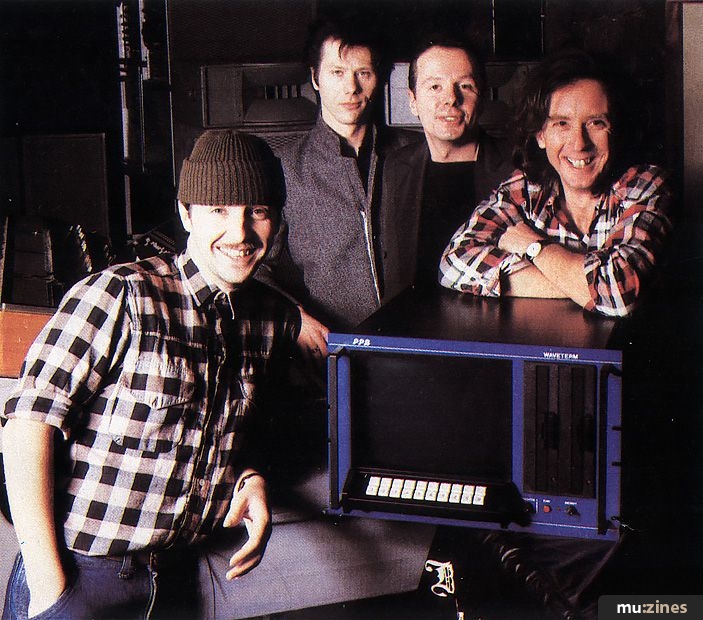
Interview Ultravox? Impossible, I thought. Surely the art of conversation has been long passed by the mechanical men in their technological quest for the ultimate synthesis. Maybe they communicate in machine code?
I should have brought a compiler along. But like all good stories my prejudices were way ahead of the truth and about to be trampled upon.
I met up with Ultravox in the foyer of the Mayfair studios where they are currently hard at work on their new album, due for release sometime in the new year. Sitting and talking with Warren Cann my initial fears were soon dispelled. Each member of the band proved to be unpretentious, friendly and, most of all, interesting. I chatted with Warren as we waited for the rest of the band to arrive (they'd been mixing until 4 o'clock the previous morning — mixing what, they didn't specify). When I questioned him about the development of and attitude to the synthesizer he drew varied parallels, from the industrial revolution to similar developments in other areas such as the motor car. He thought that we were unlikely to see the same explosion in music again as we had during the sixties, citing sociological factors such as birth-rate and the healthy economy for that marvellous period. He had hopes for the future of 'rock' but felt that the continuous search for the 'next big thing' was futile, as rock would develop rather than suddenly totally transform.
By this time the rest of the band had arrived. Again they looked strangely human to me! I sat down to begin the conversation wary of any sudden robotic movements. It didn't happen. They all proved to be outgoing, witty and straightforward. I started with their studio technique; in what stage of development was their material on entering the studio? Keyboard player Billy Currie began; "It's different every time. This one's different again. We're avoiding mixing tracks all at the same time. It gets too much pressure". Bass player Chris Cross continued, "When we did Vienna we'd actually written 90% by the time we got into the studio, except for 'Vienna' and 'Passing Strangers', so it was recorded really quickly. 'Rage in Eden' we didn't write any of before we went into the studio".
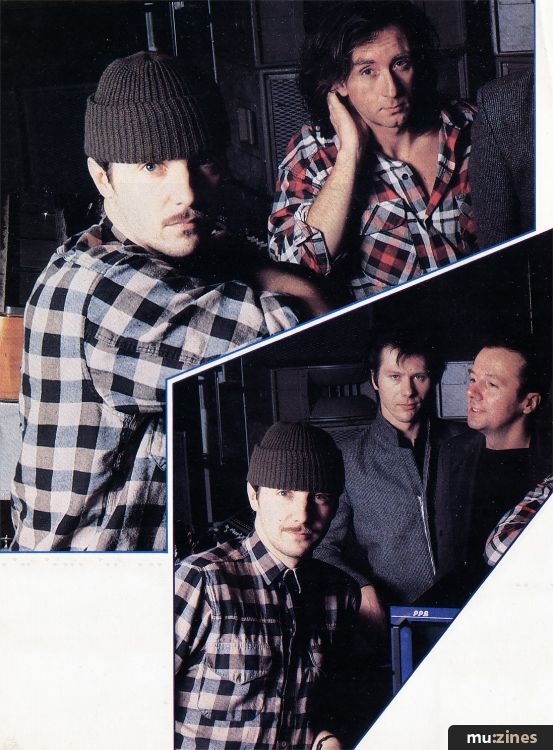
"But that was the climate," Billy remembered. "It wasn't second album problems or anything. It was just that Vienna was doing really well and we couldn't get any peace, so we pissed off to Conny Plank's." Lead singer, guitarist and focal point of the band Midge Ure was keen to jump on the nostalgia bandwagon — "We were there for three months and it's a pretty boring place to be if you don't speak the language and you haven't got a car to go anywhere. You're stuck in a farmyard in Germany. That reflected how the album was going to sound!"
Chris returned to the point — "Musically the way we usually get going is something'll spark us off." 'The Thin Wall', added Billy, "was all just really from one guitar riff. With 'Quartet' working with George Martin the general feeling from him was to get some songs together so we ended up doing a very structural, quite conventional album for us.'
"We've got a terrible habit of once we've done a 5 minute piece of music going on for another minute and a half in ever spiralling chord changes."
"'Quartet' we recorded in Air Studios and then we went off to Monserrat to mix it", said Midge, "so it's quite a light, sort of happy bit of music. Something quite unusual for us. This one's different again. It's not as light as 'Quartet' and not as hard to take as 'Rage in Eden'. We've tried desperately to keep this one more simple. Originally we were not going to go any more than 24 track but we found that a bit impossible, 'cause we like arrangements and we tend to go over the top at times. So we've gone 48 track. But as a musician if you keep pushing it and making thing more complex you start getting into bizarre time signatures and end up sounding like Yes. I'd hate that. I get a bigger kick out of a three chord song with a straight 4/4 beat. If you use a nice melody — melody's an important factor — then all the bizarre time signatures, ridiculous key changes and chord structures don't matter.'
Production People
Ultravox were producing this album themselves, a logical step considering the experience that they had gained working with two very different producers, Conny Plank and George Martin.

What had Ultravox learned and gained from working with two such eminent producers? Chris explained; "Conny is much more of an engineer and George is much more of a producer in the traditional sense. We learned more about sound and how different sounds relate off Conny". "To create atmospheres," Billy added, "Ideal for us".
Chris continued, "We went with George cause we wanted a radical change. We knew that when we all play it's going to sound like Ultravox whatever. So we thought that if we go with a producer he might come up with something new". Billy saw it from another angle. "It was a different classical side for me. Like Vienna, Conny would suck you for all that you were worth, I'd say Bartok to him and he knew exactly what I meant. I'd say 'I want a Shostakovitch chill on this' and after every one had stopped laughing he'd say (in broad Cockney judging by Billy's impression) 'Yeah! I know what you mean!' George comes from a different school of classical music which was very interesting but didn't quite appeal to me. He's been influenced by more romantic big symphony stuff and the only person I could stand in that period was someone like Brahms 'cause all my stuff's from the 1930's and '40's like Bartok and Shostakovitch — more angular. I talked with him about it and he was quite interesting!
Midge explained the relationship. "We thought George might have been a dictator type of figure, telling you about arrangements — 'No you can't do that, you've got to do it this way' — but he wasn't at all. He liked arrangements we did. George's main input would be stopping us from going too far. We've got a terrible habit of once we've done a 5 minute piece of music going on for another minute and a half in ever spiralling chord changes, and he'd say 'You don't need it. You've taken it as far as you need to,' and we'd sit back and think 'Yeah, he's right."
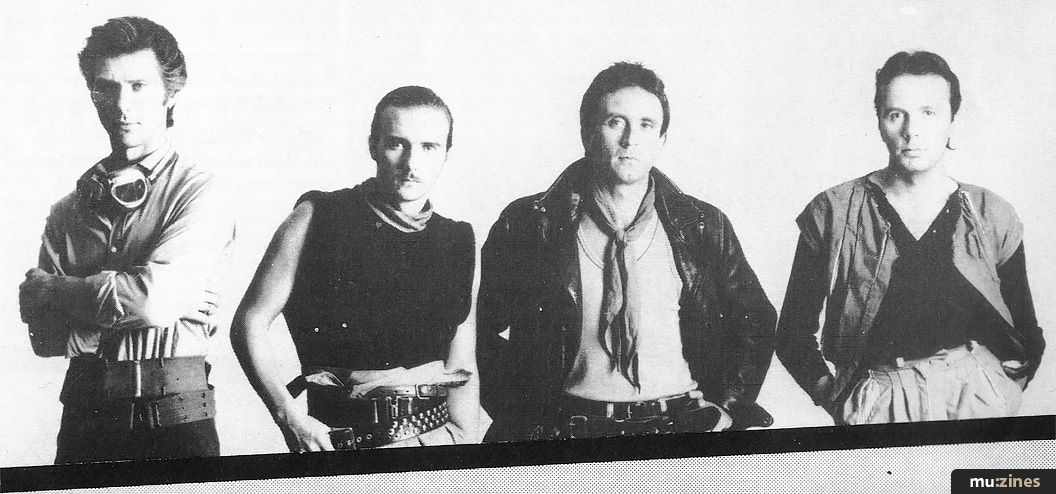
"I'm thinking of buying a Synclavier and a Fairlight but it's like having someone else's ideas dumped on me."
'In Monserrat', said Billy, 'he had us on 5-6 slaves (5x24 tracks). Geoff Emerick (the engineer), you've got to give it to him, he was so in control. He's used to working with it 'cause McCartney uses up to 7-8 slaves sometimes.' Conny's different', Chris added, 'because he does his producing, tape operating and engineering himself. George has got an engineer and a tape op. It's all well defined who does what.' But how much control did the band have over the production? 'Total', they all agreed. Midge cited an example; "It ended up when we were mixing out in Monserrat that there were five of us at the desk, the most enormous desk you've ever seen and it's not computerised. So we'd all have a section of the desk each. That was our bit to control. It was up to us."
Chris brought the conversation back to Conny Plank. "He does track sheets, and instead of writing what's on them he draws little pictures of how he sees the song going, a graphic representation that means nothing to anyone else but himself." Midge completed the picture: "He's not a producer who'll arrange songs for you. He's a really good engineer who gets you sounds and he leaves the arrangements, the construction of the music totally to the musicians." "Conny thinks in noises", Billy felt. Both Chris and Billy admired Conny — "He's done with his studio what will happen with synthesizers. He's got his unit and it works exactly how he wants it to, an extension of himself."
"Synths will go that way", Chris continued, "you'll be able to map out how they work with operating programs."
Hardware Problems
This touched a raw nerve in Billy, he wasn't happy with the relationship between musician and manufacturer. He wanted, he said, "A bit more say on what you want to do. I'm thinking of buying a Synclavier and a Fairlight but it's like having someone else's ideas dumped on me. The Synclavier is definitely built for a musician. I think there will be a time when you can suggest ideas about updating or rearranging software and get it a bit more flexible to how you like it. You always find things that you're not too keen on and there's nothing you can do about it. Like when you're sampling for the Synclavier, it's monophonic. Stupid things like that — an extra bit of memory would have got it right.'
Chris mentioned other problems, "Like a pitch wheel. Some you push up and it stays up. Others, soon as you take your finger off it flies back. You should be able to define the way that works. The most annoying thing about synthesizers is how they're all not compatible. If manufacturers could sort that out it'd make people experiment more." Billy felt strongly about this — "They're only just now sussing out a way to trigger everything. That's been a whole mystery. I'm sure they must have been bought off by big producers. It could be as weird as that — to keep the information." Billy went on to talk about the gear he was using at the moment citing the new Yamaha DX7 as an interesting and well designed synth, although he was still keeping faith with the ARPs as that was his solo sound. Having mentioned the DX7 I wondered how they felt about the differences between digital and analogue? Billy refused to take sides, "I like them both really. Trying to get a very simple waveform, which I always work with because I find it very expressive, can be difficult to do digitally. There again, in digital you can get some really nice rough things because it hasn't got enough capacity to get the sound." He explained in greater detail — "Put a violin into the PPG Waveterm and it hasn't got enough to totally copy it digitally, so it fills in the gaps and makes it quite exciting." So are Ultravox totally dependent on synthesis? Midge was quick to reply "We like being able to mix and match. A bit of guitar in amongst some acoustic fiddle in amongst some sampled sounds in amongst an acoustic drum kit with an electric bass drum, just mixing it all up and coming up with a sound we're happy with. It doesn't really matter what instruments we play as long as the result is pleasing to us."
Billy wanted to put the record straight — "It annoys me a bit being called a 'synth band'. The biggest hit we ever had (Vienna) was made up of violin, drum machine, and cellos that sounded more like cellos than actual cellos and a nice attacking synthbass, but always mixing up with natural sounds. I'll never stop playing piano because it's so expressive and it fits great with a Linn.' Midge felt the same — "We've to fight that whole thing about cold and distant music because it's synthesizers. If people didn't know that we used them and we just presented them with things like 'Vienna' I'm sure they wouldn't have known what it was played on anyway, like 'All Stood Still' is like a real uptempo rock track and it's all on guitar mainly. Most of the new bands who picked up their first synth and drum machine sounded cold and distant simply because it was easier to do so than sound like a normal band using synths. Switch on the drum machine, play the three notes they knew on the synthesizer and sing in a monotone voice 'cause most of them weren't very good singers. We thought Mr X was cold and distant but if you listen to what some of the new bands are doing using synthesizers, 'Mr X' is like a twelve-bar blues!"
"It annoys me a bit being called a 'synth band'. The biggest hit we ever had (Vienna) was made up of violin, drum machine, and cellos."
Billy saw another reason why synths were being misused — "New bands are coming unstuck frantically looking for sounds. It tends to get like a rat race. There's a whole harmony structure that's being ignored because people are frantically looking for sound, an instant effect 'cause that's how it's advertised and they end up getting these tedious, moany, melodies that I must admit we instigated! Harmonic structure's really important. Generally the tonal structures that people in the business are using are pathetic and boring. It gets back to being stuck with a bloody scale after all these years. Earlier on this century people tried to do things with it, people like Schoenberg — 12 note stuff — and no-one's really benefitting from it all. It's such a huge market, all bands try to crack the world totally. I think it's tended to hold back more experimental bands."
Instrumental Individuality
I asked Billy if synths could ever attain the same individuality as 'natural' instruments such as the guitar. "Playing the violin you get to know it but a synth can seem impersonal — the touch sensitivity can make it very expressive and Yamaha are way ahead on that one.
I use the vibrato on the ARP and that's expressive, a personal thing. With the ADSR you can change the whole sound. People don't bother to show you these things in the shops but that's where you're going to get expression from."
We'd spent most of the afternoon talking about complex studio equipment and techniques. With their live album (or rather the soundtrack to their live video) 'Monument' presently on release, how did the band cope with transposing studio material to a live situation? As the showman of the band it seemed appropriate that Midge Ure should explain. "Once you've recorded an album in a multitrack studio you end up with 150 tracks bounced down onto a 2-track tape. When you get to rehearsals you've got to learn how to play all those parts and give a performance at the same time. It's like you're writing and rehearsing for the album then you spend three months recording it, then you're another two months learning how to play what you've just written and recorded. So far we haven't used any prerecorded tapes or any preset computerised synths like the Fairlight where it plays half the stuff for you. The last one was probably the most complicated we did and we brought in a couple of guys to help with backing vocals and one of the guys played the Emulator up the back of the stage now and again on about half a dozen numbers. But we'd rather do that than just pre-program from a central synth. We like the idea of four of us playing live so if we make any mistakes you know it's live."
It was time to wrap up the interview. For my last question I asked them what developments they expected to see in the uneasy marriage between music and technology. Chris thought computers would become more user-friendly and also mentioned digital recording. Billy agreed; "Let's face it, you can't beat that. There's nothing worse than listening to music on crackly recycled vinyl. Some people will go against digital. Conny Plank was dreading it. He knows things that can happen from analogue like harmonics and general dust and dirt." Chris felt that the Springsteen digital album sounded terrible because it was so clean The best results we've had is when we record on multitrack and mix on to digital, then you don't get the other generation."
"You don't get any generation at all with digital, it's just passing absolute information."
I leave the last, rather ironic, word to Chris — "It's funny, when they first brought out the compact disc no-one knew how loud it was so they put on a little bit of (artificial) hiss at the beginning."
Technology can only move forward as fast as man's foibles will allow it. Ultravox seem sensibly in control of any developments They were keen to point out that they controlled their hardware and not the other way round. They are certainly not 'blinded by science' having a straightforward, down to earth attitude to synthesis, seeing it as another tool with which to make music and with music as their goal. They certainly enjoy the technological adventures en route, but they're determined to arrive at their' destination using whatever instrumentation is appropriate. More power to their micro-chip says I.
More with this artist
 |
 Hymn (Ultravox) |
 Love's Great Adventure (Ultravox) |
 Re-Vox (Ultravox) |
More from related artists
 Ronny's Electro-Music Cabaret (Warren Cann) |
 In The Garden (John Foxx) |
 John Foxx (John Foxx) |
 From 24 tracks to 8 (John Foxx) |
 Midge Ure - A Man With A Gift (Midge Ure) |
 Days of Ure (Midge Ure) |
 John Foxx: Recording In Mysterious Ways (John Foxx) |
 Ultraboxes (Midge Ure) |
 Life After Ultravox (Billy Currie) |
Publisher: Electronic Soundmaker & Computer Music - Cover Publications Ltd, Northern & Shell Ltd.
The current copyright owner/s of this content may differ from the originally published copyright notice.
More details on copyright ownership...
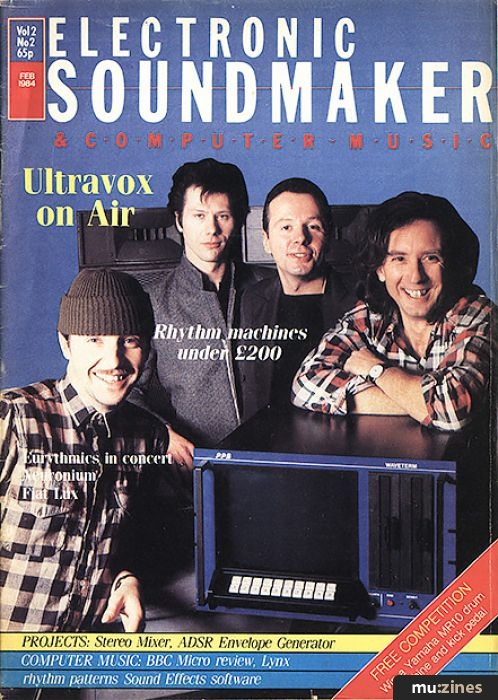
Electronic Soundmaker - Feb 1984
Donated by: Ian Sanderson
Interview by Peter Picton
Help Support The Things You Love
mu:zines is the result of thousands of hours of effort, and will require many thousands more going forward to reach our goals of getting all this content online.
If you value this resource, you can support this project - it really helps!
Donations for August 2026
Issues donated this month: 0
New issues that have been donated or scanned for us this month.
Funds donated this month: £0.00
All donations and support are gratefully appreciated - thank you.
Magazines Needed - Can You Help?
Do you have any of these magazine issues?
If so, and you can donate, lend or scan them to help complete our archive, please get in touch via the Contribute page - thanks!
Please Contribute to mu:zines by supplying magazines, scanning or donating funds. Thanks!
Monetary donations go towards site running costs, and the occasional coffee for me if there's anything left over!

 @mu_zines
 RSS Feed
 Blog
Blog