


Magazine Archive
Home -> Magazines -> Issues -> Articles in this issue -> View
Vestax MR44 Cassette Multitrack | |
Article from Recording Musician, October 1992 | |
A no-nonsense, rack-mount multitracker with an attractive price tag.
If you're in the market for a cassette 4-track, there are many to choose from. Does Vestax's MR44 offer anything significant to tempt the prospective buyer? Derek Johnson racks it up and checks if out.

Vestax have carved a small niche for themselves in the recording market by providing cassette multitrackers for those on a tight budget. To be honest, some of their past machines were stripped down so far in the way of facilities that they really only functioned as the most basic of musical notepads. This is not in itself a bad thing — at least basic multitrack recording was made available for minimal outlay; in a way, you could say that Vestax helped to pave the way for the democratisation of multitrack recording — but these basic machines could be quite quickly outgrown by the purchaser, who inevitably felt the need for more flexibility and features.
MR44 Features
- Four tape tracks
- Simultaneous recording on all four tracks
- Normal and double tape speeds
- dbx noise reduction (globally switchable)
- Global 5-band graphic EQ
- One Auxiliary send with stereo return
- Four Direct tape outs
- Footswitch record
- Sync-code compatible
Vestax's most recent entry into the multitrack fray, the MR44, could modify the common perception of their products as cheap and cheerful, but ultimately limited. It's a machine which, superficially, appears to have much in common with their rack-mounting MR66 six-track recorder. However, while it obviously has two fewer tape tracks, the MR44 does in fact feature a fully-functioning mixer rather than the basic facilities offered by the MR66.
The package is rack-mounting, is very light, and takes up only 3U of rack space if so mounted (that's 100mm high and 482mm wide). Power comes from an external 12V pack, which helps keep the weight down. However, the PSU plugs into the front of the machine, which may not be the most logical place if the MR44 is rack-mounted.
The Look
The MR44 looks pretty good. Vestax products in the past have had the air of budget hi-fi about them, but not here: what you see is what you get. There are no flash bits masquerading as something useful — everything on the MR44 has a purpose. If there is a non-sequitur, it is the rather bizarre provision of two parallel send sockets on the sole auxiliary send.
The control surface itself is divided into fairly logical sections, and everything — including all inputs and outputs — is available on top; no rooting round the back to plug and unplug cables on this unit. Starting at the left, there's the four-channel mixer section. From the top of each channel strip, there's a three-way selector for channel input source, which can be either a tape track or a mic/line input. The third, off, position is the closest the MR44 comes to having a track mute switch. Next in line is a trim control, used for setting the gain when the input selector is set to mic/line. Each channel has an auxiliary send control (for effects processing), a pan pot (for stereo placement), and finally a real fader for overall level (volume) control of the channel. The input jacks — which serve for both mic and line inputs — are found at the bottom of each channel strip.
The next mixer strip after the main input channels contains the master fader, above which is the auxiliary return level control (there is no master send control) and four record select switches. These switches route the signal from the input channels to individual tape tracks or an overall left/right mix — all four inputs could be mixed to stereo if you wanted, for example, or all onto one track, or onto the individual tape tracks. There is a socket at the bottom of this strip as well, but it is not for headphones — it's the punch in/out socket.
This brings us to the centre of the front panel, and the four rotary monitor pots, used to set the level of the monitor mix in the headphones (and monitor out sockets) while overdubbing. This middle area also features the LED bar graph meters and the 5-band stereo graphic EQ. The meters can be switched to show the level of each track, or the level of the overall stereo mix (on meters one and two).
Also in this vicinity is the (non-real-time) digital tape counter, with attendant counter reset and return to zero buttons. The EQ has a defeat switch, as does the dbx noise reduction, and the tape speed switch is also here — the choices are 9.5cm/sec or 4.8cm/sec.
The next, and last, section is the tape compartment, underneath which are the expected transport controls. These are of the soft touch electronic variety, rather than the mechanical type usually found on budget equipment — a nice touch. Last of all are the pitch control (+/-1% in either direction) and headphones/monitor level control, and the headphone socket itself.
The connectors, which are spread across the bottom, are all phonos, apart from the jack sockets that make up the mixer inputs, the punch in/out socket and headphone socket. There are a stereo pair each for line outs, monitor outs, aux return, and, as mentioned earlier, two aux sends. Four individual tape outs are provided, as well as sync in and out. So as you can see, the MR44 has quite a lot going for it.
The Facilities
All the facilities one would expect from a multitracker with any pretensions to usefulness are provided: all four tracks can be recorded at once, each track has an individual output, there is an auxiliary send with stereo return. But one compromise has been made; there's no individual EQ on the channel strips, which is a shame. The global stereo graphic is better than nothing, but I'd like to have seen bass and treble controls for each channel, or at least a basic 'tone' control. There are ways of treating individual tracks, but only during the initial recording stage and track bouncing; there's no opportunity for 'fine tuning' individual tracks at mixdown. Still, it's a lot better than nothing, but calls for a little bit of ingenuity and planning on the part of the user.
In Use
Using the MR44 was a fairly satisfying experience, though the first part of my review time with the machine was marred by some bad crosstalk and an odd tendency for the bias current to not fully erase what was previously on a piece of tape. I also discovered that the meters are not as accurate as they could be during recording, and that a little trial and error is required to discover the ideal recording levels. Once I'd got the hang of it, recording went smoothly, with only minimal crosstalk evident, and the combination of double speed and dbx noise reduction makes for reasonably quiet operation. To be honest, while I found one, possibly two, bounces to be acceptable, going any further did yield quite noticeable degradation and noise, but for demos this should be adequate; the famous '10 musical tracks out of four tape tracks' bouncing trick is eminently possible with a little pre-planning (see box). This is explained reasonably well in the manual, and involves no track being bounced more than once.
One noise problem that cannot be ignored is the rather obvious whine which operating the controls produces. This doesn't actually get recorded onto tape, but there is obviously something going on electronically, probably with the soft touch controls. This is more mildly irritating than a major problem, but I'd rather it wasn't there.
One of the features that was most welcome on the MR44 was the ability to mute tracks during mixdown using the input selector switch in its off position. It's just a little more awkward to use than conventional mute buttons, but it does the job.
Not having tone controls on each mixer channel meant a little bit of messing about to get the best sound on tape, though the global 5-band stereo EQ can be used to treat individual tracks during recording. Similarly, effects can be added during basic recording as well as during mixdown. These limited, though welcome, facilities work fine for the solo musician making demos. If more than one musician is involved, then it gets a little more tricky: the effects can be recorded in stereo, and the EQ can be used in stereo, but I'd suggest that both EQ and effects should be used sparingly, since they can't be changed later.
The MIDI sync input on channel four seemed to work fine; although there is no separate channel 4 dbx defeat switch, I suspect that the noise reduction is actually out of circuit when the sync option is used. Drop-ins are no better or worse than the majority of double-speed cassette multitrackers and, providing care is taken (drop in on a drum beat to hide the almost inevitable click, for example), good results are possible. Bouncing tracks — for example, recording three tracks and 'mixing' them onto track four — did result in a slight loss of treble, but the result was basically good. When recording in stereo, it's possible to use the graphic EQ and the auxiliary send, so tracks recorded in this way can have effects on them if you like.
Conclusion
I'll be honest: my initial impressions of the MR44 were not good. It does have some idiosyncrasies that need to be understood before work can begin in earnest. However, once these are out of the way, it's a great little performer for the price. It's such a simple design that you're forced to be a bit inventive, and this is no bad thing. That's not to say that it isn't flexible: it does, after all, allow you to record on all four tracks at once, to record and bounce (with effects and EQ, albeit slightly compromised). If the EQ configuration was my least favourite feature, the best thing about the MR44 was the layout, with all knobs, sliders, LEDs, and sockets being available on the front panel. This makes using the MR44 a lot less confusing than it could be.
It's hard to know how to sum up a product like this. It certainly seems to have a lot going for it and, although I've made a couple of negative comments, I have to say that I have a certain affection for the MR44. The lower end of the market for cassette multitrackers is crowded, but I found the MR44 capable of holding its own and performing well, with no immediate worries with regard to long-term reliability.
Schools on a budget may find the format attractive, since it has no hidden functions, and can be operated on its back or on edge, making demonstrations fairly visible. It also doesn't cost too much. The sync options and direct outputs make the MR44 an ideal bet for the heart of a small system that may grow in the future, since an external mixer can be added later and synchronised sequenced MIDI-driven material can be played along with the main multitrack tape.
Vestax MR44
- Competitive price.
- Decent basic sound quality in high speed mode.
- Useful connection facilities allow for future expansion.
- Logical Layout.
CONS
- No individual channel EQ.
- Unsophisticated finish
- Meters Inaccurate
PERFORMANCE 6/10
VALUE FOR MONEY 7/10
Sound quality is acceptable, especially at the higher speed of 9.5cm/second. Personally, I would think of the low-speed setting as a source of special effects or use it only for rehearsing complicated parts. Chrome cassette tape is not the most expensive recording medium in the world, and I think any savings made by recording demos at normal speed would be outweighed by the obvious drop in sound quality. All cassette multitrackers are set up to work with chrome, Type II formulations, and the 'name brands' seem better able to stand up to the stress of rerecording tracks or shuttling back and forth while practising drop ins. Ferric tape is not recommended and will certainly produce an inferior result.
All in all, I was much surprised with the MR44. In spite of a crowded market, I think this machine is definitely worth a listen — in fact, shopping around could turn up a machine at rather less than the full retail price, which makes it an even more attractive proposition. A nod's as good as a wink to a blind bat, as they say.
10 Track Trick
Record (bounce) the contents of tracks 1, 2 and 3 (plus a live part) onto track 4. Tracks 1, 2 and 3 are now free to be used again
Record onto tracks 1 and 2, and play a live part while bouncing both onto track 3.
Record a part onto track 1, and play along with it while you bounce it onto track 2. Track 1 is now free for your final part — usually a lead vocal or solo part of some kind.
That's 4 + 3 + 2 + 2 parts = 10 parts.
Using six or more tracks gives you more flexibility — you can bounce in stereo without running out of tracks, or create more complex layers with fewer bounces — but on limited tape formats everywhere, people are always bouncing. You can also bounce tracks that already contain bounced material, but on cassette multitrackers, noise will start to become more of problem. Bear in mind that you shouldn't really bounce a lead vocal, as any loss of quality will be very obvious.
Jargon Buster
Bouncing: Sometimes called ping-ponging. Mixing two or more previously recorded tracks and recording the result onto a blank track, often while playing along. This frees the original tape tracks for further use, since the material on them has now been transferred to a single spare track. Using this method, up to 10 tracks can be recorded with no recorded material going further than one generation (see box for method).
Dropping in: Sometimes called punching in, this means replacing a section of a part containing a mistake — perhaps a fluffed note or a click or fret buzz spoils an otherwise good performance. On cassette formats, dropping in really does need a bit of practice since the tape is moving so slowly, but basically, the facility allows the performer to play along with a track until a short time before the problem occurs, 'drop in' to record, replace the bad part, and 'drop out' of record at a convenient place. Ideally, a seamless performance should be the result. There will usually be a click of some kind, but if you choose your drop in and drop out locations well, any click should be masked. A drum beat is a good place for this.
Sync Code: This is simply a method of keeping a sequenced backing track in time with recorded material. A sync code generated by a synchronisation device can be recorded onto one tape track and can then be used to keep a MIDI- equipped sequencer or drum machine in constant time. It makes sense if all your parts are electronic and can be played over MIDI, since you then don't need to record your backing onto tape until your final mix to stereo. This means that three tracks of your 4-track are left for guitars, vocals or other non-MIDI equipment, and the electronic backing can be balanced during mixdown without ever having been on tape — the final master will contain a first-generation recording of your backing track. The down side of this is that you'll need more mixer inputs to handle the electronic instruments, but a number of economical stereo mixers are presently available on the market.
Further Information
MR44 £411 including VAT.
Vestax Europe, (Contact Details).
Publisher: Recording Musician - SOS Publications Ltd.
The contents of this magazine are re-published here with the kind permission of SOS Publications Ltd.
The current copyright owner/s of this content may differ from the originally published copyright notice.
More details on copyright ownership...
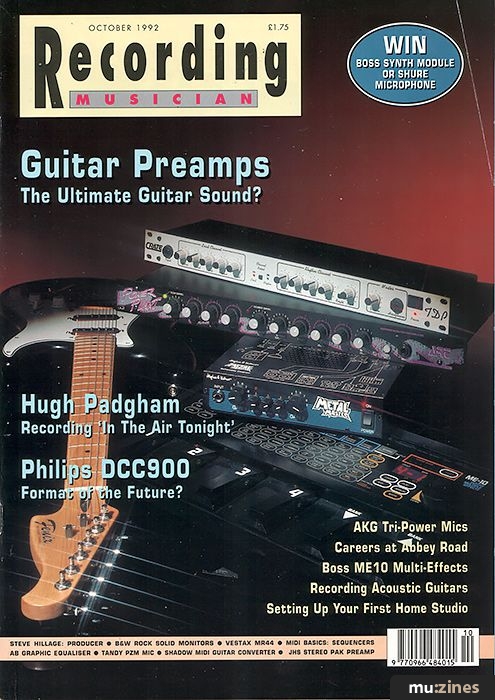
Recording Musician - Oct 1992
Review by Derek Johnson
Ads for Gear in this article:

Help Support The Things You Love
mu:zines is the result of thousands of hours of effort, and will require many thousands more going forward to reach our goals of getting all this content online.
If you value this resource, you can support this project - it really helps!
Donations for September 2026
Issues donated this month: 0
New issues that have been donated or scanned for us this month.
Funds donated this month: £0.00
All donations and support are gratefully appreciated - thank you.
Magazines Needed - Can You Help?
Do you have any of these magazine issues?
If so, and you can donate, lend or scan them to help complete our archive, please get in touch via the Contribute page - thanks!
If you're enjoying the site, please consider supporting me to help build this archive...
...with a one time Donation, or a recurring Donation of just £2 a month. It really helps - thank you!

 @mu_zines
 RSS Feed
 Blog
Blog