


Magazine Archive
Home -> Magazines -> Issues -> Articles in this issue -> View
Westone Thunder Jets | |
Article from One Two Testing, September 1984 | |
six and bass
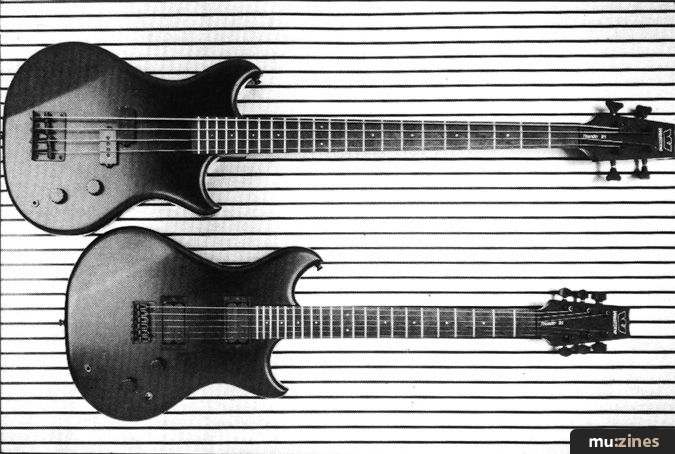
These guitars are black. No dispute. This is undoubtedly seen by Westone as a great macho blow – why else would you tag such creations "Thunder Jet"? Frankly, I doubt they would fly. So let's keep them lashed to the ground, and harness them in the more familiar pursuit of making a nice racket.
The ball is firmly in the court of cosmetics, however, regardless of how you sneak up on these guitars. The aforementioned blackness makes you pick up these objects in a rather different frame of mind than if they were, oh, grey or pink. But this is, you know, philosophy. And you want electricity, right? You win again.
So the guitar is picked up, bearing in mind one's frame of mind. Six strings here are slinky, and the left mitt positively glides up and down the glossy-smooth, slim and slidy neck; the body is bolted to the neck with four big cross-head screws. Not weedy, oh no.
Plugging in – no socket on the side, it's on the top – reveals a limited if controlled state of affairs. Nothing too exciting in the way of fancy controls here: a volume and tone knob, and a pickup selector.
A welcome addition to this stark layout is a push-pull on the tone knob, tapping off a coil on whichever pickup(s) are selected and giving a helpful single-coil rasp to the proceedings.
Fashion may lure you to use this single-coil option more frequently than the warmer, deeper sound emanating from the pickups in standard twin-coil mode. It certainly adds bite to the fluid lines that are easily drawn from these speedy playing surfaces – damped, fast picking on low-pitched strings was a favourite scheme with the coil-tap on the rear pickup and treble right up.
Back to humbuckers and with both pickups selected, then psychedelia, even, is within reach, and chord-based bashing becomes a temptation.
This is certainly a guitar which wants to be played: some want to; others would rather sit in their box all day and dream about forests. This one, black and oddly plastic-like, would have a hard job convincing a tree that it was a distant relation, let alone wooden.
It's a familiar Westone shape, of course, and doubles the Concorde style almost exactly. The finish here would best be described as dull black, which scuffs easily, and which does indeed completely hide any glimpse of the (we are assured) alder body beneath: the maple neck is similarly encased, with the rosewood fingerboard seeming much darker than you'd normally expect, presumably as a result of the surrounding gloom. Even so, it has a slight shine about it, adding to the encouragement to nip around the fretwork. The position dots under the 24¾in scale are tiny – it's possible you could lose them from sight.
At nigh on 150 quid this guitar is a bargain – but what about that sombre black? Cold and disturbing, I find – not what I want when I'm playing. Course, if you play in a cold and disturbing ensemble...
The bass, too, is familiar in shape to students of previous Westone catalogues, comes in the same unforgiving 100% black, and has another astonishing dark-looking piece of rosewood locked on to the neck. The presence of a graphite nut is shared with the guitar, too: Ibanez and Westone, at least, seem keen on standardising this material for their nuts. What advantage to you and me? It's hard stuff, it's reasonably resonant. To them? It's cheap, and it can be sold as a technological innovation, so unless you're thinking of hanging on to these Westones till you're 80, a graphite nut makes no difference at all. And there's something to be said for that.
The bass has controls more limited than the six-string's: a single volume and tone knob. In which case the basic sound you get has to be worth having for there's little to be done with it at this end of the jack lead – which, as many a top bass operative will tell you, is where it matters.
Oh! Here's a top bass operative now, who's saying: "It matters a lot what sound you get from the bass itself." And off they go.
The sound of the £159 Thunder Bass itself is, for me, a little plodding. There's not a great deal of attack or excitement about it at all. The string spacing at the neck's end is fine for slapping, and over the edge a little under-generous for pulling. Finger style felt surprisingly stretched; the left hand, too, is called upon for some span-in-reserve on this 34in scale, particularly down at the open-string end of the 22 frets. We try once again to keep track of those tiny dot markers, too.
These are tempting prices, for sure. Way over there in Matsumoto City, which makers Westone have told One Two is "the home town of electric guitars today", they're evidently working to those prices. Costs are shaved here and there, whilst still producing a playable, desirable, modern instrument.
But with the bass at least, Westone have skimped on the sound range and potential, while making sure to have guitars that are smart and up to what they identify as the minute.
We've seen elsewhere in this issue how one home-grown maker is reacting to the success of cheap Japanese instruments which are indisputably musical instruments. And while there are instruments around like the Thunder Jet six-string at £149 the only advice I can offer other hopeful British makers, is don't make black ones.
Westone thunder jet guitar: £149
thunder jet bass: £159
Publisher: One Two Testing - IPC Magazines Ltd, Northern & Shell Ltd.
The current copyright owner/s of this content may differ from the originally published copyright notice.
More details on copyright ownership...

One Two Testing - Sep 1984
Review by Tony Bacon
Ads for Gear in this article:

Previous article in this issue:
Next article in this issue:
Help Support The Things You Love
mu:zines is the result of thousands of hours of effort, and will require many thousands more going forward to reach our goals of getting all this content online.
If you value this resource, you can support this project - it really helps!
Donations for May 2026
Issues donated this month: 0
New issues that have been donated or scanned for us this month.
Funds donated this month: £0.00
All donations and support are gratefully appreciated - thank you.
Magazines Needed - Can You Help?
Do you have any of these magazine issues?
If so, and you can donate, lend or scan them to help complete our archive, please get in touch via the Contribute page - thanks!
Please Contribute to mu:zines by supplying magazines, scanning or donating funds. Thanks!
Monetary donations go towards site running costs, and the occasional coffee for me if there's anything left over!

 @mu_zines
 RSS Feed
 Blog
Blog