


Magazine Archive
Home -> Magazines -> Issues -> Articles in this issue -> View
Wilmslow Audio/Wharfedale E70 Speaker Kit | |
Speakercraft Flat Pack Kit AssemblyArticle from Home & Studio Recording, January 1984 | |
Hints and tips on assembly

Probably one of the greatest juggling acts of all time, is the one performed by loudspeaker system designers as they balance engineering excellence with cost considerations. To produce the best value, since labour represents a large proportion of loudspeaker manufacturing cost, you can tip the balance of this juggling trick in your favour by substituting your labour for the factory labour and assemble your own system.
Wilmslow Audio are leaders in the field of home assembly systems, their kits having eliminated the dust and mess which characterised the DIY project in the past. All panels are cut from MDF (Medium Density Fibre-board). Despite the implication which 'medium' gives, it is in fact a very hard, dense material by comparison to regular chipboard, which is the home constructors usual choice. One notable feature of the kits is the high standard of the machining and it is because of such accuracy that panels virtually fall into place, and trimming of overlaps (if any) rarely requires more than a few strokes of abrasive paper.
The kits fall into two categories, the first comprising the 'special' designs which have been developed by independent designers whose prototypes are detailed in the popular hi-fi press. These often use drive units from several different manufacturers and incorporate special crossover units, which are custom wound for Wilmslow and are included in the package. The second category covers 'duplicates' which are systems virtually identical to those produced by leading manufacturers and incorporating that company's drive units and crossovers. A 'duplicate' system, namely the Wharfedale E70, is the subject of this month's practical project. The choice of the E70 enabled a direct comparison to be made between the factory and the home product, the result proving conclusively that kit building is worth the effort. A second reason for choosing the E70 as a home monitor is its ability to double as a live performance speaker, particularly in its 'ruggedised' version: the E70 Pro.
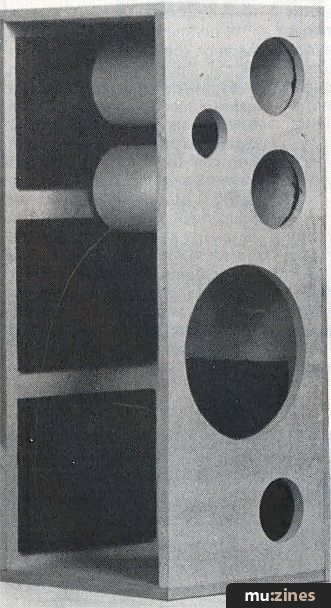
E70 showing tubes in place prior to fixing side panel.
The comprehensive nature of the kit can easily be ascertained from the photograph. Everything is there down to the last screw, the only items not to be found in the pack are those which it is felt that the purchaser could buy advantageously at a discount store, such as PVA adhesive or the Bostik 6 sealant, which is used to bond the laminated bituminous felt damping pads to the panels. The pads, though not essential, are included in the kit and the effect of the damping was proven by the comparative performance traces of Wharfedale's laboratory reference model and the kit version. The degree of improvement (where it occurs) is really only academic, since distortion is below 1% without the pads. Distortion, like the frequency response was measured at realistic working levels and the results were obtained in Wharfedale's own anechoic chamber. The traces did not receive any 'advertising adjustment' to produce a smooth as glass trace which only indicates trends not truth - the 'ragged' traces plucked straight from the plotter were, in fact, smooth by virtually any standard and particularly so when its original role as an efficient high quality 'discotheque' type system is taken into consideration.
So much for the performance, what about the hammer and nails aspect of the kit? Well, it is good news there because care rather than skill is the key to a successful project. All of the panels are ready cut to size, rebated and cut out as necessary. This makes assembling the enclosures both quick and easy with the added bonus of cleanliness, since all of the sawdust and mess was left at the factory. Detailed assembly instructions are included but there are a few tips worth mentioning, which if followed will reduce the total assembly time.
Build both units at once and proceed systematically, so that work can progress on one whilst adhesives are setting on the other, thus attaining an almost continuous work programme.
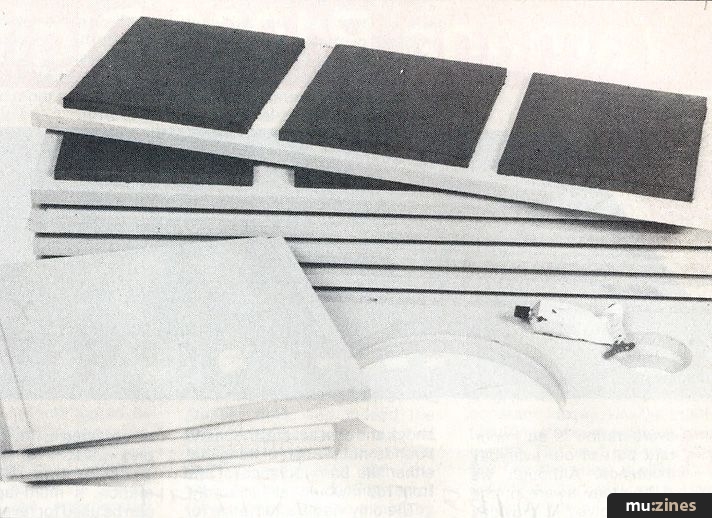
Damping pads - bonded to panels and stacked for best adhesion.
Construction
The construction is best tackled in stages with perhaps one or two being completed each evening.
1 - Identify the panels and other components.
2 - Select the panels requiring damping, and working with one pad at a time, coat it evenly with Bostik 6 and lay it in position. Repeat until the panel has the correct number of pads in place - do bear in mind the location of input sockets etc. Lay the next panel requiring damping directly on top of the first and repeat the process, stacking each in turn, finishing the pile with the undamped panels to provide additional weight and leave overnight.
3 - Check the instructions and identify panel edges requiring nails - pre nail.
4 - Lay adhesive evenly along panel edge to be joined and be sure to align the panels as the nails are driven home - this will correct any errors due to panel bending which could occur with improper storage.
5 - Remember to fit the midrange isolation tubes before attaching the final panel. In the event of a memory lapse do not panic because they may be fitted through the cut-out for the bass unit. A foam disc is glued to the capped end of each tube, making them difficult to slide into place, the solution is to place a sheet of paper (not soft or easy tearing) between the foam and the rear panel to provide 'lubrication', once positioned, the paper may be torn from around the tube base. The other end is sealed to the front panel with a fillet of Bostik 6, the same material also being used to seal the entry holes for the connecting wires.
6 - Cabinet finish is a matter for individual taste and may vary from a classy veneer to functional paint. Black is the usual choice for bands but grey may be more suited to a home studio. Dark grey satin finish emulsion looks good but may be difficult to obtain, in which case it must be mixed. A small tin of black, a larger tin of white and a third tin to mix it in are required. Mix sufficient of the desired shade to complete the painting of both enclosures - 'home-mix' paint which runs out before the job is complete is a regular ingredient of comedy, though when you are the star of the show it may not seem so funny.
Covering

Finished E70 prior to covering.
Those constructors not wishing to use paint may finish them in wood veneer, plastic laminate or PVC/fabric, whichever material is chosen systematic application will speed completion. Pre cut the panels and start by applying the left side of cabinet one, followed by the right side ensuring the cabinet is laid on its side on a smooth surface. The left side of cabinet two is covered and laid face down on cabinet one leaving side two uppermost ready for covering and once applied a weighted board can be rested atop to provide sufficient pressure. The same sequence is used for the other faces. If the cabinets are to be moved it is a good idea to fit runners or a base to prevent damage.
There is a tendency to make contact adhesives the first choice for bonding covering materials into place, but for the DIY constructor with time to wait for adhesive to go off, UniBond universal adhesive may prove a more suitable choice; it is free from heavy vapours, is applied to one surface only and is inexpensive. A word of warning, select an appropriate adhesive for the covering in use and ensure that the surfaces are dry and dust free because a poor bond will ruin the finish, with rectification being both difficult and time consuming.
Wilmslow Audio (Contact Details).
Publisher: Home & Studio Recording - Music Maker Publications (UK), Future Publishing.
The current copyright owner/s of this content may differ from the originally published copyright notice.
More details on copyright ownership...

Home & Studio Recording - Jan 1984
Donated & scanned by: Mike Gorman
Feature by Steve Taylor
Previous article in this issue:
Next article in this issue:
Help Support The Things You Love
mu:zines is the result of thousands of hours of effort, and will require many thousands more going forward to reach our goals of getting all this content online.
If you value this resource, you can support this project - it really helps!
Donations for July 2026
Issues donated this month: 0
New issues that have been donated or scanned for us this month.
Funds donated this month: £0.00
All donations and support are gratefully appreciated - thank you.
Magazines Needed - Can You Help?
Do you have any of these magazine issues?
If so, and you can donate, lend or scan them to help complete our archive, please get in touch via the Contribute page - thanks!
Please Contribute to mu:zines by supplying magazines, scanning or donating funds. Thanks!
Monetary donations go towards site running costs, and the occasional coffee for me if there's anything left over!

 @mu_zines
 RSS Feed
 Blog
Blog