


Magazine Archive
Home -> Magazines -> Issues -> Articles in this issue -> View
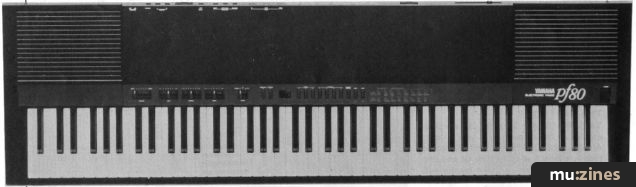
Yamaha PF70/80 Pianos | |
Article from Electronics & Music Maker, June 1986 | |
The PF10 and 15 proved how well FM voicing is suited to the electronic piano. Now those instruments have been updated, and Simon Trask has been listening to the results.
Hot on the heels of the successful PF10 and PF15, Yamaha unleash two new electronic pianos that use a couple of the DX synths' greatest strengths - FM for clear sound and MIDI for good connections. Do they make the piano's future rosier?

When Yamaha introduced their original PF10 and PF15 electric pianos (reviewed in E&MM August '84), MIDI had yet to become firmly established, and neither instrument sported the five-pin DIN. But the situation has changed, and nowadays it's not just synths that are MIDI'd; every variety of home organ and home keyboard has sprouted the dreaded socket, and now you can even MIDI your grand piano if you wish.
Cue Yamaha's new MIDI'd electronic pianos, the PF70 and PF80. Like the original PFs, the new machines are 76-note (A-C) and 88-note (E to G) versions of the same instrument. Both are 16-note polyphonic and both sport suitably professional-feeling (whatever that might mean) weighted keyboards for those players with pianistic inclinations.
But whereas the original PFs were very much stand-alone instruments, the inclusion of MIDI on the 70 and 80 makes them candidates for the role of master keyboard, alternatives to voiceless keyboard controllers such as Oberheim's Xk and Yamaha's KX88. Owners of the original PFs needn't tear their hair out in frustration, however; the Forte MIDImod for the PFs 10 and 15 is now available in this country.
The PFs are heavy. If you tried slinging one of these round your neck, you'd end up crushed to death. Maybe that's the price to pay (the weight, not death) for rugged construction and a substantial keyboard.
So what are the sounds that the new PFs have to offer? Well, there are ten in all: three pianos, four electric pianos, harpsichord, vibes and clav. Given Yamaha's recent track record in the voicing department, you'll not be surprised to learn that these sounds are FM-generated, not sampled.
The piano sounds are more electronic than acoustic, but an effective bunch nonetheless: one is a smooth, full-bodied sound, while another has more the character of an earlier pianoforte, and the third is a phased 'electric grand' sound.
The electric piano sounds range from a rich phased Rhodes type to a hard, bright, brittle sound. The harpsichord is convincing, if a little on the light side - more French than German, if you know your early instruments. The inclusion of a complimentary 'heavy' sound might have been useful (the earlier PFs had two harpsichord voices), though on the other hand, most musicians would probably prefer the extra piano sound, and the PF keyboard isn't ideally suited to harpsichord-playing anyway.
The vibes are pretty effective when adjusted to either a mellow or bright sound (courtesy of the inbuilt EQ, of which more later), and, of course, work particularly well sent through the PF's tremolo effect.
Finally, the clav is suitably bright, spiky and funky.
Preset sounds like the ones just described have instant appeal, but have a tendency to become dull after a while - especially if they're few in number. Luckily, both PFs have stereo chorus and tremolo effects built in, and whilst the former is a simple on/off affair, the latter incorporates adjustable speed and depth parameters. Both treatments can easily be switched in and out from dedicated front panel controls, and are programmable for each of the ten patches.
The three-band equaliser, activated by three sliders on the front panel, allows you to create a wider variety of timbral variation. Settings aren't programmable per patch, but the easy front-panel access allows you to set up different sounds very quickly.
And talking of front-panel access, the PFs' function parameters are organised in a fairly accessible way, though the limited display facilities afforded by the familiar two-digit LED are an irritation; surely Yamaha could have fitted a backlit or fluorescent LCD?
Parameters are divided into those that are common for all the PFs' patches, and those that are patch-specific. The former include master tune and transpose functions, along with common MIDI transmit and receive channels.
You can switch the attack-velocity response of the PF's own sounds on or off for each patch. This is useful, for instance, on the harpsichord sound. Harpsichords aren't exactly renowned for their touch-sensitivity, and it already feels strange enough playing a harpsichord on a piano-type keyboard, so every little helps. It's also possible to adjust the overall volume level of each PF sound, which can be useful where some sounds are inherently louder than others.

As befits a piano-style instrument, the PF has three pedal inputs: for sustain, soft and key-hold. The first of these will be familiar to most keyboard players, and using one of Yamaha's fancy FC4 or FC5 piano-type footswitches, it's possible to have four sustain levels which progressively alter the amount of sustain damping. The soft pedal does what it says, ie. mutes the notes played; the intensity of this effect can be programmed (0-8) for each patch.
The key-hold pedal is equivalent to the 'third pedal' found on more upmarket acoustic pianos. When depressed, it sustains only the notes that are playing, subsequent notes not being held - no longer do you need three hands for playing those ambitious classical and ELP pieces. Yamaha supply only their FC8 sustain footswitch as standard with the PFs, so you'll have to fork out a few more pennies to take full advantage of these foot-bound capabilities.
Like the original PFs, the 70 and 80 have an internal stereo amplifier and speaker system (rated at 18 watts per channel), which automatically cuts out when you insert headphones and may be switched off if you choose to use external amplification via the stereo outputs on the rear panel. Yamaha have even included an external audio input on the back panel, which means you can play a drum machine or another keyboard, say, through the PF70's internal speaker system along with the PF itself. It's a logical extension of having internal speakers in the first place, I suppose, and no doubt useful for anyone who'd rather splash out on a second instrument than on external amplification.
So what about the PF's qualifications as a controller keyboard? First, the (potentially) bad news. The keyboard itself is sensitive to attack velocity, as you'd expect, but not to pressure. Aha, I hear you say, but what sort of piano is pressure-sensitive? Not many, I grant you. But the point is that you may well want to take advantage of pressure-sensitivity on slaved MIDI instruments (for a volume swell or a filter sweep, or whatever else your particular instruments allow for), and if you do, the PF keyboard won't be of much help.
On the plus side, you can define internal and/or MIDI splits. This doesn't mean you can play two sounds at once on the PF, but setting an internal split-point (which can be anywhere on the keyboard) allows you to restrict the Yamaha's own sound to either an upper or lower section of the keyboard. So you could, for instance, be playing a PF piano sound on the upper section of the keyboard, and a DX7 bass sound via MIDI on the lower half. A sensible idea, all in all.
This feature really comes into its own when used in conjunction with the MIDI split. Again, you can set a split-point anywhere on the keyboard, but the PFs don't allow you to have overlapping MIDI and internal split-points - setting one automatically sets the other to the same value. One section of the keyboard (you decide which) is set to the MIDI transmit channel, while the other half is set to that channel number plus one.
Other MIDI features include separately-definable send and receive channels (1-16), note-event on/off (useful in conjunction with the internal split), patch-change on/off, pitch-bend range (receive only) and MIDI merge.
Each of the piano's patches can be allocated its own patch number (0-99) to be transmitted over MIDI when the patch is selected, which lessens the problem of aligning patches on different instruments which employ different counting systems for their memory locations; it's also possible to send a patch change manually from the PFs' front panel, which can be useful if you want to step through more than one slave patch for a PF sound.
You'll probably have noticed by now that the PFs don't include pitch-bend and mod wheels. OK, so you don't expect to find them on a piano, and maybe Yamaha were afraid that their inclusion would give the PFs a low-cred rating among traditionally-minded piano fans. But consider again these pianos' possible role as MIDI controllers: you might want to use mod and pitch-bending effects while playing or recording synth parts. Yamaha have thought of this, though, and have produced the MCS2 (yet to be reviewed in these pages) which you plug in between the PF and any slave instrument/sequencer, and which allows you to insert pitch-bend and mod data into the MIDI event stream using its own pair of performance wheels.
And just in case you're wondering what the 'MIDI merge' is, it allows incoming data on MIDI In to be mixed with your performance on the PF keyboard, and sent over MIDI Out. This is an interesting feature which allows you, say, to mix sequence data with your live playing, or to control slave instruments from both the PF and another MIDI machine simultaneously. This could be useful if you wanted to, for instance, use the PF's piano-type weighted keyboard for some parts and a synth-type keyboard for other parts, or to switch quickly from one set of sounds to another without having to do any re-routing.
Like their predecessors, the PF70 and PF80 are well-constructed, solid-sounding instruments with a wide enough range of sounds to satisfy those after a piano-type instrument as opposed to the (supposedly) endless sonic delights of a synthesiser. Whether or not you're going to prefer Yamaha's FM piano sounds to those of Technics' PCM versions, Ensoniq's samples, and Roland's SAS impressions is a question only you - and a fair bit of time spent playing and listening to each of them, I'd say - can answer.
With their newly-discovered MIDI facilities, these PFs are a viable proposition as controller keyboards in a MIDI setup, and can, of course, be used in MIDI recording.
The impending crop of new electronic pianos is ample evidence that the ol' Joanna is far from dead, and these new Yamahas, for their part, are evidence that digital synth technology has just as important a role to play in furthering the cause of traditional instruments as it has in shaping new ones.
Prices PF70 £899, PF80 £999; both RRPs including VAT
More from Yamaha-Kemble, (Contact Details)
Also featuring gear in this article

Publisher: Electronics & Music Maker - Music Maker Publications (UK), Future Publishing.
The current copyright owner/s of this content may differ from the originally published copyright notice.
More details on copyright ownership...

Electronics & Music Maker - Jun 1986
Scanned by: Stewart Lawler
Review by Simon Trask
Ads for Gear in this article:


Previous article in this issue:
Next article in this issue:
Help Support The Things You Love
mu:zines is the result of thousands of hours of effort, and will require many thousands more going forward to reach our goals of getting all this content online.
If you value this resource, you can support this project - it really helps!
Donations for September 2026
Issues donated this month: 0
New issues that have been donated or scanned for us this month.
Funds donated this month: £0.00
All donations and support are gratefully appreciated - thank you.
Magazines Needed - Can You Help?
Do you have any of these magazine issues?
If so, and you can donate, lend or scan them to help complete our archive, please get in touch via the Contribute page - thanks!
Please Contribute to mu:zines by supplying magazines, scanning or donating funds. Thanks!
Monetary donations go towards site running costs, and the occasional coffee for me if there's anything left over!

 @mu_zines
 RSS Feed
 Blog
Blog