Shades of Yello (Yello)
(IM Oct 86)


Magazine Archive
Home -> Magazines -> Issues -> Articles in this issue -> View
Yello - The Colour of Art | |
YelloArticle from Music Technology, January 1989 | |
Dieter Meier is a writer, painter, performance artist and an ex-professional gambler; he's also the face and voice in front of one of the most influential bands of the '80s. Tim Goodyer joins the Swiss race.
Better known for its cuckoo clocks and wristwatches than its musicians, Switzerland has given us one of the most innovative and influential bands of the decade. Yello.
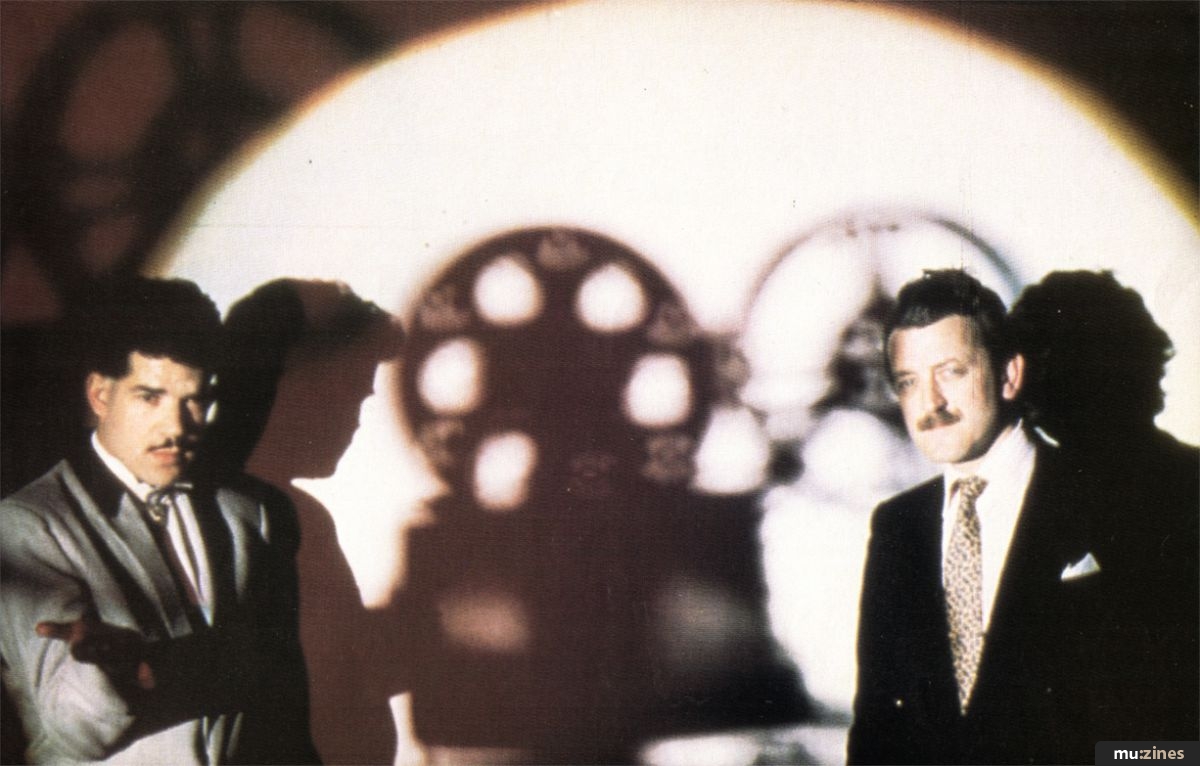
Any style of music, particularly fashionable music, has its "credible" influences. In most cases those influences are safely locked away in the past - aspects of bygone musical eras whose stars may be retired or even dead, or at worst artists that have moved on leaving their "best" work behind them. But ask many of today's most innovative artists for their influences and you're likely to find Yello pretty high on the list - yet not only are Yello still going strong, but they're as close to the roots that produced '83's classic 'You Gotta Say Yes to Another Excess' as the day they recorded it. Yello closed last year with two charting singles, 'The Race', and 'Tied Up', and a long player entitled Flag, all of which exhibit the same innovative approach to songwriting and production that spawned 'You Gotta Say Yes to Another Excess', 'I Love You' and 'Pumping Velvet'. Also inescapable is the eccentricity that has characterised Yello since their 'Solid Pleasure' debut in 1980.
Arriving at the Phonogram offices literally straight from his native Zurich, and with only a black coffee for refreshment, Yello frontman Deiter Meier is eager to talk about the events that have made Yello a seminal influence in popular music. Apart from his eight-year partnership with Boris Blank as Yello, Meier is recognised for his work as a film-maker, performance artist and one-time professional gambler. But let's begin with Flag.
"I insisted on doing something that was 100% Yello with our craziness, our voices" confirms Meier. "The last single, 'The Rhythm Divine', had been done with Shirley Bassey, it was a very nice song but it was not 100% Yello. With the new album I Felt like showing a flag of our new direction.
"Everyone said the song with Shirley Bassey was going to be a hit, but it was Yello pure - 'The Race', with all kinds of crazy noises and crazy voices - that made it. And this, of course, encouraged us to do the album as it is."
The "wackiness" of Yello's music and the "craziness" of the band's members is well documented, yet Meier and Blank have consistently produced music that is as innovative as it is individual. Meier maintains that Yello's character is a product of their Swiss background and what he terms their "provinciality".
"Yello is anarchy and precision - which is what Switzeriand is all about. Yello is very provincial, it's not an expression of any musical trend. You can't group Yello in any musical category - in America this is still our problem.
"If you come from the deepest provinces your only chance to be successful is to live your fantasies, to go back to your roots and not be influenced by anything else. Only by being 100% original can you hope to have international success. It sounds very contradictory - in order to be international you have to be provincial but if you come from London and you try to be international, you're part of a trend that is part of your roots. People grow up here with music, like in Spain they grow up with bullfighting and in Italy they grow up with bicycle racing - they have roots. Here you can he part of a trend and then develop your own thing. If you come from Zurich and you try to be international you're being ridiculous.
"Rock music has no tradition in France, Germany, Switzerland or in Japan. I always say it's like somebody who is a Japanese yodeller: what the hell is he yodelling? Swiss rock music is like a Japanese yodeller, it has no roots - it's a copy of a copy of something. Your music here is a combination of black soul, folk ... It is a conglomeration of lots of influences that created pop music which has its roots in this very country.
"In order to be successful you should not aim your life at success; success is something that comes as a sideline of your subjective truth."
Confronted with the influence Yello have had, and continue to have, over other popular artists, Meier responds with modesty and one of the references to painters that is to litter our conversation.
"It shows that we have done something of value, which is encouraging, but it's not for me a very important thing. Cezanne lived all his life in Aix-en-Provence. France is extremely centralistic and, in order to make a career, you have to be in Paris whether you are a prostitute, a singer, a painter or a writer - there is no such thing as making a career outside Paris. But Cezanne stayed in Aix-en-Provence and important young painters travelled to visit him until he became a very respected painter among the respected painters in Paris. I don't want to compare myself with Cezanne but the fact that he stayed away from the mainstream tendencies of painting of his time gave him the freedom to develop his style.
"But there's another thing that's been important for Yello, I must admit that this is very important, never in my life have I had to worry about money. So it is partly unfair when I say don't care about commerciality, because I never had to make my money with music. Same with Cezanne, his father was a banker and left him enough money to make a fool of himself all his life. This was my case and, after a while, was Boris' case because I decided we should do this together - I had some other income and we lived off this and developed Yello. It was an investment."
According to Meier, record company investment is at the roots of at least part of the problem facing music today.
"For the first time in the history of art I think the business is like a werewolf. There is this coincidence of young people doing the right thing at the right time, not knowing what they're doing, and they're being eaten up by the industry. After a year or two or three they don't know what happened to them, they don't have time to develop. Finding your identity is what art is all about. If you look at writers or painters, you have to give them time - a publisher works for 20 years with a writer, or a gallery for a long time with a painter. In this industry, it is more and more difficult for an A&R man to develop a young guy because, if the second album is not working he already has a problem. And the base of this very bad development is that the investment is getting bigger and bigger.
"Video didn't kill the radio star, video killed the young artist because it's all international mega products, with mega videos - if you want to compete in that race the investment is just ridiculous. The record companies are very scared to invest in artistically interesting programmes because they know they're looking at long development times. I think album six or seven was the first Pink Floyd album that sold, before they were an underground band. Then the yearly investment in a group was £30,000 or or £50,000 a year. These days, even in Germany, you're talking £300-400,000 yearly investment."
"Like a painter can mix colours and do with it what he wants on a canvas, you can do this for the first time in the history of music with the Fairlight."

Returning to his roots, I ask Meier about his own perception of Yello.
"Our concept was to become like kids, and Yello was our toy", he says. "It was nothing to do with the colour. We had all kinds of ideas of what we should call our band and I had the idea it should have a name that could be the name of a kid's toy - like Lego. Something that didn't mean anything but has a nice sound to it and is not pretentious - this was very important. The toy has become quite big, but it is still a toy."
And in keeping with the theme, Meier's account of his early days with Blank make his partner sound like an overgrown boy. The setting is Meier's small studio located on the first floor of a disused factory.
"Boris was a truck driver then, making money to survive. I'll never forget the way he'd come rushing in when work was finished, say 'hello' and he was up there. Five o'clock work was finished, five-fifteen he was at his machines. And he worked 'til 12 and produced more or less a piece a day. And for him the big pleasure was the next day in his truck he had a little cassette recorder and he could listen to his music. And then next, next... He had a whole suitcase full of tapes which he did like this."
Before the factory studio he set up with Meier, Blank had a studio installed in his kitchen. Today the Yello studio in Zurich is as well-equipped as any professional London studio. All three studios have one thing in common - the mess Blank has made of them and the instruments in them.
"When I met Boris he had his studio in a kitchen and it looked like a musical garbage tip - truly", recalls Meier with obvious amusement. "He'd drilled a hole through the wall and the recording room was in his bedroom. And he had all kinds of weird instruments - broken guitars, rusty trumpets, an old flute, a drum kit that was absolutely ridiculous. He's never had a decent instrument all his life, everything was kaput, even now his guitars, everything, is kaput. He's just bought himself a real bass but he has to demolish it before it's his bass.
"He likes to work out of a mess, it's very important - he hates clean studios, he loves a mess. We got a fabulous new studio about two years ago and it took him about one year to create a substantial mess in there. He has a sound library in the Fairlight of about 10,000 sounds that he's created. Each sound has a name, and when you read the names of his sounds it's like a novel on its own. The names of his sounds are so funny. And he doesn't have a register anywhere, all these diskettes and streamers are flying around the studio."
The effort of explaining Blank's working environment is obviously too much and Meier pauses to regain his composure before continuing.
"It would take an engineer probably five Years to get the studio in order after a year of Boris' messing it up. You can't walk in the studio because it's a cable salad. In Mickey Mouse they had an inventor who invented nonsense things in his little lab. This is how Boris works. But he needs it, it is his world, his home.
"Also acoustically it is ridiculous, we have just two very cheap old JBLs and they constantly are moved around by some cleaning lady. And the studio is just a room like this, no acoustic specialities - it's all bullshit anyhow, all this Eastlake, Westlake... But we have a nice room, you can open the windows and walk out into the garden and this is very important for us. Another engineer could not work in there, not a second.
"We had this visitor, some important producer, he was talking to Boris and, after about half an hour, he said 'now, Boris, can we see your studio?' because he couldn't believe this dirthole was the studio."
Nor are Blank's extraordinary studio antics limited to the mess in which he works. Like any true artist, be pursues his quest religiously. Meier continues, inspired ny his partner's eccentricity.
"When he mixes he doesn't have a track sheet, the bastard. One-hundred-and-twenty tracks, can you believe it? He hires in as many multitrack recorders as he needs - we used 120 tracks for 'Tied Up' - he starts knobbing around and he knows what's there for more or less every second of every track. It's unbelievable. We worked without a track sheet when we had an eight-track machine - OK you can remember eight tracks - but now this guy is like a conductor who can conduct a 150-piece orchestra after having read the symphony just once or twice. No track sheet!"
"Boris has never had a decent instrument all his life - he's just bought himself a real bass but he has to demolish it before it's his bass."
While Blank is obviously obsessed with music technology, Meier claims it makes him neurotic.
"I sit in there in my chair and I just listen and talk - I never touch any of these machines", he says. "Even to put a gramophone player in action is something I don't like. I have absolutely no connection with machines. I also have a bad influence on machines, they break down when they see me. True. Boris says I do.
"But this is very good in combination with Boris because I have no need to be in the studio, I'm only in the studio when I'm desperately needed. Boris has to call me three times to come to the studio. Normally everybody wants to be in the studio because it gives them the feeling of being important - to fly the engine, to fly the machine. I have no need for this."
Instead, Blank constructs the basis of the music in Meier's absence, calling on him only when he has something he feels is worth pursuing.
"I first hear a piece when Boris has the first sketches done - maybe a rhythm, maybe a bassline or just a sound - and he asks me what I think of it", explains Meier. "I encourage him, I tell him why I like it and give him ideas - verbal ideas, how he could go on with it.
"It's basically an encouragement for him to continue and not to worry too much. He is such a perfectionist that he sometimes loses his best sketches because he thinks they are not good enough. In the early days he was even too shy to play his ideas to me - it made him feel too naked. Now some of our ideas, like 'Tied Up' and 'The Race', are made out of sketches that would have been thrown away. Probably my only quality in music is that I have a very strong imagination for how something could sound at the end - whether something is rolling or not. I'm a very rhythmic person, I can dance very well, anything that has to do with throwing and moving I'm very good at. I'm a very good golf player. I often make bets when I come into a room, about whether I can throw this coin into..."
He produces a coin and searches for an appropriate receptacle. It seems this was not one of the considerations when Phonogram furnished the room. Meier considers the point made and we turn to the music itself. How does the some-time sculptor view his music?
"Of course it's a piece of music," he says, casually, "but in the process of making it, it becomes a film in our heads. When Boris has his sketch I encourage him in a certain direction and I develop a little story in my head. I develop a little character for the piece - they all have names these guys, crazy little names. I have to find a person to act in Boris' sound pieces. When I have found the guy I propose him to Boris and Boris directs me playing this guy.
"It is quite a contrast of styles we have. Boris is an incredibly talented musician who can do everything with his instrument - which is the studio. But because he is in the studio ten hours a day, be loses a certain distance from what he is doing. So he needs a director like a good singer or a good actor needs a director. I need a director as a performer - I don't think I'm a singer really, I'm more like an actor in Boris' sound paintings, in his invisible movies. And he's my director when I do this.
"Boris is like a Renaissance sculptor or a Baroque sculptor, and he does his David in sound - he really wants to have things right. He works ten hours a day until he has the perfect shape of a musical body. I have more of Jackson Pollock's approach - Jack the Dripper - I throw colours at canvases. I put my brush into pots of colour and it's either there or it's not there.
"And this is the total contradiction between our two methods and the reason we have incredible discussions when we produce - I'm encouraging him to be more spontaneous and to concentrate on the looseness and the expression of the musical body he's working on, and not the precision with which it's made. And he has to remind me that I should concentrate more on the result of how it sounds and not the gesture of doing it. This is what really makes Yello: he's precision and I'm anarchy. In our two characters the Swiss mentality is represented. This is why I think our music is - not on the surface, of course we are not yodelling or making Swiss folk music, our roots are not there - but in our methods of making it, it's very Swiss music, because of this contradiction of precision and anarchy."
We select 'The Race' as an example of Yello's story board approach to music and Meier relates the story-line.
"The character's name is Snootie Paulson. He's the guy who wants to do something but instead of starting somewhere and really doing it, he dreams of it. Snootie Paulson takes this steering wheel and sits in his chair in his room and dreams of winning 'the big race' - but he's not even started a race on a bicycle. This is the mistake most young artists make, they always think of doing something fabulous instead of doing something very small and unimportant that's right for them. It's like climbing a mountain - of course it's fabulous to be on top of Mount Everest, but doing it starts with lifting your first foot...
"In the video a character comes in and pulls Snootie Paulson back from his dream and says 'OK I give you a prize, now come back to the real world' - and his name is Willy Ratio."
In the Yello studio, where it's hard to distinguish where reality ends and fantasy begins, it is the Fairlight that presently holds centre stage. Now it's the state-of-the-art Series III, but Yello had one of the first Series Is and claim to have been working with it even before that.
"The power of the programmer, the power of the producer and the power of money - this is what's killing the radio star, not the video."
"We were working with the techniques before the Fairlight was invented. We were already working with noises, tape loops, transfers from one tape recorder to another... For us the technological progress did not change the quality of our work, just the quantity of it.
"The Fairlight was there in our heads before the Fairlight was there in our studio. It was just much more time-consuming to work. Now, for someone who works the way Boris works, the Fairlight is just the most incredible machine in the world.
"We used some little £300 synthesisers on Flag, but it is very misleading to call us a synthesised band because we use all kinds of sounds that exist in nature - we form them in such a way that the colour that comes out is usable for our sound painting. Synthesisers are probably only 10% of our sources, the rest is sound sculptures the way Boris does it. At the start of each piece there is no melody, but there is Boris' week- or month-long work on the quality of one sound or one note. Sometimes he works for four days on one bass note - like a painter has a dream of a dark purple colour that represents for him this and that.
"The artist Marcel Duchamp spoke of l'objet trouvé, the found object: his famous beer glass stand he declared a sculpture. You could call what Boris uses le don trouvé because he looks for sounds and finds them everywhere. Once we had a balloon for kids to ride on and he found out that when he was banging this balloon and swinging it at the same time this created the bass sound he wanted. He had an idea of a sitar-like Indian bass and the balloon gave him this sound. Once you get this sound digitally recorded, then you can form it like a sculpture.
"Unfortunately very few people work this way with this beautiful machine, the Fairlight. Instead they just buy programs. They have a sax and then they have a violin, then they have a guitar and a slide guitar . . . They play these things and feel happy when they've sampled some sounds from another record. But this is only 1% of this machine. This machine is so fascinating because it lets you create sounds without limits. Like a painter can mix colours and do with it what he wants on a canvas, you can do this for the first time in the history of music with the Fairlight.
"For our next album we want to use classical instruments in an unusual way - out of one violin you can create a thousand sounds: by banging it, by strumming it, by bowing it, by making the strings crack. There are an incredible amount of possibilities but always with the warmth and the specifics of the violin. On our next album you'll probably hear a whole piece just made out of one violin.
"But, of course, the Fairlight for many people is a devil. All interesting art is a meeting with the devil, this always was the case. I think a lot of people lose because, instead of playing the devil they are being played by the devil. When you come into a studio you have five specialists sitting there and you, as a musician, feel like a guy who is invited to fly through space. And you don't really know what's happening with your music, you might have a happy landing or you might have a landing where you totally lose your mind. Most people come in with their little song and then it's the producer. And his power is represented by the fact that he makes more money these days than the musician - if you have a four-peice or five-piece band each guy gets two points, if you have a good deal, and the producer gets six alone. The power of the programmer, the power of the producer and the power of money and the responsibility for money, this is
what's killing the radio star, not the video."
A few days before our conversation, Meier has been working in Switzerland on a new film called Snowball. All has not gone well - the Swiss producers have been dismissed from the project. He refers to the film as "a difficult baby" and the period as "probably the worst two working weeks of my life". But still he is optimistic. He prefers to blame the Swiss film industry rather than the producers for what has happened, and is still "very proud" of the film.
"You are very lucky, you have a very good TV station - Channel 4", comments Meier, "I think that changed the British movie industry. But in Switzerland and Germany it's very bad because the people there are the worst cultural administrators. They're very, very pretentious, stupid people who are only interested in what they think are 'educational' projects. And they want to be involved artistically themselves. This is the worst thing, when the administrators are artistic failures and now they are taking their revenge through their position.
"I'm lucky: the Polygram group is very much behind the Snowball project because they think it is a movie that lives of the image rather than a movie that uses images to narrate a story. And they think it's right for their new Compact Disc Video format.
"Who wants to buy a movie - even Casablanca, which is one of the best movies of all time - which they won't watch more than twice a year? But they might buy something like a new type of opera where the image is something that you want to see again and again, like you want to see a painting again and again or hear a certain piece of music again and again.
"Snowball is like an opera, in the absence of a better word, but it has a narrative. The difference between it and an opera is that people don't sing instead of talking. Only when people make music on a stage is there music made in the film. The rest of the music is just an important soundtrack to the images. A lot of the rest of it is just images; it's like a silent movie with the orchestra playing in the orchestra pit. The music is dramatising the image and vice versa. It's kind of an opera but more like a silent movie opera which is another contradiction."
Which is exactly how I feel about Dieter Meier after our conversation: apparently too eccentric and excitable to apply himself to the intricate arts of making films and music, the man has built a reputation that will outlive that of most other contemporary artists.
Still there is no indication he feels satisfied with his work. I ask him when he will tire of his toy Yello.
"I hope when I'm 107 and killed by lightning in the Sahara when they have the first rain in 500 years" comes the reply without a trace of hesitation. "I cannot see any end.
"The only thing that's changed is the playground has become more accessible. If you have been successful, people throw money at you much more readily. It has never to do with the project, it just has to do with the fact that you're successful. Our music has always been Yello but it's only now that we get the front page of Melody Maker, only now that we get a Top 10 hit. We're enjoying it tremendously but it has its other sides: you have to be careful not to go on in the administration of your growing circus. At the end of the day you're still a clown or a trapeze artist, not the manager of a circus."
More with this artist
 |
 Point Blank (Yello) |
 Race Against Time (Yello) |
 Yello (Yello) |
 Baby Boom (Yello) |
 True colours from Yello (Yello) |
Publisher: Music Technology - Music Maker Publications (UK), Future Publishing.
The current copyright owner/s of this content may differ from the originally published copyright notice.
More details on copyright ownership...

Music Technology - Jan 1989
Interview by Tim Goodyer
Help Support The Things You Love
mu:zines is the result of thousands of hours of effort, and will require many thousands more going forward to reach our goals of getting all this content online.
If you value this resource, you can support this project - it really helps!
Donations for August 2026
Issues donated this month: 0
New issues that have been donated or scanned for us this month.
Funds donated this month: £0.00
All donations and support are gratefully appreciated - thank you.
Magazines Needed - Can You Help?
Do you have any of these magazine issues?
If so, and you can donate, lend or scan them to help complete our archive, please get in touch via the Contribute page - thanks!
Please Contribute to mu:zines by supplying magazines, scanning or donating funds. Thanks!
Monetary donations go towards site running costs, and the occasional coffee for me if there's anything left over!

 @mu_zines
 RSS Feed
 Blog
Blog