


Magazine Archive
Home -> Magazines -> Issues -> Articles in this issue -> View
Zypher Electronics Digi-Atom 4800 | |
Analogue-to-MIDI converterArticle from Electronics & Music Maker, September 1984 | |
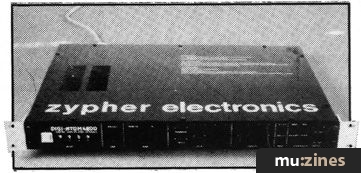
The first of its kind to appear on the UK market, the Digi-Atom is a CV-to-MIDI converter that allows old analogue equipment to be used in conjunction with new MIDI gear. Paul White again.
Whatever else you may think of it, MIDI is definitely here to stay, and the Digi-Atom is the first interface that enables musicians to use analogue equipment with hardware of the new standard.
The introduction of MIDI has solved a number of problems for the modern musician, but it has also created a few headaches.
Because electronic equipment has become so reliable, there are a great many analogue synths, sequencers and drum machines, all capable of producing musically viable sounds, that will refuse to lie down and die for a long time to come.
Specification
The Digi-Atom enables up to eight CV and trigger inputs to be converted to MIDI code and squirted down a five-pin DIN lead in various different manners, depending on the mode selected. Dynamic information may also be interpreted by the interface, and four additional sockets are provided for converting CVs to modulation, bend, release and 'option' information, the possible options depending on the type of poly-synth being controlled. There is no MIDI In connection (the Digi-Atom is a purely one-way device), which precludes syncing to a MIDI drum machine, but a sync input is provided for use with Roland drum machines, enabling the TR606, 808 and even the Bass Line to be successfully used within the system.
Modes
Only three MIDI channels may be addressed by the Digi-Atom, and these are dictated by the Output mode selected.
Mode 1 opens up MIDI Channel 01 and carries four-voice polyphonic information with independent velocity response, while Mode 2 allows eight-voice polyphonic information to be transmitted on Channel 01 but without velocity information. Mode 3 opens up channels 01 and 02, the first channel carrying four-voice polyphonic information with group velocity and the second carrying two-voice polyphonic data, again incorporating group velocity. Lastly, Mode 3 opens up Channels 01, 02 and 03, Channel 01 being four-voice polyphonic with group velocity, and channels 02 and 03 being monophonic, the latter including velocity information.
Construction
Housed in a functional-looking 1U high 19" rack case, the front panel contains the trigger and CV sockets, which accommodate mini-jacks. The current mode is indicated by green status LEDs, and these may be stepped through by means of the mode selector button.
On the CV In panel are two slide switches. The first of these is labelled Transpose, the L position giving the full MIDI range of 10% octaves, corresponding to 128 keys. The H position sets middle C to code 24, for devices with a more limited pitch range such as the Roland MC202. The second switch (labelled A/B) is used only during tuning calibration, and this procedure is described adequately in the handbook.
"The electronics consists of a dedicated microprocessor system which scans the analogue inputs via ADCs, effectively converting notes into digital codes."
After the Mode section come the MIDI out DIN connector and the Sync In DIN socket, which is parallel wired to the adjacent 'Patch Out' socket for chaining.
The electronics consists of a dedicated microprocessor system which scans the analogue inputs via analogue-to-digital converters, effectively converting notes into digital codes. These codes are then embedded in MIDI command messages and despatched via the MIDI Out socket without any perceptible delay.
There are in fact a variety of different configurations in which the Digi-Atom system may be used, and several examples are outlined in the user's handbook, including patching diagrams. The handbook contains a wealth of potentially useful information, but this is presented in such a way that it could be considered intimidating by someone who has only recently encountered MIDI. The copy that we received had a footprint on the cover and several more inside: could they be a sign of the previous owner's frustration?
Conclusions
This unit is by no means cheap, and the restrictions outlined above must be seriously considered before any firm decision to purchase is made. If all you have is an MC202, there's not much to be gained from buying the Digi-Atom, as it costs about the same as a MIDI sequencer.
The high cost is probably due to lack of confidence on behalf of the manufacturer. If Zypher Electronics are only going to build a few at a time, then the Digi-Atom's price will stay high and sales will be limited. If, on the other hand, they saw fit to adopt the usual positive Japanese approach and produce these units for around £200 in the sure and certain knowledge that they would sell in their thousands, then sell they would, and the benefits of mass production would allow them to make a reasonable profit without having to charge prices that many people consider unacceptable.
The Digi-Atom 4800 has an RRP of £799 including VAT, and further information can be obtained from London Rock Shop, (Contact Details).
Also featuring gear in this article

Publisher: Electronics & Music Maker - Music Maker Publications (UK), Future Publishing.
The current copyright owner/s of this content may differ from the originally published copyright notice.
More details on copyright ownership...

Electronics & Music Maker - Sep 1984
Gear in this article:
Review by Paul White
Ads for Gear in this article:

Previous article in this issue:
Next article in this issue:
Help Support The Things You Love
mu:zines is the result of thousands of hours of effort, and will require many thousands more going forward to reach our goals of getting all this content online.
If you value this resource, you can support this project - it really helps!
Donations for July 2026
Issues donated this month: 0
New issues that have been donated or scanned for us this month.
Funds donated this month: £0.00
All donations and support are gratefully appreciated - thank you.
Magazines Needed - Can You Help?
Do you have any of these magazine issues?
If so, and you can donate, lend or scan them to help complete our archive, please get in touch via the Contribute page - thanks!
If you're enjoying the site, please consider supporting me to help build this archive...
...with a one time Donation, or a recurring Donation of just £2 a month. It really helps - thank you!

 @mu_zines
 RSS Feed
 Blog
Blog