


Magazine Archive
Home -> Magazines -> Issues -> Articles in this issue -> View
AB Graphic EQ | |
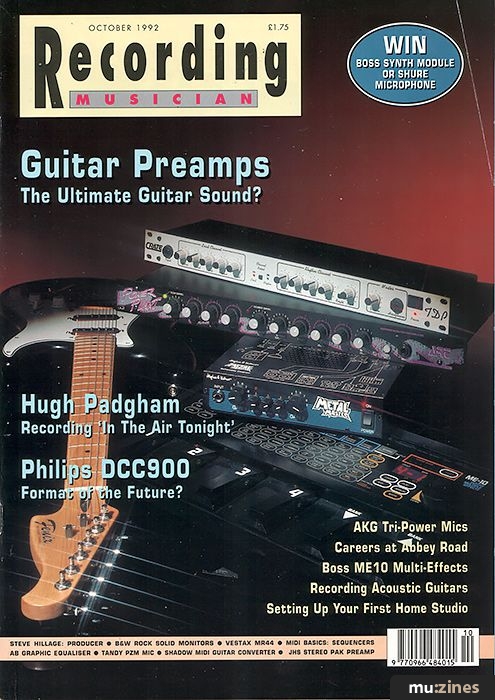
Article from Recording Musician, October 1992 | |

AB's graphic equaliser is closer to the budget end of the spectrum than the esoteric, but it incorporates some careful design work and has a good performance to cost ratio.
The complete AB range embraces single and dual-channel 31-band equalisers, as well as a dual-channel 15-band model, though for the purpose of this review, we picked the biggest! Even so, the 62 sliders, six knobs and four buttons all fit onto the front panel of a 2U rack case and, though the cosmetics are definitely utilitarian, at least the control positions are nice and clear.
The 31 slider-controlled filters are constant Q types and have a centre-frequency accuracy of 3%. In addition, there are high-cut and low-cut filters which have a usefully sharp 12dB per octave slope and are variable over the frequency ranges 10Hz to 250Hz and 3kHz to 40kHz respectively.
The unit is powered directly from the mains and has a passive bypass that links the input directly to the output when the bypass switch is operated. There's a ground lift switch on the rear panel and the signal input can be fed in via balanced XLRs, balanced jacks or unbalanced phonos — input level controls are fitted. The system headroom of 26dB balanced or 20dB unbalanced ensures that the unit will operate comfortably with either -10dBV semi-pro systems or +4dBu professional equipment. RF filtering is built in to help reduce the effect of high frequency interference.
The 25mm sliders have click detents at their centre positions, and a range switch is provided which changes the filter cut/boost range from +/-12dB to +/-6dB, which makes life easier when using such short slider. This switch has LED status indication, while a further LED indicates signal clipping.
As an additional tone control for creating new sounds from guitars, basses and so on, the AB 231 is very effective and is far more intuitive to set up than something like a parametric equaliser. It is also useful for tweaking finished mixes, so long as you are careful not to use more EQ than you have to. The circuitry is sensibly quiet, though you have to be aware that any form of high frequency boost will also boost any noise present in the sound being processed.
Just out of curiosity, I tried to combine the actions of the equaliser sliders and the low-pass filter to set up a speaker simulator treatment, with a view to DI'ing a standard overdrive pedal. The low-pass filter needs to be set right down at 3kHz and then the graphic section can be used to warm the sound up a little, with a touch of 100-200Hz boost and a little bite added by boosting between 1 and 2.5kHz. It isn't perfect in this role, but if you don't have a dedicated guitar processor or a pukka speaker simulator, you can produce some very worthwhile sounds this way. The high-pass filter also helps remove guitar hum without robbing the sound of too much punch.
The addition of the sweepable high and low-pass filters make all the difference between just another budget graphic and one which offers something extra that is truly useful; the choice of XLR, jack and phono connections is unusual in this price range. While graphic equalisers will never set the world alight (unless you replace the fuses with silver paper!), they are intuitive to use and make good general-purpose equalisers. As such, the AM models offer exceedingly good value and are more versatile than most budget models.
Further Information
AB 231 £334 including VAT
Key Audio Systems Ltd, (Contact Details).
Publisher: Recording Musician - SOS Publications Ltd.
The contents of this magazine are re-published here with the kind permission of SOS Publications Ltd.
The current copyright owner/s of this content may differ from the originally published copyright notice.
More details on copyright ownership...
Recording Musician - Oct 1992
Review by Paul White
Previous article in this issue:
Next article in this issue:
Help Support The Things You Love
mu:zines is the result of thousands of hours of effort, and will require many thousands more going forward to reach our goals of getting all this content online.
If you value this resource, you can support this project - it really helps!
Donations for September 2026
Issues donated this month: 0
New issues that have been donated or scanned for us this month.
Funds donated this month: £0.00
All donations and support are gratefully appreciated - thank you.
Magazines Needed - Can You Help?
Do you have any of these magazine issues?
If so, and you can donate, lend or scan them to help complete our archive, please get in touch via the Contribute page - thanks!
If you're enjoying the site, please consider supporting me to help build this archive...
...with a one time Donation, or a recurring Donation of just £2 a month. It really helps - thank you!

 @mu_zines
 RSS Feed
 Blog
Blog