


Magazine Archive
Home -> Magazines -> Issues -> Articles in this issue -> View
Acoustic 220 Bass Head | |
Article from In Tune, May 1986 | |
Back on the U.K. scene after several years' absence, America's renowned Acoustic bass amps are again attracting attention from British players. In Tune checks out their 220 watt head.
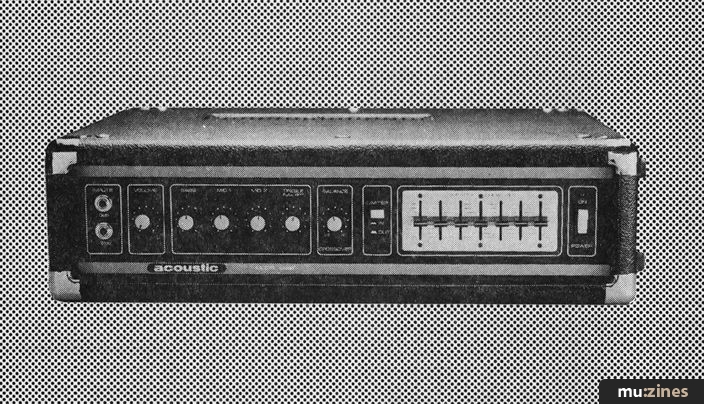
For many years now, America's Acoustic range of bass amps has been among their market leaders. Other brands have come and gone, but since these Californian made amps first appeared (almost twenty years ago now) they've been right at the top of the tree, attracting such users as Jaco Pastorius, Earth Wind & Fire, Queen's John Deacon, Led Zep's John Paul Jones, Larry Graham — the list of name players using Acoustic has been endless. In fact, prior to the challenge afforded by Britain's Trace-Elliot, Acoustic possibly reigned supreme among pro bassists. Now, after an absence of several years from the British market (due in no small part to the artificially high value of the U.S. Dollar against the Pound) the Acoustic range is back again, vying for sales with the very best from our own shores. To see how 1986's Acoustic amps compared, we borrowed a 220 head from distributors Scott-Cooper marketing.
CONSTRUCTION & SPECS
Sturdily packaged in a vinyl wrapped wood casing, the Acoustic 220 head (the model number relates to the unit's RMS output in watts into a 4 Ohm load) is the middle one of three bass heads offered by this maker, the other two delivering 120 and 320 watts RMS respectively. Cosmetically it follows typical Acoustic tradition, having a tough carrying strap on the thin end of its 20 3/4" x 6" x 14 1/2" body. Weighing 30lbs. it's quite heavy for a bass amp, but seems tough and workmanlike in all respects.
Electrically, however, we were very unhappy about certain aspects of the way in which this amp had been, ostensibly, converted for the U.K. market. To begin with, the mains cable had a moulded U.S.A. standard three-pin plug fitted — this was useless. Secondly, the mains wiring was not of the proper fireproof type suitable for the U.K., and worse still the colour coding on the mains lead ran White, Black and Green. To most British musicians this convention is meaningless, and it could result in a potentially dangerous misunderstanding of which colour relates to the proper standard for the UK, which is Brown=live, Blue=Neutral and Green/Yellow=Earth. If you must wire an amp connected with this standard of American wiring to a British three-pin 13 amp mains plug for U.K. use (firstly, of course, checking that it is correctly set for U.K voltage — i.e., set to 220/240 volts) then the correct conversion is Black=Live, White=Neutral and Green=Earth. Wire it any other way and you could be in serious trouble!
Almost as bad was the presence on the Acoustic's back panel of a mains outlet socket. These are acceptable in the U.S.A. and some other countries, but are not kosher for the U.K., and Acoustic must blank this off (as do Fender, Peavey, Sunn et al) before shipping it to this market. Finally, is 220 volts A.C. the right voltage anyway?! True, the amp will run in the U.K. when set thus (we tried it and it worked satisfactorily), but it really should be set to our domestic standard of 220/240 volts. Given the nonsense surrounding American standards in car exports to their market, it is only right that they should reciprocate in electrical goods!
Having said this, Scott-Cooper (the U.K. agents for Acoustic) took our comments immediately to heart, and have promised us that future Acoustic imports will be properly converted. This is, of course, good news; but be careful if you happen upon one of the incorrectly converted types, and insist that it is set-up properly for U.K. use before you part with your money!
But what about the amp itself? Well, it's jam-packed with facilities, and represents just about all you could ask of a modern bass head. Starting with the back panel, the mains lead is a fixed type, but wraps around a well designed pair of storage posts which stop it trailing all over the floor when you shift the amp around. Speaker connection is via a pair of standard 1/4" jack sockets (fused) and these are followed by a variety of pretty essential 'extras' for a Pro bass head, including a power amp input, pre-amp output, balanced XLR output (for mixer feeds), effects send and return sockets and (very handily) two Crossover outputs, one feeding high frequencies, the other delivering lows. By directing either of these outputs into the power amp input, you can save on the cost of having two outside power amps, because you can employ the Acoustic's own internal power amp for either highs or lows, and use just one subsidiary power amp for whichever end isn't using the internal one. Incidentally, a front panel balance control allows you to decide the amount of feed sent to either the high or low outlets.
The 220's front panel is also nicely comprehensive. Two inputs (0 and -12dB) are linked to a single volume control, which is followed by a nicely extensive tone control stage using rotary pots. These are labelled Bass, Mid1, Mid2 and Treble (the latter having a Pull/Bright option), and they provide ±12dB @ 60Hz (Bass), ±15dB @ 280Hz (Mid1), ±12dB @ 400Hz (Mid2) and +15dB @ 1.2kHz (Treble) with the Pull/Bright adding a 'tweak' of +12dB @ 2kHz. This, as you can imagine, is a highly impressive range of tone controls — but there's more to come, because the 220 also has a very tasty graphic equaliser section, providing seven band control at ±12dB on frequencies set at 40, 80, 160, 640, 800 and 1,500Hz — a very sensibly chosen range. Finally, for those who like them a limiter/compressor is also provided, alas not on a rotary/variable basis, but with a fixed, neon indicated setting which maintains the amp at just below clipping outputs, even when used to its maximum power.
IN USE/THE SOUND
Humming into life when you push the front mounted mains switch, the Acoustic settles down an impressively quiet level of operation. Even when the tones are used (provided you apply a little common sense!) the hiss and background noise levels are very well restrained, and demonstrate both Acoustic's pedigree and their experience with working pro players. Even relatively low noise levels aren't acceptable in the studio, and the 220 is very well suited to recording uses in this respect.
Power from the amp is equally smooth, and very high. Run into a test set of 12" speakers wired to give the optimum 4 Ohm load, the output at maximum was superbly meaty, and having the limiter set 'in' certainly does hold the amp back from unwanted overload sounds, even when the volume control is set to full wellie.
In terms of its character, this is a very precise sounding amp. The absence of a master volume control implies this, as it restricts you from getting overload/distortion bass sounds at low levels; and that makes the Acoustic best suited for those bass players who like clean power, with really exact control over their sound. Almost analytically clean, the sound would be perfect for Jazz/Rock and slapping (it seems to exhibit a usefully fast 'rise time' on percussive notes) as well as Pop, Country, Electric Folk — just about any bass uses, in fact, where you didn't want a really heavy Rock growl.
CONCLUSION
Although not cheap, the Acoustic 220 head is a very fine sounding bass amp, particularly suitable for players who want maximum tonal control and a really impressive clean bass sound. We have some serious reservations about the wiring and conversion for the U.K. market on our sample, but are assured that future models will be o.k, in these respects. We certainly hope so.
Assuming that all is well in these safety areas, the Acoustic can give even a Trace Elliot head a run for its money in terms of tonal facilities and in/out options, and in many ways is worth comparing one against the other if that's the sort of class of bass amp that you are aspiring to. Given the price advantage of the Acoustic, it's quite possible that you could even think it a better buy than the equivalent T.E. We weren't, unfortunately, able to do a direct side-by-side comparison; but, working from memory, we'd be hard pressed to choose between these two makes.
Is the Acoustic head worth trying? For the right player, you bet it is!
RRP £515.14
More info, from Scott-Cooper Marketing Ltd., (Contact Details).
Publisher: In Tune - Moving Music Ltd.
The current copyright owner/s of this content may differ from the originally published copyright notice.
More details on copyright ownership...

In Tune - May 1986
Gear in this article:
Review
Previous article in this issue:
Next article in this issue:
Help Support The Things You Love
mu:zines is the result of thousands of hours of effort, and will require many thousands more going forward to reach our goals of getting all this content online.
If you value this resource, you can support this project - it really helps!
Donations for June 2026
Issues donated this month: 0
New issues that have been donated or scanned for us this month.
Funds donated this month: £0.00
All donations and support are gratefully appreciated - thank you.
Magazines Needed - Can You Help?
Do you have any of these magazine issues?
If so, and you can donate, lend or scan them to help complete our archive, please get in touch via the Contribute page - thanks!
If you're enjoying the site, please consider supporting me to help build this archive...
...with a one time Donation, or a recurring Donation of just £2 a month. It really helps - thank you!

 @mu_zines
 RSS Feed
 Blog
Blog