


Magazine Archive
Home -> Magazines -> Issues -> Articles in this issue -> View
Akai's Hot Stuff | |
Article from In Tune, February 1986 | |
Within hours of closing for press on this month's IT, Akai revealed their new gear for the coming year! We despatched Nick Graham, notebook in hand, to compile this Stop Press review.
Akai are a company with a mission. As relative newcomers in musical instrument technology they are determined to make further inroads into the professional and semi-professional markets, and they think that 1986 is the year to do it. With a view to this, they will unveil at Frankfurt a number of new products which are all 'state of the art' machines at very reasonable prices, and although I couldn't actually try any of the forthcoming goodies for myself, it was clear from the photographs and the technical specifications that the name Akai is going to mean a lot more to musicians in '86 (always assuming, of course, that the machines in question work exactly as they're supposed to do!). What really made Akai's name last year was the introduction of their S612 digital sampler. Coupled with the MD280 quick disc drive, this provided high quality, easy to use 12-bit sampling at a price which was well within the reach of musicians and small studios alike.
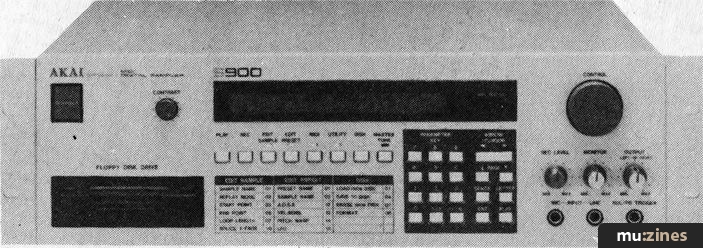
Within six months, this product had outsold all its rivals and given Akai a definite lead in sampling technology. It comes as no surprise, therefore, to find that at the head of their list of new products is another world-beater - yes, you've guessed it. Akai have another superb rack-mounted sampler, the S900 8-Voice Polyphonic Digital Super Sampler.
In the words of their own publicity, the S900 is 'ready to beat all newcomers', and it's no idle boast. The S900 is 12-bit (like the S612), but offers a stunning 12 seconds of sampling (40kHz sampling rate) at full bandwidth (20 Hz to 16kHz), extending to 45 secs, at minimum bandwidth (20Hz-40kHz). It can be used as an 8-voice polyphonic sampler or with 8 individual mono voices, and has a 6-octave range and full MIDI protocol. Moreover, the S900 allows a maximum of 32 different samples or split point programmes, and has a wide range of editing features including two modes of looping, full ADSR/loudness control. Velocity and Positional cross fade, Attack Pitch Offset, LFO, Filter and Sample merge.
The machine occupies 3 units in a 19" rack and has a built-in 3.5" IM6 double track, double density drive. Prospective users will also be very happy to hear that the machine formats ordinary blank discs, making data storage incredibly cheap. Akai have also provided a range of optional software which will expand the possibilities of the S900 still further; for example, making it into a short period digital recorder with punch in and out, or a comprehensive sine wave synthesiser. To cap all this, the price of this incredible machine will be RRP £1599 - low enough to make recent purchasers of the S612 and MD280 kick themselves. However, Akai say that although samples will be available for review shortly after Frankfurt, the S900 won't be the shops until May. Start saving!

Two new keyboards and a rackmounting synth module also feature in Akai's Frankfurt lineup. These are the MX73, a keyboard controller with 6 octaves and everything else you'd expect from a modern touch-sensitive MIDI mother keyboard (RRP £499); the AX73, similar to the MX73 but incorporating a one-oscillator analogue synth (RRP £699), and the VX90 (RRP £499), a 2-unit 19" rack-mounting synth module which roughly corresponds in performance to the onboard synthesiser in the above-mentioned AX73. Akai have made it clear that the AX80 synth will stay in the range, but in appearance and specification the new keyboards have little in common with the AX80, so it's difficult to predict how they will actually perform. On paper they look impressive, especially considering the price; but only a 'hands on' will confirm this.
Turning now to the area of control, Akai have developed a MIDI Recorder and System Controller, which actually consists of three separate units. The CPZ1000 'brain' is a rack-mounted MIDI Music Computer with integral 3.5" disc drive, and it takes its commands from the RZ1000, a remote unit with a keypad from which data is entered. Completing the package is the MZ1000, which is a green screen VDU. Claimed as a comprehensive 16-track real time/step time MIDI recorder, the system has among its features a built-in SMPTE/EBU generator and the facility to record three separate MIDI sources simultaneously in real time on different tracks. Total memory is 50,000 events — more than enough for your next concerto — and the price is a competitive £1599 for the three items.
I sincerely hope that when the system is switched on, the display that appears on the screen is a musical stave and not just another mathematical grid. Editing and step time composition are so much more interesting when you're visually dealing with actual notes on a stave. It will also be interesting to see how this product and other dedicated musical processors fare in the face of competition from some of the superb music software which is now being written for personal computers.
Still on the subject of control, two new MIDI effectors are also to be launched, joining the three already available. The new items are the ME25S, a programmable MIDI note separator, and the ME30P - a programmable MIDI patchbay! Effectively, the ME25S provides the facility for splitting a non-split keyboard with four optional splits, while the ME30P enables quick selection of complex MIDI routings. Each occupies 1u of a 19" rack, matching the size, but not the appearance, of previous models in the range.
Finally, Akai have designed a fully programmable eight-channel audio mixer with complete MIDI compatibility and SMPTE time coding options. All the front panel functions can be stored in RAM for instant recall, and up to 99 setups can be programmed. Without going into further detail on the lengthy specifications, this looks like a very interesting piece of equipment, and I can't wait to get my hands on one! At £1299 the MPX820 may seem a bit expensive, but this also includes automated fading, panning, cues, incredible quality (EIN<-128dB, THD<0.04%) etc. etc.
By now, you must have come to the same conclusion as me - Akai are going for it! They've even introduced new professional monitor speakers - the MS200s (RRP £249), a new professional, three head, closed loop, dual capstan cassette deck - the GX912 (£499), and the ML14, an SMPTE-equipped autolocate for the MG14D 1/2" cassette multitrack recorder.
If Akai's previous record is anything to go by, all the new products will be competitive, well engineered and designed, and generally pleasant to use. However, their ace is definitely the new S900 sampler, which I look forward with great anticipation to reviewing for these hallowed pages soon. Till then, just think of that amazing technology which manufacturers the world over are at this very moment assembling for the Frankfurt Toy Fair — sorry, Music Fair! It's enough to give you...
More information on Akai products from Akai (UK) Ltd., (Contact Details).
Publisher: In Tune - Moving Music Ltd.
The current copyright owner/s of this content may differ from the originally published copyright notice.
More details on copyright ownership...

In Tune - Feb 1986
News by Nick Graham
Previous article in this issue:
Next article in this issue:
Help Support The Things You Love
mu:zines is the result of thousands of hours of effort, and will require many thousands more going forward to reach our goals of getting all this content online.
If you value this resource, you can support this project - it really helps!
Donations for June 2026
Issues donated this month: 0
New issues that have been donated or scanned for us this month.
Funds donated this month: £0.00
All donations and support are gratefully appreciated - thank you.
Magazines Needed - Can You Help?
Do you have any of these magazine issues?
If so, and you can donate, lend or scan them to help complete our archive, please get in touch via the Contribute page - thanks!
Please Contribute to mu:zines by supplying magazines, scanning or donating funds. Thanks!
Monetary donations go towards site running costs, and the occasional coffee for me if there's anything left over!

 @mu_zines
 RSS Feed
 Blog
Blog