


Magazine Archive
Home -> Magazines -> Issues -> Articles in this issue -> View
Big Troubles | |
Ellis, Beggs & HowardArticle from Music Technology, August 1988 | |
Recently seen effortlessly blowing Bo Diddley and Ron Wood off stage, Ellis Beggs and Howard have been compared to the Rolling Stones in musical significance. Tim Goodyer rediscovers rock 'n' roll.
If you ve been wondering about the future of rock 'n' roll, wander no further - Ellis, Beggs & Howard believe they have the answer: they are the future.
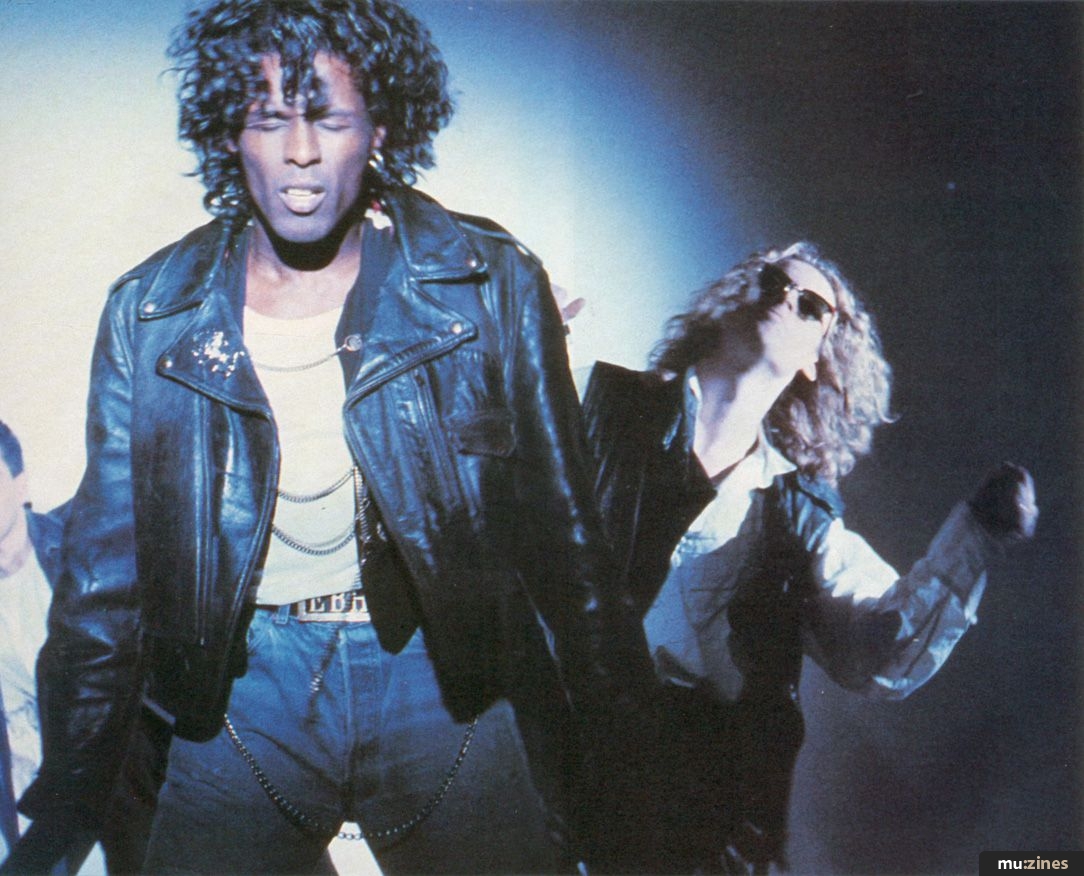
Ellis, Beggs & Howard, where do you start? Energetic? Yes. Good Looking? Most certainly. Categorisable? Not readily. Pretentious? Well, Simon Ellis did tell me that if he heard Rick Wakeman play a lick he couldn't, he'd go home and cry. Not exactly the sort of confession you'd expect to hear in 1988. Meanwhile Nick Beggs is laughing at the press that are still laughing at him for his time with Kajagoogoo, and playing the Stick (the Chapman variety). Austin Howard? Well he's into serious soul singing and pink 'n' black silk trousers.
Their musical tastes and ideas are as varied as their backgrounds. The debut single, 'Big Bubbles, No Troubles', is as smooth a piece of funk as ever filled a dancefloor but comes backed with 'Rock Me' which does just that with sampled-and-looped drum tracks. Are Ellis, Beggs & Howard just another rock band?
"I think that's what people want", comments Beggs, "because rock stands the test of time. It's the only phenomenon which is the real epitome of what popular music is all about. Rock music inspires people to a greater degree than reggae or funk. Rock music is more raw, people can relate to that energy. It's more stage-orientated music. Being a live band is something that will perpetuate a band. And unless you play live you won't get much of a following, especially in America.
"You can either do it the Pet Shop Boys' way or the U2 way. I know which I'd rather do.
"I saw a thing on Wired recently about how Zeppelin had influenced a lot of people. They had John Paul Jones with The Mission on, and all these '70s-orientated bands. But I think it's going to go a stage further than that, I think we're going to see bands coming out sounding like Bad Company. I think that's where we're coming from: that sort of '70s rock and soul feel. Our soul is Austin, he's taken those influences from his earlier days and, in turn, we get inspired by them."
But the rock parallel isn't limited to the music itself - Ellis, Beggs & Howard also believe in proving themselves on the stage in the best tradition of '70s rock bands.
"It would have been the easiest thing in the world to go with a big video and the big record company hype for the single, and go straight to the top of the charts", Ellis explains. "But we said 'let's build a following first, let's earn ourselves a reputation'. We didn't even have to play live if we didn't want to, but we thought it was so important to build up a following. The industry is so messed up, in this country anyway, that if you're not in the charts then you're not going to get the media coverage and all those snowballing things that make a band what it is. The alternative is to hang around for six years and release five albums and have no hits like U2 and Simple Minds. Basically we want to make people aware that there are other things in music coming along - like us. Something is going to happen to music soon - I don't think it'll be like punk, punk could never happen again - what I think will happen is that there will be bands like us."
"I feel it's the right time", agrees Beggs, "because I hate everything else that's going on. We're lucky really because we're sitting here at a time when a certain type of music has reached its zenith - in a way it's kind of a reaction. The positive thing about punk was that it happened when everything else drossy was around. I loved Yes and all those dinosaur bands that they were reacting against, but there was this very positive kinetic energy that went off in all sorts of different directions. Malclm MacLaren was like the godfather of punk in England and he's the guy who started off scratch music in England as well. He's one of those people who has an insight."
"People have called us the new Rolling Stones", continues Ellis, "not because we sound like them but because of the attitude."
The drum tracks that form the fundation of 'Rock Me' were lifted from Schoolly D and James Brown - not so much a rock approach as hip hop.
"It doesn't sound anything like house or hip hop", counters Beggs. "It's just a hard sound - and live it's even harder. We wrote that song on stage during a soundcheck at the Heaven gig we did. Then we did it during the set as a jam. Then it ended up as a B-side. But that's where the band's coming from, that sort of spontaneity. A lot of the songs are written like that."
"It's the heaviest drum beat I've ever heard in my life", comments the keyboard player. "It's a four-bar Schoolly D pattern and a two-bar James Brown shuffle that came from a studio in South London. They'd got them on disk but they weren't refined so I had to mess with the loops right until it was happening. I'm sure I'm going to get in trouble for it one day, but it's such a wicked drum beat..."
"I can't understand why rap and house music have gone on as long as they have so successfully", continues Beggs. "I can't understand why people can watch rap artists doing what they do and not feel embarassed about it. Watching the Mandela gig I just wanted to turn the rap section off because I felt so embarassed by the whole thing.
"The guys have done it - they've all proved what men they are through rapping - so now the women are doing it. You've got Salt 'n Pepa going 'Hey, I'm real cool. I've got great breasts'. It's a load of rubbish. It's like someone taking a formula and working it until everyone's pissed off with it. It was a great idea to start with but these ideas have been perpetuated much longer than they deserve."
"Rap artists say that it's really tough music", interrups Ellis, "but I've been to some shows where the drum beats are the tinniest, tackiest drum beats I've ever heard in my life. If they're going to do it they should at least get a massive drum sound and a guy who looks really mean - not some guy with a baseball cap round the back of his head and white sunglasses going 'I'm bad. I'm cool, I gonna break every rool'.
"Something is going to happen to music soon - I don't think it'll be like punk - what I think will happen is that there will be bands like us."
"The first house records were bass and snare drum, four on the floor with a bass groove running through it. It was so hypnotic it was brilliant. But now there's a million samples going on. Having said that, there's a lot of brilliant music in hip hop."
Beggs: "I hate it."
Ellis: "'Doctoring the Tardis' blows all that S-Express and M/A/R/R/S stuff away because it's such a good piss take."
Beggs again: "I wish I'd made that record."
If Ellis and Beggs are critical of hip hop and house music you can be sure that the weekly music press are going to give them a hard time for promoting old-fashioned rock.
Ellis: "That's because all the left-wing journalists don't want to see rock musicians make a lot of money."
"Journalists want everybody else to think they've discovered something new", offers Beggs. "Rock 'n' roll and hard rock sounds have always been with us and always will be. It's very easy to slag something off that's established, yet they want to find something else that they will, in turn, make established. It's a complete contradiction. That's why I don't think you should take music very seriously - it's only music."
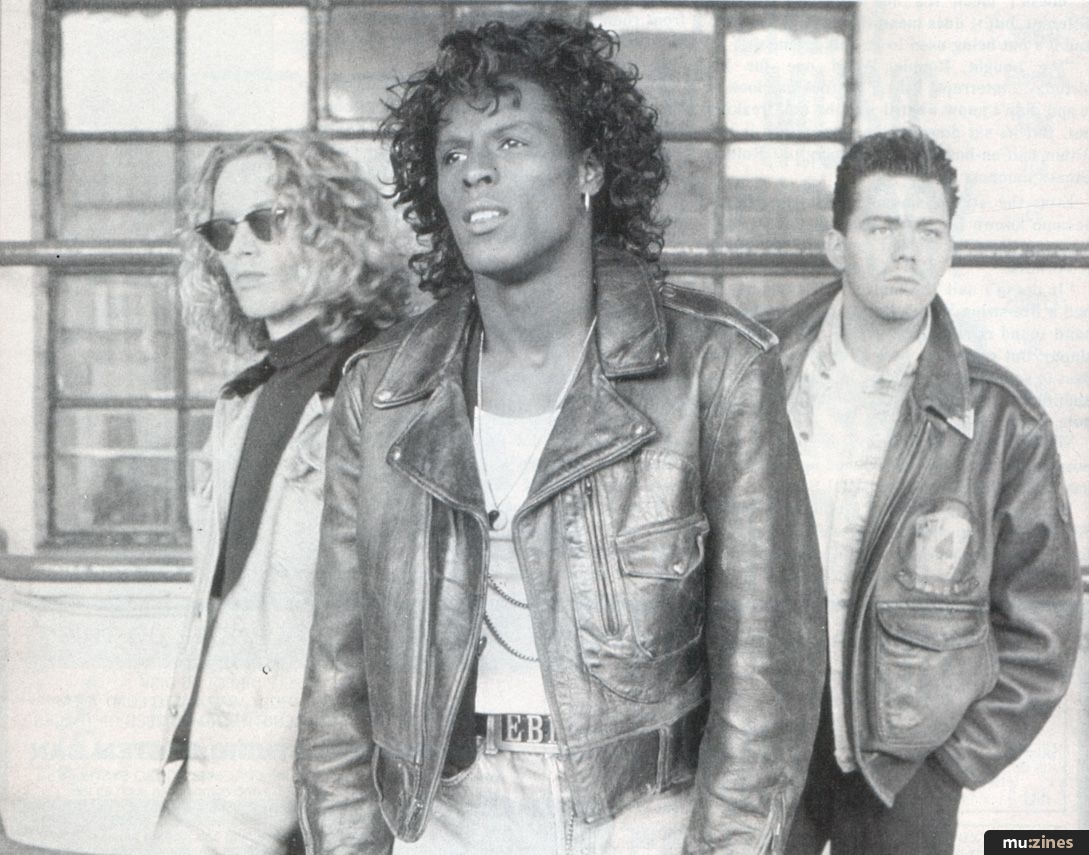
BRING UP THE subject of Beggs' bass and Stick playing, however, and you'll find that Beggs takes his music a little more seriously than he'd have you believe. First of all he'd prefer to be known as a Stick player rather than a bass player - a wish 'Big Bubbles, No Troubles' and the title track from the forthcoming LP, Homelands, go a long way towards granting. Then there's the opposition he met when he first introduced it to the other members of the band.
"I used to dread him picking the Stick up", admits Ellis with a grin. "He looks like a hippy with this big thing sticking out of his trousers.
Seriously: when we were jamming and I'd see him put his bass down and pick up the Stick I'd think 'oh no, not that bloody thing again'. Then he started coming out with all these licks that freaked me out because I'd never heard anything like it before."
"I had to keep pushing it" confirms Beggs. "I think the Stick is more versatile than a bass because you have a melody expression as well as a bass expression. On a bass you have got melody expression but it's very linear. It's very exciting, because it opens a whole new vista of possibilities to the musician.
"I see the Stick as predominantly a percussion instrument in the same way that the piano is a percussion instrument. I think people, especially bass players, are intimidated by it but it's wrong to think of it as a bass player's instrument.
Forget the bass when you pick up the Chapman Stick. It's got nothing to do with playing the guitar either and I'm surprised there aren't more keyboard players using it. The piano is the only comparison to the playing technique, there is no other comparison you can make. If you watch a pianist he's got an arpeggio going with his bassline and he's playing a lick that's complementing it. You combine lead and accompaniment lines on a piano and you combine them both on a Stick. But most Stick players don't do that - Tony Levin doesn't do that, he only really uses the bass. And when he does use the top hand he uses a vamp approach. It doesn't mean it's not as good, it's just different, but it does mean the Stick is versatile and it's not being used to its full potential."
"We bought Ronnie Wood one for his birthday", interrupts Ellis. "He took one look at it and didn't know what it was, he was freaking out. But he sat down in the corner with it and within half-an-hour he was tapping out Rolling Stones numbers on it."
"Sampling is controversial and the Musicians' Union must hate it, but what do you do? It's technology, people want it and it's so easy."
Even the stylish slapping technique Beggs became known for in his Kajagoogoo days has been sacrificed for the new sound of Ellis, Beggs & Howard.
"It doesn't suit the music", he explains. "I had a five-string Wal made for me to make this band sound right. It's really low, not dicky and slappy, but really low with a low B. I want this bass to sound like it could be in Steel Pulse. My ambition is to play a note that's so low it's not a note. I want to jellify people."
Whilst Beggs is clearly excited by the possibilities the Stick has opened up for him, he has reservations about the MIDI Stick.
Personally I'm not into synthesised sound, Simon comes up with all that stuff. It's not my forte. I think the acoustic rock 'n' roll instrument is the side of it I'm supposed to supply."
Turning our attention to Simon Ellis' keyboard rig we encounter the eclecticicism that is the trademark of Ellis, Beggs & Howard once again. For alongside the predictable DX7II and D50 there's a beautiful Hammond C3, vintage '63 - I read the inspector's label. Although it now bears evidence of Howard's stage antics, Ellis describes it as his "pride and joy".
"A guy about 60 years old had it. He bought it brand new and it looked as if it had never left his front room. Then this young kid bought it from him and sold it to me. It's the best Hammond I've ever heard."
As well as making their own contributions to the EBH sound, the DX7 and D50 act as master keyboards for a Roland Alpha Juno 2, JX8P and a rack containing an Akai S900, Roland Super Jupiter and MKS20 piano module. There's also a Yamaha RX11 for drum sounds and a Roland MC500 for a little sequencing. A Yamaha DMP7 handles an automated mix under the guidance of a Sycologic M16. All in all, a very effective setup.
Much of the gear arrived as part of the record advance ("All I did for six months was read instruction manuals"), but the old polysynths were there from the start.
"The JX8P has got the best sounds ever on a keyboard", enthuses Ellis. "The hook line from 'Big Bubbles' is just a tinny old sound from it. At the time we wrote that song that was the only keyboard I had to write with. I'm really pleased I didn't have the setup I've got now because the song wouldn't have sounded the way it does, it would've sounded big and horrible. When we write the next album I'm going to write with just two or three keyboards - the JX8P, the D50 and maybe a couple of rack things. Then I'll have to find all the brilliant sounds that you'd never really use because you're using some massive brass sound from 25 synths. I'll go back to basics again like we did in the first place."
The RX11 was also there from the start, although the S900 provides many of the sequenced drum sounds.
"I use it mostly for drum sounds and a few backing vocal sounds that need layered voices. We put the backing vocals for 'Big Bubbles' in there because we needed a really big sound that the band can't sing live. And on 'Where Did Tomorrow Go?' there must be about 36 voices in the backing vocals and I've sampled those off the multitrack.
"I've got some great drum sounds and some Louis Jardine percussion sampled from our multitrack and I've got a Scritti snare... It's controversial and the Musicians' Union must hate it, but what do you do? It's technology, people want it and it's so easy.
"Keyboard playing must be the worst job in the world for equipment because you always want a bigger sound and you always have to update your equipment. In the next few months I want to get a second desk and another couple of Akais - probably S1000s because they're compatible with the S900. Eventually I'd like to get a KX88, then I'll get a nicer piano module and rack the D50. I miss some of the sounds on the DX7I - like the fuzz guitar and clav sounds I used on the album - they just don't have the bite of the old presets. So eventually I'd like to get some of those sounds back."
Quite how the band will achieve major success without the co-operation of the press, and how well they will live up to comparisions with the Rolling Stones only time will tell. But the band's own energy and enthusiasm are as infectious as their single. In musicians' circles, the word is that Beggs is a player to watch. As Ellis points out, there are still music papers that won't touch Ellis, Beggs & Howard because of Beggs' Kajagoogoo history.
"It's not my problem", says Beggs lightly, "it's everybody else's problem. I made a lot of money out of Kajagoogoo, I had a lot of musical fulfilment and I had some very good times. There were mistakes that were made, there were things that went wrong and there were people who couldn't handle it. But having said that, it was a lifetime's experience in two years and I'm lucky enough to have a second bite at the apple. I just knew it was going to happen as soon as I met Simon and Austin. I thought 'now, your waiting's over, just go for it'.
"NME and Melody Maker won't touch us, they won't give us an interview because I used to be in Kajagoogoo. But one day they'll come and interview us so anyone who reads this and then reads an article in NME or Melody Maker later on can write in and say they're complete hypocrites - because they are."
Publisher: Music Technology - Music Maker Publications (UK), Future Publishing.
The current copyright owner/s of this content may differ from the originally published copyright notice.
More details on copyright ownership...

Music Technology - Aug 1988
Interview by Tim Goodyer
Previous article in this issue:
Next article in this issue:
Help Support The Things You Love
mu:zines is the result of thousands of hours of effort, and will require many thousands more going forward to reach our goals of getting all this content online.
If you value this resource, you can support this project - it really helps!
Donations for August 2026
Issues donated this month: 0
New issues that have been donated or scanned for us this month.
Funds donated this month: £0.00
All donations and support are gratefully appreciated - thank you.
Magazines Needed - Can You Help?
Do you have any of these magazine issues?
If so, and you can donate, lend or scan them to help complete our archive, please get in touch via the Contribute page - thanks!
If you're enjoying the site, please consider supporting me to help build this archive...
...with a one time Donation, or a recurring Donation of just £2 a month. It really helps - thank you!

 @mu_zines
 RSS Feed
 Blog
Blog