


Magazine Archive
Home -> Magazines -> Issues -> Articles in this issue -> View
Blancmange | |
In The Kitchen Of Sound | BlancmangeArticle from One Two Testing, November 1985 | |
new album, new gear, know how
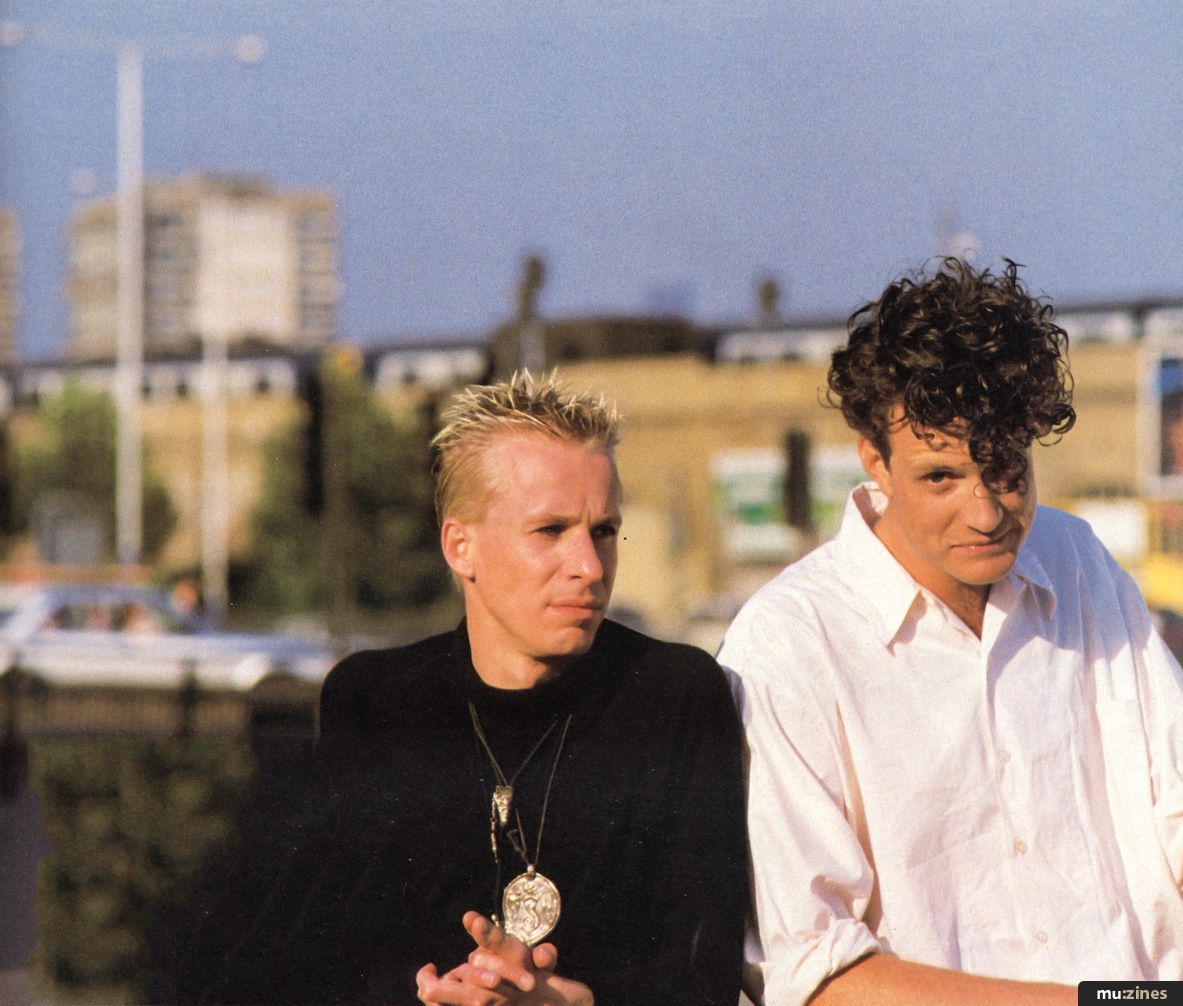
Image credit: Paul Rider
Neil Arthur and Stephen Luscombe have been making a record. An LP record (or album, as they call it). In three months work with producer Stewart Levine and engineer Femi J, they have recorded 13 songs, nine of which have found their way onto "Believe You Me".
So just because they haven't released anything in a while is no reason for you to imagine that Blancmange are no more, and that Top Of The Pops might possibly be safe from their catchy tunes and surreptitiously daft appearances...
THE INGREDIENTS
We almost fell at the first fence: a refusal to be photographed in front of Yamaha equipment in Chappell's kindly loaned hi-tech room gave us time penalties, but it did help elicit the information that Blancmange have a sponsorship "arrangement" with Casio, a liaison that has spawned CZ101s, and others of the CZ1000 and 5000 ilk.
Also lined up in the Blancmange equipment cupboard are a Jupiter 8, a Roland JX8P, and a Korg Polysix. On the top shelf lurk Roland rhythm machines, the TR707, TR808, and TR909. "We've got the lot," quipped Neil.
"But all we had once," continued Stephen, "was one rhythm unit, a Jupiter 8 and the Polysix. We've built it up, getting to know them over the years."
"It's not as if someone said, here y'are lads, here's a load of toys to play with," justified Neil.
While claiming not to be a good player, Neil owns up to owning a Fender Strat Elite ("the one with the white pickups and the onboard power"), an £18 Toreador SG copy, and a £150 Epiphone Coronet.
"And we've both got these UMIs..."
THE COOKER
SL: "We've just got these UMI things. Having them makes life so much simpler, both writing and recording."
NA: "It's a MIDI interface that runs off a BBC micro. The UMI has 16 MIDI channels, so you can use it as a 16-track sequencer; it's got four outputs — two MIDI 1s and two MIDI 2s. It sends its own MIDI and tape codes, and it's got a Sync 24 output that you can link up with Roland equipment.
"Obviously, it's got an input as well, so you can write and compose onto it. It remembers all your keyboard's touch sensitivity information, too."
SL: "You can write in real or step time, as it's got its own click track. It's also got an autocorrect which you can turn off, so when the computer loads to disk, it remembers everything you've played — your style, and your mistakes."
NA: "For writing, using the UMI has been the most helpful thing, though obviously it doesn't have a sound of its own.
"I don't really write music in any sense, just hear it in my head. Now I can go to the keyboard, play a part in, and hear it over and over straight away, as the UMI links it up automatically, like a rhythm unit. When I write, I often hear music and lyric at the same time, so once I've got this bass or melody line going, I can immediately start writing. But we're not totally reliant on it. Stephen's done quite a lot of things onto it live to balance, so it's his playing, even if it is being committed to tape by the UMI."
SL: "One song on the album I did when I was so drunk, just going 'crash crash' at the keyboard. Next day it was all a big jumble, so we took some things out, put others in, and something came out that I was really pleased with. That was "Other Animals": this little piano line goes 'dedededededede'... It was a one-in-a-million chance that it would happen like that, but doing it with the UMI, it was there, recorded."
NA: "And it was designed by Linton Naiff, who's been helping us put things together, like string arrangements, and remixes of our old stuff for live work."
OTT: So the UMI has completely changed the way you work?
NA: "Last year, some of the songs I wrote were just done on a Polysix, with a bit of guitar and a Roland rhythm unit. Then Stephen and I would work on them again, adding a Jupiter-8 and a 909. Then the Casios came, and we didn't have anything to MIDI them up to..."
SL: "Yes we did, we did a bit of 'Lose Your Love' [on the new LP]. We found out that the 909 would transmit notes on 1-16 through the MIDI, which would play from bottom C up to E on the Casio. We were quite thrilled to bits with that. And then the UMI turned up."
THE RECIPE
NA: "A lot of the time we write separately, and only get together to hear each other's demos."
SL: "It's a way of working we've used since the beginning — there's no-one else there when we're writing."
NA: "Five or six of the demos for this album have been around since Christmas, so David Rhodes has had copies to work out ideas of what he wanted to play."
SL: "David's played guitar with us since 'God's Kitchen'; he's an associate, really."
OTT: Do the songs start from musical or lyrical ideas?

Image credit: Paul Rider
SL: "Lyrics are Neil's department. I usually start with nice sounds. A modulation within a sound can perhaps suggest a rhythm pattern to go with it; or a tune may appear. It's just playing around, really."
NA: "I really enjoy writing songs, arranging The Song, while Stephen likes arranging sounds..."
SL: "I like building textures."
NA: "I'm into writing verse and chorus. I'll make the two work together, then even if it doesn't sound too good, I'll know where I'm going with it — like where the middle eight would be, if I wanted one. Once you've got something solid, then you can start chopping it up, breaking it down..."
OTT: Deconstructing?
NA: "But then sometimes we'll do exactly the opposite. There's one song we haven't recorded for this album, called 'Muezzin Divers'. We were both pissing around with these keyboards, and this rhythm just came out."
SL: "Then we put this Islamic muezzin man on top, just sort of wandering through..."
NA: "...and the words came really quickly; almost automatically.
SL: "That's a real interest of mine — taking things from other things and chopping them up together. A lot of the Indian sounds were really silly things, like trumpet lines from Indian records with all the bass rolled off so you couldn't hear the rhythm underneath — bung it onto something else, then put someone wailing away in the background... build it up like that. Like automatic writing."
OTT: Huh?
SL: "Like starting with a blank page — you need something to start you off, get you going."
PREPARATION
SL: "For recording purposes, we've always tried to buy identical things: a Studiomaster each, a synth each, hundreds of the bloody things. It means we don't have to cart all of our gear around when we got to each other's houses."
OTT: How do you demo your songs before going into the studio proper?
SL: "We've got these RSD Studiomasters at home, which we discovered by accident in the Sound Centre. Although we've now just bought a TEAC ½in 8-track each, I haven't had time to use mine yet."
NA: "When I saw the Studiomaster, I thought, 'It's a real studio!' Well, it makes you pretend a bit..."
SL: "Before we started the album, I did some music for the Alternative Miss World, all at home with the UMI and the 4-track cassette, and it sounded perfectly all right. Cost nothing, too. Similarly with our demos, we don't have to go to a demo studio unless we want to."
NA: "I like the idea of getting out of the house, it puts a new angle on things."
SL: "But you don't have to be so careful at home. Sometimes you need a bit of dirt, that bit of hiss."
OTT: Do you find it difficult translating your demos into the professional studio?
ST: "I have Acoustic Research speakers at home, which we use in the studio as well, it means we get a pretty consistent representation of what we want to hear, which makes it easier taking our demos in. Cut as many variables as possible. Everything is becoming much easier to interchange between studio and home — we can take the UMI in, link it up to the SRC, and away we go."
COOKING TIME
OTT: Now, what about this album — why did you pick Stewart Levine, who's best known as a soul producer?
NA: "He was recommended to us. He happened to be in the country, looking for people to work with, then we heard a tape of things he'd done — Hugh Masekela, Womack & Womack, the Crusaders, B B King, Joe Cocker — we were just knocked out. He wanted a change, and was intrigued by the tapes we played him."
SL: "He's not someone like, say, Peter Collins, who can take anybody off the street and think, 'There's the germ of an idea here, I can manipulate that.' Stewart only tends to work with people who have definite ideas about themselves."
OTT: Did you use many other musicians on the LP?
SL: "Apart from David, and Pandit Denesh, we worked with Justin Hildreth on drums. Others came in as and when we needed them. Linton Naiff did the string arrangements on 'Lorraine's My Nurse', Hugh Masekela played flugelhorn..."
OTT: That's the track that sounds like Handel?
NA: "That must be because I play guitar on it!"
OTT: Did Justin play the only drums on the album?
NA: "The drums on the album are mainly the 707. 'Life', or 'Other Animals', as it's also known, has 707. 'Why Don't They?' is real drums. 'Lose Your Love' is real drums."
OTT: What were you using for the bass sequence on 'Lose Your Love'? It sounds like a distorted bass drum.
SL: "It's not a sequence, just a bass part. It's a JX8P doubled up with a CZ101, with a fancy repeat. A lot of the bass parts are done with the JX for the bottom, and the knock at the front of the note from the Casio, which is good for that. Two tracks, then double it up using the UMI... you get lovely textures."
NA: "We found an interesting thing with the hi-hat on the 707: record it twice and bounce them together — they phase as they move slightly in and out of time with each other. It's on 'Lose Your Love', 'What's Your Problem?', and on 'Eggy Pegs' as well."
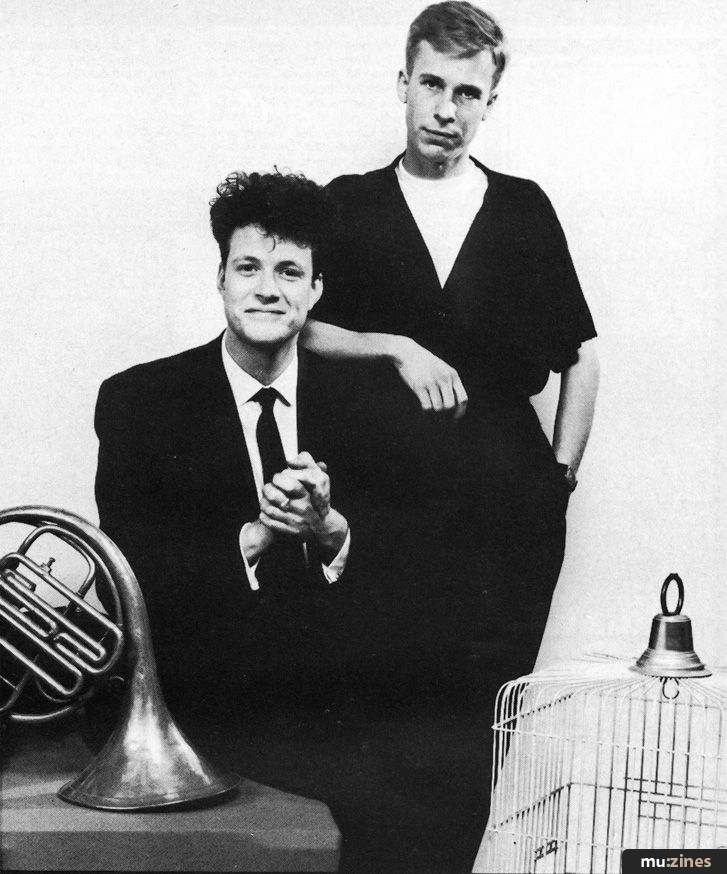
Image credit: Paul Rider
SL: "We used the 909 when we did the demo of 'What's Your Problem', speeded up. It sounded like timbales, so we EQ'd it to death on the Studiomaster. We got this really tinny, awful sound, but it's good in context.
"One of our problems is persuading engineers to be less technically minded, to let us do what we want. It's real cheek, trying to tell us 'you can't do that'. You should always have the option of being able to abuse the way things are used. It's something you have as an attitude, a personal slide rule. It stops you being so precious about other things."
OTT: 'As They Are' has a sampled strings part...
SL: "There aren't any samples on the album."
NA: "I wrote that song on the UMI, then did it at Redan on their Neve desk — I love the sound of those Neves. Anyway, we put real cello and flute on it, but there's a JX8P sound underneath to beef it up.
LAYING THE TABLE
OTT: What's happening after the release of 'Believe You Me'?
SL: "We'll probably be taking a band out on tour, with Justin on drums. Live, we used to use a 2-track stereo mixdown of the basics, but we found it was getting uncontrollable in different halls, so now we're going 8-track. With the old songs, we're rearranging all the old parts with the UMI, then linking that to the multitrack and taking any elements of the original that we consider essential and adding new sounds for the others. It gives them a new lease of life, more of a live feel."
CAN WE HAVE THE MENU, PLEASE?
NA: "Having a UMI each has made writing much easier — we just swap disks."
SL: "We're thinking about getting a telephone link! And we've often thought about writing by post, swapping cassettes and adding a layer each."
NA: "Another thing we've talked about is writing a rhythm pattern, which I would describe to Stephen, telling him the tempo but without letting him hear it. Then Stephen would do a bass part, which he'd describe to me. We'd know how long the song is, what key it's in, and where the choruses are, but only those parameters."
SL: "It'd be dead interesting to see what happens."
OTT: Any other plans in your diaries?
NA: "I'd actually like to set up a studio somewhere, out of the house, that I know I could go to if I wanted."
SL: "Oh no, I need my stuff set up at home, so if I get an idea at two in the morning, I can work on it straight away..."
NA: "Oh yeah, I'd have to have that too."
SL: "We're greedy, that's the problem." Another helping of Blancmange, anyone?
More with this artist
 Ceiling Tales (Blancmange) |
 Blancmange (Blancmange) |
 The Day Before You Came (Blancmange) |
 The Proof of the Pudding (Blancmange) |
Publisher: One Two Testing - IPC Magazines Ltd, Northern & Shell Ltd.
The current copyright owner/s of this content may differ from the originally published copyright notice.
More details on copyright ownership...

One Two Testing - Nov 1985
Interview by Jon Lewin
Help Support The Things You Love
mu:zines is the result of thousands of hours of effort, and will require many thousands more going forward to reach our goals of getting all this content online.
If you value this resource, you can support this project - it really helps!
Donations for June 2026
Issues donated this month: 0
New issues that have been donated or scanned for us this month.
Funds donated this month: £0.00
All donations and support are gratefully appreciated - thank you.
Magazines Needed - Can You Help?
Do you have any of these magazine issues?
If so, and you can donate, lend or scan them to help complete our archive, please get in touch via the Contribute page - thanks!
If you're enjoying the site, please consider supporting me to help build this archive...
...with a one time Donation, or a recurring Donation of just £2 a month. It really helps - thank you!

 @mu_zines
 RSS Feed
 Blog
Blog