


Magazine Archive
Home -> Magazines -> Issues -> Articles in this issue -> View
Roland Electronic Kit | |
Article from One Two Testing, November 1985 | |
drum synth

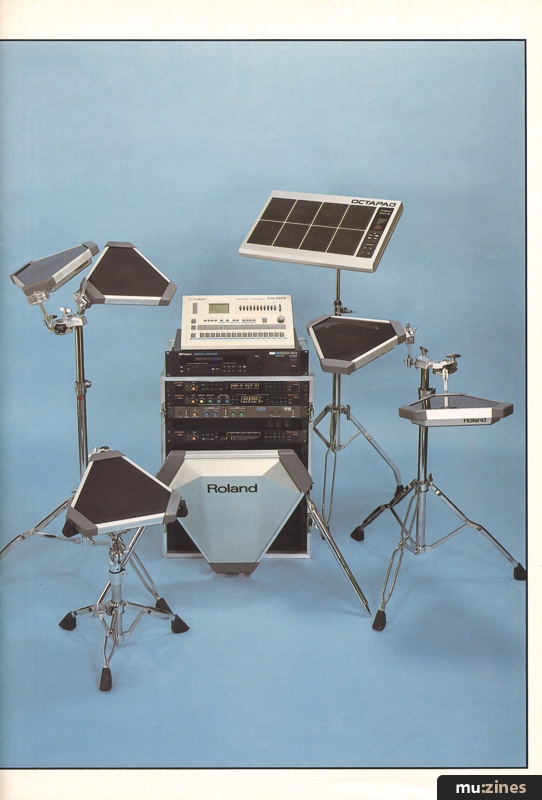
THE COMPETITION in the electronic drum market is hotting up, the past year having seen the arrival of several serious Simmons rivals. Inevitably, an increasing proportion is Japanese. Not only have acoustic drum makers like Tama and Pearl launched electronic ranges, but now electronics giant Roland has come up with its contender — hardly a surprise.
The system consists of a control unit, the DDR30, with inputs for six pads: snare, bass and four toms. Each drum has the choice of four starting voices, PCM sampled sounds (Roland in Japan preferred not to divulge the sources of the samples), from which to make your own sounds via the manipulation of four "modes" encompassing 16 "parameters". These sounds are then stored in four banks of eight "patches" each.
Let's start by hitting the pads. The tom and snare pads are identical, the bass pad somewhat larger. They're all triangular, with the corners squared off, a shape tried before by Ultimate Percussion. Pad shape seems to be a bit of a worry for electronic kit designers, and I'm not sure that a triangle is the best solution. It's an awkward shape to aim your stick at, and I'm not just saying that from a traditionalist point of view.
The playing surface is a triple laminate of hard, black, rubbery material, with just sufficient give to make it quite pleasing to play. At one apex of the triangle there is a hinged jaw-clamp for tightening on to the vertical rods of a typical double-tom floor stand. You have to buy your double-tom stands separately as Roland don't manufacture these; the Tama stands on the kit I saw were fine, but you could get cheaper Premier (for instance) stands which would be equally serviceable. The spurs on the bass pad point directly forward, a great idea as this is decidedly more stable than the usual side-mounted set-up.
All the pads have well moulded, grey plastic backs, and are bounded by brushed-silver metal rims. The squared-off apexes are encased by hard grey plastic. Very solid, handsome and well made, they nevertheless look a bit labtech. They are connected to the DDR30 control unit via Cannon leads, always a good idea since they don't accidentally pull out. But there are also standard jack sockets, so the pads could be connected to a rhythm unit or to some other control unit if you fancied. The system is intended, sensibly, to be as flexible as possible.
The DDR30 is a standard 19 in rack unit, a slim black box which looks very stylish, unlike many other drum brains. At the back are the six pad trigger inputs. These are fed into six channels of your mixing desk, or alternatively you can take a pre-panned stereo output or a single mono mix. There are also MIDI input, output and through sockets so you can hook up to drum boxes or output to keyboards and so on.
Looking at the front panel we find a pretty extensive though cleverly laid out set of controls. When the power is turned on the display window shows P(programme) — 1.1. The 1.1 refers to bank 1, patch 1. The bank switch is an up-down control which can select from 1 to 4; the eight patches each have a separate button so it's an easy matter to select the bank and patch location from 1.1 to 4.8 — they can also be selected by two footswitches (connected to the rear panel), one each for bank and patch number.
How do you make your own sounds? Well, you start by pressing the up-down instruments select switch to choose the drum (bass, snare etc). You then choose a programme number on the programme switch next door. Then fiddle with the four modes: "voice", "pitch", "gate" and "EQ", which between them cover 16 parameters.
First, "voice": press the voice button, then turn the large data entry dial to select a starting voice from the four pre-programmed samples. Pressing the "forward" button you enter the next parameter, which is voice level (volume), 0-99 on the data entry dial. Next up is "envelope decay" (the decay time of the beat), then "attack" (to create an attacking feel or a soft-edged feel), and finally — a little more subtle — "attack decay" (the decay time of the attack sound itself).
The second mode is pitch. This has four parameters, "pitch" -24 to +24 where zero is the original pitch value of the sample: "Bendpitch" down (there's no pitchbend up), which obviously becomes less effective as you get nearer to -24; "Bend decay", the decay time of the pitch bend; and "Dynamic sensitivity" which makes the pitchbend depth more sensitive to the dynamics of your playing (how hard you hit the pad).
In fact the "dynamic sensitivity" of the whole kit is pretty good. This is something electronic kit makers — led by Simmons — are improving all the time, and the Roland's better than most. Still a long way from the sensitivity of a real kit, yet you do feel you're playing an instrument rather than acting as a glorified trigger operative.
On to the third and fourth modes. "EQ" is straightforward -6 to +6 treble and -6 to +6 bass, while "Gate", an enterprising inclusion, gives you a lot more control over sounds and effects where you'd normally be at the mercy of the mixing desk. Gating effects are particularly popular, and noticeable, on the snare, and the DDR30 has five parameters for you to experiment with. "Gate 1" operates only when you hit the drum hard enough, acting a bit like a compressor and releasing after a certain time. The "Gate Time" (the time the gate is holding) and the "Release Time" are programmable, and "Gate 2" operates no matter how hard you hit. Again, the release time is programmable.
Once you've made your sound it is a simple matter to save it by pressing the edit-write button.
What of the sounds themselves? Well, you've got the initial advantage of four starting voices for each drum. The four bass and four snare samples cover the complete range from high and snappy to low and thuddy, and the toms particularly are capable of extraordinary manipulation.
You can go for a relatively natural acoustic sound (particularly bass and snare), or use the array of controls to make something decidedly synthetic. I found the controls easy to use and I imaging you'd get familiar with their operation fairly quickly.
Finding good sounds, as always, takes longer; but of the Roland factory suggestions I heard, there is an impressive range on can. The attack on some of them was so clean and gutsy as to be almost frightening! There were some particularly fetching toilet-cistern type noises, and some others eliciting the sort of experience a mouse in a grand piano would receive if the lid were slammed shut. Considering you can get from this extreme to digital acoustic quality, and with the capability of triggering other drum devices as keyboards and so on, you've got a pretty versatile system.
Sounds can be transferred to memory cartridges which cost about £40 each. There's no facility, though, for storing info on ordinary cassettes. There's also no headphone socket for private listening, which is a pity. Finally there's a sensitivity control to match the DDR30 unit to pads other than Roland's.
All the units are sold separately: the DDR 30 is £999, the snare/tom (PD 20) pads £85, and the bass (PD 10) £175. Then you have to buy stands. In other words, this is pretty expensive gear.
However the DDR30 is an impressive box of tricks: it has a greater range and sophistication of parameters than any of its rivals, excepting the SDS7 (which is rather different and a bit dearer). This is obviously Roland's forte.
If the system falls short I feel it's in the shape and presentation of the pads. It's noticeable that the acoustic drum companies cited at the beginning — Tama and Pearl — concentrate on the pads, using real heads and so on to woo acoustic drummers, while Roland inevitably go first for the electronics. I suspect that with a bit more thought about the pads (more colours, and maybe closer to a round shape), Roland could be on to a winner.
ROLAND electronic kit: £1500
CONTACT: Roland UK, (Contact Details).
Publisher: One Two Testing - IPC Magazines Ltd, Northern & Shell Ltd.
The current copyright owner/s of this content may differ from the originally published copyright notice.
More details on copyright ownership...

One Two Testing - Nov 1985
Review by Geoff Nicholls
Help Support The Things You Love
mu:zines is the result of thousands of hours of effort, and will require many thousands more going forward to reach our goals of getting all this content online.
If you value this resource, you can support this project - it really helps!
Donations for June 2026
Issues donated this month: 0
New issues that have been donated or scanned for us this month.
Funds donated this month: £0.00
All donations and support are gratefully appreciated - thank you.
Magazines Needed - Can You Help?
Do you have any of these magazine issues?
If so, and you can donate, lend or scan them to help complete our archive, please get in touch via the Contribute page - thanks!
If you're enjoying the site, please consider supporting me to help build this archive...
...with a one time Donation, or a recurring Donation of just £2 a month. It really helps - thank you!

 @mu_zines
 RSS Feed
 Blog
Blog