


Magazine Archive
Home -> Magazines -> Issues -> Articles in this issue -> View
Bokse Clever | |
Bokse US-8 SynchroniserArticle from Home & Studio Recording, April 1986 | |
This British product solves a surprising number of interfacing problems between machines designed to run on different time code systems. Peter Roythorne investigates.
Bokse boast that their new US-8 Universal Synchroniser will solve virtually all known synchronisation problems. This seems like a claim worth investigating.
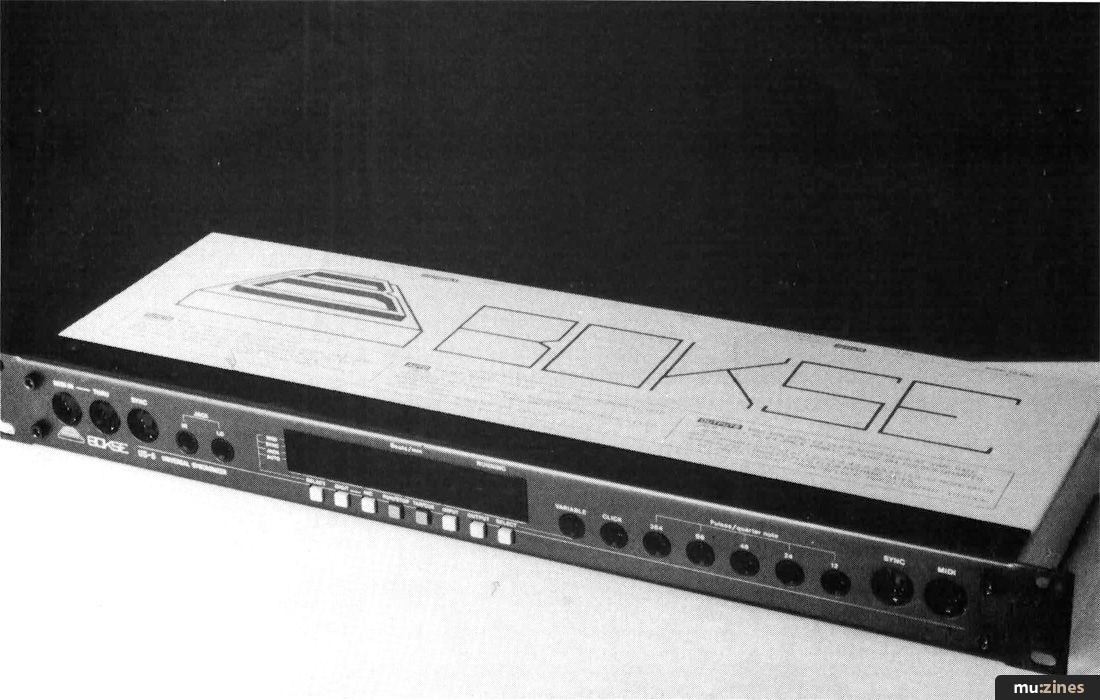
Recently I saw an advertisement from a large computer manufacturer which read something like 'The first sign of madness is buying a computer that only talks to itself'. This amusing observation conjured up the image of half-crazed musicians frantically trying to synchronise their non-communicative drum machines and sequencers. However, with the increased emphasis on this kind of technology in the modern recording world, I am sure that many of you will have had similar experiences.
Despite the advent of MIDI, there are still large numbers of perfectly good machines with different time codes that are impossible to synchronise with certain other equally good devices. The US-8 offers a remedy, with its 30 or so different time code outputs and ten inputs including everything from MIDI and DIN Sync to a wide variety of pulses and clock rates. So now, at a very reasonable cost, the individual with a variety of different systems or the studio owner faced with a constant stream of drum machines all incompatible with his own, can now relax and let the US-8 solve his problems.
First Impressions
This 19" rack mounting unit from the 'Silicon Valley' around Cambridge is superbly presented, with styling and layout being of the highest standards. Upon opening up the unit, a quick internal inspection confirmed that the professionalism was not only superficial. Without question, the mechanical layout and design is excellent and certainly up to the standard that is currently giving the British computer industry its well deserved reputation for reliability and design flare.
"It offers great flexibility to the modern recording studio and in some cases could be regarded as essential."
Inputs
The US-8 can act either as a master or as a slave and to this end there's a comprehensive selection of controls and in/out sockets. As a slave, it's designed to run from one master source (tape or machine) and therefore has a relatively simple input section. This comprises MIDI In and MIDI Thru, an input for DIN Sync and two jack inputs; Jack Hi for clock pulses from drum machines and the like and Jack Lo for accepting pulses recorded on tape. Nothing could be simpler, all the engineer has to do now, is take the clock output form his machine or off tape and connect it to the appropriate input. The final operation at this stage is to select the input value required. This is achieved by pressing the input and select buttons and then stepping through the different values now displayed on the multi-function LED. The various time code options are then given in this order:
A. MIDI
B. DIN Sync 24 (Roland)
C. DIN sync 48 (Korg)
D. 12 pulses per ¼ note
E. 24 pulses per ¼ note
F. 48 pulses per ¼ note
G. 96 pulses per ¼ note
H. Auto
Assuming the machine you wish to use has one of these time codes then there is no problem. Otherwise you may have to do some juggling and use it as a slave instead; the output section of the US-8 has an even greater range of possibilities. However, it does appear that most of the major manufacturers' standards, past and present, are well covered. The 'auto' mode is selected if the US-8 is to be used as a master control unit. In this mode a number of devices can be driven simultaneously by setting the master tempo in beats per minute. An interesting extra, which I found most useful, was the Tap-Cue facility. By using this function, all the units being driven by the US-8 can be counted in, just as if they were a real band. By manually tapping in a count of 1, 2, 3, 4 onto the Tap-Cue button or with a foot switch connected to the rear, the master tempo can be set and all the connected devices will start together on the fifth beat.
Outputs
At this point, the US-8 should now be simultaneously giving out 13 entirely different time codes. Moreover, some of the outputs are variable, giving a total of 30 or so possible time code conversations. The mind can only boggle at the potential array of weird and wonderful devices that could be assembled together. Apart from the time codes that are duplicated from the previous list, the output section also provides: 384 pulses per ¼ note, a click output as well as a +5 volt pulse, a +10 volt pulse, and a short to ground output, each with twenty variations, from 12 pulses per bar through to pulses at demi-semi-quaver intervals!
In Use
The opportunity to review the US-8 could not have come at a better time, as I was in the process of re-mixing a selection of some of my old recordings. Most of them were fine. However, one had a badly programmed rhythm track, originally recorded with a MXR Drum Computer. Fortunately, I had taken the precaution of keeping the 24 pulse sync tone on one of the tracks, the only problem being that I had now changed my MXR for an Oberheim DMX and the latter only accepts 96 pulses. Still, with the US-8, this should no longer prove to be a problem.
The first stage was to connect the tape output direct to the Jack Lo input on the synchroniser. Bokse explain that the Jack Lo input should be used for this purpose, as it's able to accept low level signals off tape and 'clean them up', thus producing a good sharp square wave to drive the US-8. With the DMX now connected to the appropriate output on the US-8, I preceded to run the tape. Initially, the tempo of the US-8 began to vary wildly, the display making little sense. At this point I decided to refer to the manual (always a good idea)! Here it explained that level into the synchroniser was fairly important and that the output from the tape machine should be varied until the tempo display on the US-8 was stable. After a little bit of re-routing on my mixer and a few adjustments to the output I achieved my goal - the DMX was now running in perfect time.
The next stage was to connect up a few other goodies just to confirm this. After a little while, in addition to the DMX, a PPG system and a Roland Drumatix were also running happily in tandem. As a result, after a complete day of re-programming, my original and thoroughly average recording was transformed, mainly with the help of the PPG sounds, into a fashionable dance track.
"Bokse themselves tell me that they have tested the US-8 with everything they could lay their hands on, from Korg through to Fairlight and Synclavier and have yet to discover a device that it will not synchronise."
Conclusion
Without question at only £395, this is highly desirable and professionally made piece of equipment. It offers great flexibility to the modern recording studio and in some cases could be regarded as essential. Bokse themselves tell me that they have tested the US-8 with everything they could lay their hands on, from Korg through to Fairlight and Synclavier and have yet to discover a device that it will not synchronise. Four new products are also promised in this vain: a SMPTE/EBU time code controller with MIDI, an Active Time Code Splitter, a 7-way MIDI Patch Selector and a MIDI Humaniser! We shall just have to wait and see...
The Bokse US-8 costs £395 and is distributed by: Sound Technology Ltd, (Contact Details).
Also featuring gear in this article
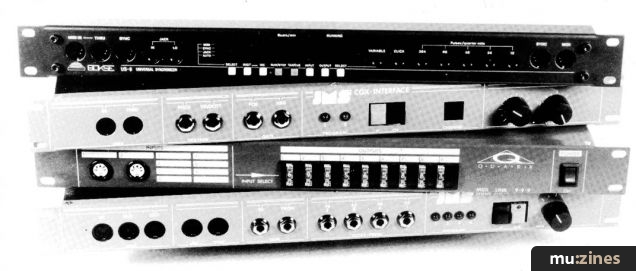
MIDI FX
(EMM Jun 85)

Synchronicity - Bokse US-8 Universal Syncronizer
(SOS Nov 85)
Browse category: Synchroniser > Bokse
Publisher: Home & Studio Recording - Music Maker Publications (UK), Future Publishing.
The current copyright owner/s of this content may differ from the originally published copyright notice.
More details on copyright ownership...

Home & Studio Recording - Apr 1986
Donated & scanned by: Mike Gorman
Gear in this article:
Review by Peter Roythorne
Ads for Gear in this article:


Help Support The Things You Love
mu:zines is the result of thousands of hours of effort, and will require many thousands more going forward to reach our goals of getting all this content online.
If you value this resource, you can support this project - it really helps!
Donations for April 2026
Issues donated this month: 0
New issues that have been donated or scanned for us this month.
Funds donated this month: £0.00
All donations and support are gratefully appreciated - thank you.
Magazines Needed - Can You Help?
Do you have any of these magazine issues?
If so, and you can donate, lend or scan them to help complete our archive, please get in touch via the Contribute page - thanks!
Please Contribute to mu:zines by supplying magazines, scanning or donating funds. Thanks!
Monetary donations go towards site running costs, and the occasional coffee for me if there's anything left over!

 @mu_zines
 RSS Feed
 Blog
Blog