


Magazine Archive
Home -> Magazines -> Issues -> Articles in this issue -> View
British Music Fair | |
Show ReportsArticle from One Two Testing, October 1985 | |
what we saw
Jon Lewin abandons his Press ID and goes to the British Music Fair disguised as a punter. This is what he found.
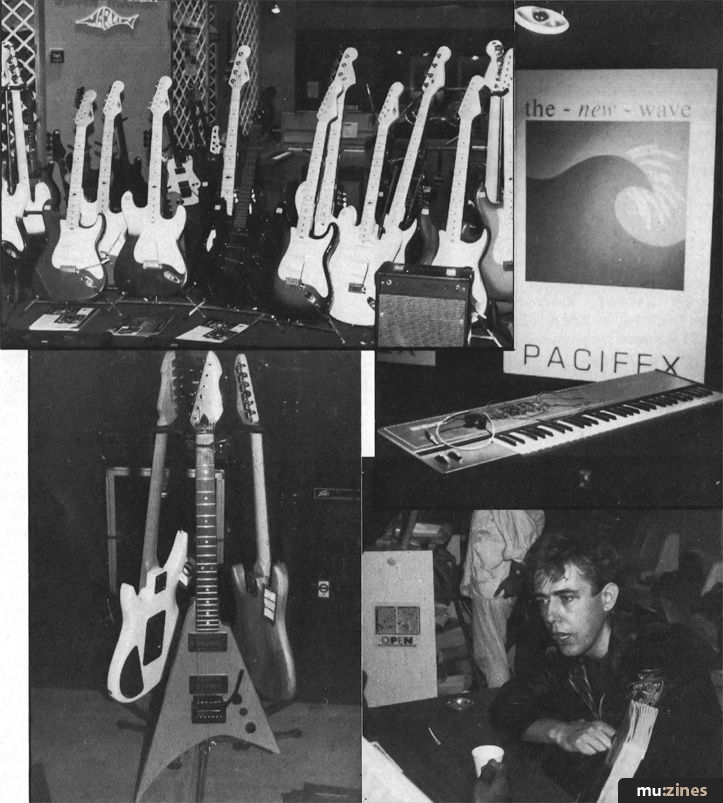
Clockwise, from top left: Marlin guitars on the British Music Strings stand, Mirages under the Pacifex wave, Big Country's Mark Brzezicki answers drummers' questions on the One Two stand, Peavey's pink (if you could see it in colour) show stopper.
First impression on pretending to come through the main doors, after having concealed my trade pass: the noise. On the three levels of this large hall, somewhere in the region of 4000 people were plinking, plunking, blooping and farting, all trying to hear themselves, all ignoring the racket the others were making. Some manufacturers had seen fit to provide sound-proofed booths, but these were often so over subscribed that they were usually reserved for demonstrations by name players.
Headphones were the only other alternative to amplified mayhem, and lots of stands thankfully came equipped. This was fine for keyboards, but could look hilarious on the Simmons stand, where hordes of grinning youths stood clattering away on otherwise unamplified plastic pads.
Launching myself into the whirling melee that was the ground floor, it immediately became apparent that the people were the problem of this year's BMF. So many. My first visit — the Roland stand — suffered for this reason. Bored with watching someone give himself lockjaw grimacing along with the GR707, I strolled across to the effects pedal booth, where a Roland tour-jacketed demonstrator was running through the whole gamut of Boss pedals to a rapt audience.
Employing just one person to demonstrate arguably the country's most popular pedals, was questionable. Other manufacturers had supplied pedal boards for the public to play with. If Roland could lay out nine or ten TR707 and 727 drum machines to be programmed into submission (a favourite stand for finger-artist Bill Brufords), then surely a corresponding number of pedals could have been made available?
Sidling past the crowds gathered about the One Two stand for the Mark Brzezicki drum consultation I headed for the Rose-Morris stand, with its racks of new Vox Teardrop and Phantom guitars. I struggled with their headphones for a while, but being unable to turn them down beyond ear-drum wrinkling volume, or stop the guitar sliding off my knee (all but mine had thoughtfully been supplied with straps), I turned my attention to the idea of an electric 12-string.
"Sorry sir, but we're waiting to see what the public reaction is like on these new models before we introduce a 12-string." Ho hum again, but a helpful (if not immediately hopeful) answer.
Korg keyboards were plagued with attendant punters, but a lack of attentive attendants. My efforts to understand the "so easy to use" MIDI sequencer SOD-1 were even further thwarted when I discovered the one I thought I was writing into had been disconnected.
Further around the ground floor, I discovered the bar, with its expensive fizzy lager. There were hundreds of guitars, both on the Hohner stand and under the British Music Strings banner, Marlin guitars, with pickups covered in knobby protrusions, white Kay guitars dipped up to their middles in peculiar blues and browns, Hohner Steinbergerish headless guitars, acoustics a-plenty, and all there for the playing.
What bliss it was, throughout the Music Fair, to be given freedom to paw virtually anything you liked: obviously certain objects were more popular, and thus harder to reach than others (hello Yamaha keyboards, and in particular the DX21), but the more esoteric instruments were generally under-used. I'd always wanted to play a mandolin/banjo/bazouki without suffering the damning attention of a shop assistant. Hence, while the lack of assistants on the stands was a nuisance for the more hi-tech gear, it was a positive advantage around the more traditional toys.
Highest of the hi-tech was to be found in the Pacifex (aka Syco) booth, where numerous Ensoniq Mirage sampling keyboards were attended by blue-shirted staff. By the good grace of one of these noble persons, I was permitted to, er... sample... two different sets of sounds. The drum kit was split across the keyboard, and gave a reasonable variety of pitch (slow cymbal was especially effective). String sounds were pleasantly lush, though I could discover no sequence of pressing the Mirage's buttons which would alter the waveforms or any other parameters. Noticing my impotent prodding, the official one smiled. "Impressive, isn't it?"
I wandered away, counting my blessings that I had actually been allowed to manhandle the (purportedly) wonderful machine. The Akai sampling device, the S612, was primarily visible at one of that company's fine demonstrations. These 20-minute displays featured the playing (excellent) and dancing (peculiar) talents of Naomi and Seiko (bet you didn't realise your watch had a girl's name). As with all the demos I managed to get into, we were given a virtuoso performance from musicians who could make a comb and paper sound good, on equipment that cost as much as a small house.
It can be difficult to assess the capabilities of an individual piece of gear if it is being played by A Master through a succession of signal processors/MIDI links/etc. But is there a better way? At an event of this size, I think not.
Elsewhere on the ground floor, I had a pleasant discussion with two gentlemen on the Ibanez/Summerfield stand, who met my inquiry about guitar construction materials first with a wide grin — "That's tree wood, mate," — then a long and thoroughly plausible history of the use of various woods in the RS series of guitars. Much appreciated.
Upstairs: escalators up, but only stairs down. Yamaha seemed to dominate the first level, with guitars (but neither amps nor headphones attached) and a good selection of keyboards, expanders and drum machines with headphones. Their 'Enquiries' counter was doing a roaring trade when I called and was run by people who seemed to know their subject (no CX5 real time software till September, they told me).
Strolling counter-clockwise round the floor, I passed the new, faintly plasticised Fender guitars (Strat bodies, plus a choice of pickup configuration ranging from one humbucker up), in preference for the Rickenbacker stand. However, these glorious beasts were too expensive for mere mortals to touch (we're talking telephone number price tags — and that was trade), and even Ricky plectrums were 20p. Towering over this haven of beauty and high finance was the Washburn non-sound-proofed booth, most of which was filled with Frank It, Washburn's very large, very short-haired German bassist. And very good he was too, using that black headless to great and loud effect.
Washburn guitars were amongst the leaders of a general trend towards spiky guitars. Ranging from the tiny Pulse six strings (only £70) on the Barnes & Mullins stand, to the most extravagantly fluorescent (non-fleshy) pink object yet seen at a music fair on the Peavey racks, angular bodies are definitely flavour of the month. Even Gibson had a new Explorer available (but no sign of the more traditional Spirit). Will these fretsaw exercises be the collectors items of tomorrow?
From the public's point of view, the BMF's practise of listing stands in the catalogue and on maps under the names of distributors is awkward and frustrating. While it may make us more grateful to Messrs Fletcher, Coppock, and Newman to know that they distribute the "No 1 selling Japanese guitar in the UK," it doesn't make the spectator's life any easier having to read through the whole booklet searching for the name Westone before being able to find these musical miracles. The same goes for Rose-Morris (Vox, Korg), Rosetti (Gibson), JHS (Hondo, Kahler), and virtually every other distributor. Any chance of a product A-Z next year?
Second only to the queues for equipment as a source of annoyance came noise problems. Not so much the ego battles on the guitar stands of who can play the fastest blues scale, but the lack of opportunity for trying amplifiers and drums. HH's "new era for musical instrument amplifiers", the 100 series, had to be conspicuously silent (perhaps that's what they mean), while Zildjian cymbals relied upon a video to show most of their wares. More sound-proof booths? Not if they were as ineffective as Washburn's, which was rumoured to have cost £500.
Best part of level one for me was the quiet area, with its plethora of acoustic instruments, strings, brass and woodwind, and various sheet music stalls. So what if some of the more expensive banjos had been completely detuned (to deter the incompetent? Fender were also guilty of this). This part of Olympia was quiet, cool, and on the way to the bar with its delicious hot ham rolls, and the theatre for Henry Thomas' Westone bass clinic (which was full). Among the song books Billy Bragg's excellently illustrated 'Back To Basics' caught my eye: written in Billy's own scruffy hand, it even contains details on how to join the Labour Party. A bargain.
Resting briefly over more fizzy lager, I had time to take stock of all I'd seen, before climbing to the top floor. The new under-£100 Aural Exciter on the Atlantex stand was unapproachable through over-crowding; AKG microphones proved untestable through headphones; devices listed in one free handout as expanding the DX7's memory from "32 to 128 pounds" were too complicated to think about...
The third floor seemed packed with home keyboards, Bontempi, Yamaha and Casio. To be fair to the latter, I should mention that their full range up to the CZ5000 was there for the public to explore — it wasn't all middle-aged men in pink shirts playing "Tie A Yellow Ribbon" with chord and rhythm accompaniment, swaying in time.
Blue Suede Music provided the Tokai guitars, and a selection of re-launched Hi-Watt amplification for trying them out on. The resultant din was compensated for by the number of guitars and basses available to tamper with, not to mention the effects pedals.
Naturally, during an afternoon spent at Olympia 2, the punter's attention occasionally wanders. Other non-specific diversions on offer at the BMF included spotting the pop star (Rock Goddess, the drummer from Killing Joke, Patrick Moraz, The Edge, Dave Gilmour, Mark King), counting the guitar badges on each leather jacket (maximum tally six, including two doublenecks), chatting up the bored girlfriends of musicians with headphones on, entering competitions, programming stupid rhythms into drum boxes, writing tunes on the Singing Blackboard (which is just what it sounds like)... all sorts of entertainments were available.
For the last two years, the British Music Fair has been closed to the public. Re admitting them this year to what is still essentially a trade show undoubtedly caused some problems, but these were far outweighed by the advantages. It's easy to pick holes and find fault with individual displays and attitudes, but the overall impression I received wandering around on Sunday was of a lot of people having a really good time, staff and public alike. As an incentive to try new things (instruments, effects, whatever), having so much equipment under one roof is unbeatable. And if it gives the manufacturers a chance to meet their public, and hear their views, that also can only be a good thing.
Spending time in Olympia over the weekend also gave you a fair idea of what the music industry is up to. I've already mentioned the trend in guitar bodies. Elsewhere, MIDI seems to be permeating all levels of musical society, dispelling the mild air of disillusionment that seemed to surround it for a while last year. With the IVL 7000 Pitchrider MIDI convertor for guitars on its way, we can expect it to become all-pervasive.
Sampling hard- and software seems about to take off in a big way, with the imminent arrival of the full MIDI, digital sampling, Sequential keyboard, the Prophet 2000, for around the same price as the Mirage. Other companies are also obviously working in the same field, so we can expect a sampling boom later this year (as opposed to a sampled "boom!").
Electronic drums are also falling prey to the spread of MIDI, while C-Tape (not a contraceptive) seem to be trying to do away with the necessity for drum pads with their new Acoustic Percussion Trigger C-ducer mikes for triggering drum synths from acoustic drums. Now, if these could be used with any drum module...
There was nothing blindingly new at the BMF — given its place relative to America's NAMM in the music trade calendar — and it's unlikely there would have been. But this didn't prevent it from being a thoroughly... er... an extremely... um... a jolly good show?
Publisher: One Two Testing - IPC Magazines Ltd, Northern & Shell Ltd.
The current copyright owner/s of this content may differ from the originally published copyright notice.
More details on copyright ownership...

One Two Testing - Oct 1985
Donated by: Angelinda
Show Report by Jon Lewin
Help Support The Things You Love
mu:zines is the result of thousands of hours of effort, and will require many thousands more going forward to reach our goals of getting all this content online.
If you value this resource, you can support this project - it really helps!
Donations for May 2026
Issues donated this month: 0
New issues that have been donated or scanned for us this month.
Funds donated this month: £0.00
All donations and support are gratefully appreciated - thank you.
Magazines Needed - Can You Help?
Do you have any of these magazine issues?
If so, and you can donate, lend or scan them to help complete our archive, please get in touch via the Contribute page - thanks!
If you're enjoying the site, please consider supporting me to help build this archive...
...with a one time Donation, or a recurring Donation of just £2 a month. It really helps - thank you!

 @mu_zines
 RSS Feed
 Blog
Blog