


Magazine Archive
Home -> Magazines -> Issues -> Articles in this issue -> View
Engl Digital Amp | |
Article from One Two Testing, July 1985 | |
memorable combo
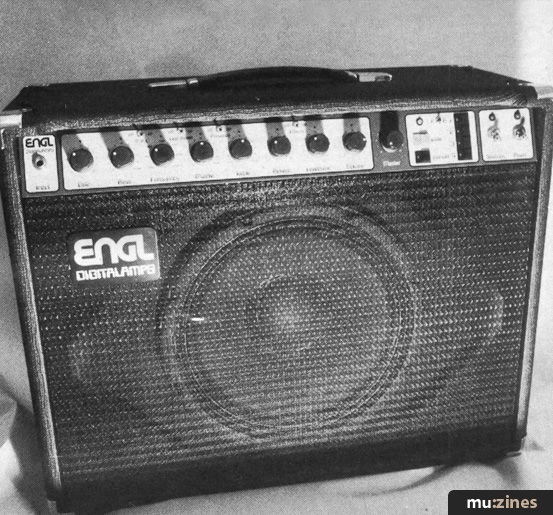
WHAT WE HAVE HERE is an extremely high quality, German-made combo — but the big attraction is its ability to store eight tone, reverb and overdrive settings in its memory and throw them back to you at the touch of a footswitch.
Turn the amp on and you are immediately greeted by the noise of the combo's built-in (Taiwanese) fan churning away. I must say that I think this could be a hindrance for low-level, subtle playing in the studio — put a mike up in front of it and you'll pick up the hum of the fan. So turn the fan off, you say. Gott in Himmel, nein, say Engl in the leaflet that comes with the amp.
"The amp should not be used without the fan," they shriek, "because of big heat-generation!" And indeed there are four huge valves sitting upside down in the back of the amp — put your fingers nearby and the big heat generation is well evident.
Here, too, is an advantage, of course. Nice big bottles to give that huge, meaty guitar sound that only they can provide. The controls whose levels you can store in the combo's memory are those on the light blue panel on its front: gain, for setting the input level of your pickups accurately; bass; sweepable mid (and therefore two knobs marked "frequency" and "middle"); treble; reverb level; "Leaddrive" for overdriven effects; and volume. Also available for storage are the settings of two on/off switches giving a "lead boost" lift (not mentioned in the leaflet) and a "presence" high shift.
Once you've got over the fan's hum, you will be inspired by the extremely well-made box that faces you. The cabinet is sturdy and strongly constructed, with some very reassuring metal cornerpieces. The strap handle on the top is something of a token, however, as the combo is very heavy, and will not respond well to weaklings.
But nosing about around the combo will reveal a well-appointed rear panel giving what you'd expect from such a professional amp in the way of speaker-out options, effects loop and line-out sockets. There's also a nifty switch that will only work with a key provided — this will protect your memorised selections, and only you have the key to switch the amp back into write-mode. In other words, the roadies will not be able to write in their favourite Eddie Van Halen patches during the soundcheck.
What you'll need to do once you've taken a look round and become entranced with pure German efficiency is to connect up the footswitch. This interfaces via a special eight-way locking connector on each end of a long cable — jolly good and solid, but not much fun if you leave this cable at home, because no-one else in the band or at the local music shop will have anything like it.
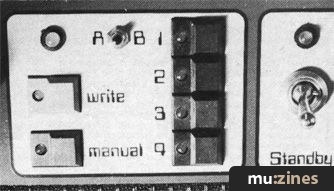
But how to save the sounds you set up on the Engl? Actually, very simple. There's a bank of switches to the far right of the front panel which takes care of the business in combination with the (optional) footswitch. You can use the combo on its own, without the footswitch, and still get all the memory facilities. But the footswitch does make things a lot easier, specially if you're playing live with the Engl. Then, all those sounds you so laboriously programmed in rehearsal and at home are magically available from one dainty tap of your Size 10 Doctor Marten.
Imagine. You've set up a deeply subtle sound on the panel, lots of reverb, a touch of overdrive, and a strong accent on toppy accentuation. All this you will do in "Manual" mode, selectable from the footswitch or front panel switch. Satisfied? Then choose a memory position you know is empty from the eight available (two banks of four each — only four switches on the panel, with a red or green LED indicating A bank or B bank, but all eight switches on the easier-to-use footswitch), press its switch, and then press the Write switch on the combo. Said Write switch will, after a few seconds' deliberation, go yellow to tell you that your sound is now transferred to the memory position chosen. Told you, didn't I? Simple.
You can do that up to eight times, switching back to manual each time to set up the sound. You can even patch in some outside effects on the combo's loop and have them on or off in your setting. Impressive. When you come to recall the sound, the controls used originally will now have no effect — only the Master volume works. But that was the intention in setting up eight great sounds in the first place: never touch a tone control again.
There's no way to tell you what the sound you're calling back up is all about, other than the racket that'll come out of the big EV speaker (a special customer request on the review sample, but normally a very respectable Celestion Sidewinder — EV version is £1010 inc. footswitch). I reckon you'd probably be gaffering notes of some description to your footswitch — and there is room for it. Glancing back at the combo won't help too much either: all you'll get there is a rather unhelpful bank of lights twinkling at you.
Course, there'd be no point in all this if the amp wasn't able to give good sounds for you to want to recall anyway, but thankfully the Engl's EQ is vast and effective in all the right places, the facilities are simple and useful, and the combo is a workmanlike beast to handle.
Apart from wishing the high-tech had also provided the player with a better display of what sort of sound was being recalled (you can, incidentally, recall the memorised control knobs' positions by a switch which illuminates LEDs above each knob when you hit the right setting for that memory, which is handy if you want to edit), I really would have hoped for more instruction than the flimsy leaflet giving poor translations from the German in a haphazard and confusing way. But fear not — it is simple. Otherwise full marks — but empty pockets for a long while.
ENGL digital amp: £935
CONTACT: Musimex, (Contact Details)
Publisher: One Two Testing - IPC Magazines Ltd, Northern & Shell Ltd.
The current copyright owner/s of this content may differ from the originally published copyright notice.
More details on copyright ownership...

One Two Testing - Jul 1985
Donated by: Colin Potter
Review by Tony Bacon
Help Support The Things You Love
mu:zines is the result of thousands of hours of effort, and will require many thousands more going forward to reach our goals of getting all this content online.
If you value this resource, you can support this project - it really helps!
Donations for May 2026
Issues donated this month: 0
New issues that have been donated or scanned for us this month.
Funds donated this month: £0.00
All donations and support are gratefully appreciated - thank you.
Magazines Needed - Can You Help?
Do you have any of these magazine issues?
If so, and you can donate, lend or scan them to help complete our archive, please get in touch via the Contribute page - thanks!
Please Contribute to mu:zines by supplying magazines, scanning or donating funds. Thanks!
Monetary donations go towards site running costs, and the occasional coffee for me if there's anything left over!

 @mu_zines
 RSS Feed
 Blog
Blog