


Magazine Archive
Home -> Magazines -> Issues -> Articles in this issue -> View
Family Values | |
JBL TR Series LoudspeakersArticle from Sound On Stage, March 1997 | |
Mike Crofts road tests two models from JBL's heavy duty TR Series — the TR225, handling 450 Watts between two 15-inch speakers and a compression driver, and the TR105, which can double as a wedge monitor.

Meet the TR Family (left to right clockwise): TR126, TR225, TR125, and TR105.
JBL's TR Series' loudspeaker cabinets are a family of four models, ranging from the TR105 speaker/floor monitor to the mighty TR225, which has a 2 x 15-inch plus horn configuration. The series is being marketed with both professional installations and serious portable systems in mind, and the two models tested here represent either end of the range, namely the TR105 and the TR225 as already mentioned.
MEET THE FAMILY
Let's deal with the facts and figures first. The baby of the range (a 225 Watt, 22.7kg baby, mind you) is the TR105, which is presented in fairly standard single 15-inch bass unit plus HF compression driver format. The special feature of this model is its wedge-shaped cabinet design, which allows it to be used either as a floor monitor speaker or on front-of-house duties in its own right. Frequency response is quoted as 60Hz up to 16kHz (at 10dB below the rated sensitivity figure of 99dB at 1W/1 metre), with a power handling capacity of 225W.
The next model in the range is the TR125, employing the same speaker components — and therefore power capacity — as the TR105, but this time in a traditional rectangular cabinet, albeit of the same height and width, and looking exactly the same viewed from the front. Bass response is, as you would expect, improved in this model by a useful 5Hz down to 55Hz, at the cost of a modest weight increase of 4.5kg.
The TR126 is an interesting design. It again uses the same drive units as the first two cabinets, but this time they are housed in a larger enclosure incorporating angled side baffles, which results in still further extended bass response (to 50Hz this time) and improved projection of the lower frequencies with a 100dB sensitivity figure.
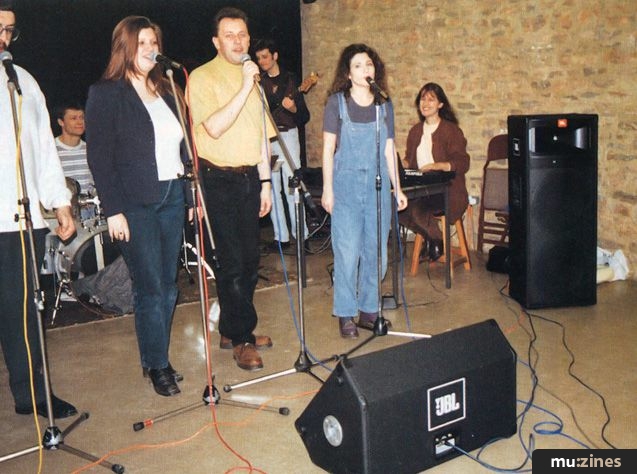
On trial, the TR125 acted as monitor, with the TR225s pumped up at front of house.
The Big Daddy of the range is the TR225, which retains the same HF driver, but this time used in conjunction with two of the 15-inch bass units, mounted vertically above one another in an effective 'column' layout. The result is a tallish (nearly four feet) and eye-catching cabinet design with the same width and depth of its smaller relation the TR125, which could be of considerable practical value if using a combination of the two cabinet types in a rig. Frequency response is the same as for the TR126 at 50Hz to 16kHz, but the power capability has increased to a more than respectable 450 Watts, and sensitivity has increased to 102dB.
All the cabinets in the range are fitted with titanium diaphragm liquid-cooled HF drivers, all have bass ports in the front baffle, and all are finished completely in black except for the classy orange JBL badges. The covering material appears very tough, and the edges appear to have been welded to prevent premature fraying or snagging.
"First impressions were definitely very favourable, mainly due to the smooth, clean top end with good clarity at this fairly low volume."
WEIGHTING AROUND
The cabinets, which arrived well packaged and brand spanking new, looked seriously loud even as they emerged from their boxes. The first thing I noticed was the weight — the TR225s are not really single-person items unless you've just had at least seven Shredded Wheat or you're a member of the Stonehenge Rearrangement Society. Being fairly slim in design (the speakers, not me), it is no problem at all to get a really good grip on both side handles — it's just the lifting part which presents a problem! As things turned out, there was no-one around to help me load up, and I did manage to carry them about 20 metres and put them in the car without incurring any lasting injury.
Being rectangular in shape the TR225s, although long, fitted easily into the back of my estate car, leaving just enough room for the wedge-shaped TR105s. Our first road journey together did not produce any nasty surprises, and the cabinets sat snugly together without rolling about. Although I did suspect that had it been at night, the headlamps might have been aiming a little high!

The wedge shaped TR105s can be used as floor monitors.
Each TR105 cabinet incorporates a nice deep metal pole mount socket, and a carrying handle at the other end (or on top, depending which way up it is), which makes it easy to carry in one hand, or pull towards you (for example, out of the back of a vehicle), without having to get your fingers underneath and risk a painful de-nailing. The two sets of feet are made out of hard plastic, and the cabinet sits very securely in either position.
THE TRIAL
I took the speakers to try out at a rehearsal, and the singers in particular were understandably keen on the monitor speakers; for my part, I couldn't wait to pump up those big TR225s. During the first rehearsal session, the four singers were practising their harmony lines with a simple piano accompaniment, and this afforded an ideal opportunity to listen critically to the sound character. The speakers were driven from a Spirit Powerstation (with a separate monitor amp), which was more than powerful enough in this situation. First impressions were definitely very favourable, mainly due to the smooth, clean top end with good clarity at this fairly low volume. With the rest of the band in tow and at a much higher level, the sound remained well-balanced overall, and the TR225s were able to deliver an effortless supply of tight, focused bass, which helped keep the overall sound under close control.
"These speakers seem as though they'd take almost anything you could dish out."
One interesting aspect of using cabinets this tall is the question of speaker placement and security; the user manual advises the higher the better, but the height of the TR225s is greater than many other cabs, therefore they will be quite usable standing on the floor if nothing else is available. The user manual stresses that these cabinets cannot be flown or used other than standing on a solid surface; they are indeed very stable, and having felt the weight of them, I would certainly endorse this.
Having started out with only one of the TR105s in use as a floor monitor, I found that it did the business so effectively in this venue that the other one remained idle all night, although I did rig the pair of them up on stands later, and tried them as main speakers. Apart from the expected reduction in bass, they performed very nicely thank you, again exhibiting that smooth, controlled quality which made them so easy to work with.
WHERE THERE'S BRASS
Rather than mike everything up in such a small (and empty) space, I decided to test the speakers with kit, bass, piano, and brass separately. The results were as expected by this time — clear and always under control. Kit produced good results from all mics, with the kick mic needing no low EQ assistance to achieve an authoritative and centred sound. Piano was smooth with a particularly deep bottom end, and brass really cut without any noticeable honkiness — the impressive low-end output from the TR225s added a whole new dimension to bass trombone! Being so well impressed with the punchy bass sound, my last experiment was to feed the output of the Trace Elliott 1215 bass combo directly into one of the TR225 cabinets, just for fun. And fun it was! JBL's brochure describes how much punishment these cabinets can take; it even says "turn it UP" on the back page of the user manual — so I did. The cabinet performed beautifully, producing really clean attack and body-thumping, solid bass, especially with one of the 15-inchers being so high off the floor. All this added to a feeling of great confidence in these speakers, and I reckon you'd have to perform some pretty daft tricks to do them any damage.
GLUTTONS FOR PUNISHMENT
Overall, I was most impressed by the powerful, tight bass response, and by the smoothness of the HF output. These speakers seem as though they'd take almost anything you could dish out. If you can make a pair of these sound horrible, then you should first check to see if you're using Fisher-Price microphones, and then go and lock yourself up in the interests of public safety.
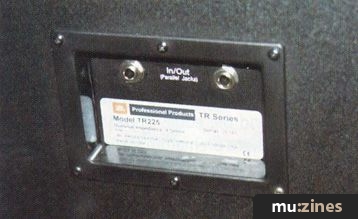
The connector panels are deeply-recessed into the rear of the enclosures, but I did wonder why only jack sockets (admittedly, good quality ones) are provided.
The finish of the cabinets is very good; the metal grilles are quite rigid and should provide enough protection for the driver cones in all reasonable situations, short of serious physical intent; all cabinet corners are well-protected by metal fittings which are securely screwed in place. The connector panels are deeply-recessed into the rear of the enclosures, but I did wonder why only jack sockets (admittedly, good quality ones) are provided, especially alongside the word 'professional'. Personally, I have been a Neutrik 'Speakon' convert for a while now, and that is an option I would prefer.
A TOWN CALLED INDULGENCE
When testing speakers, in addition to PA usage, I always like to try them out in the open air with a known CD source. Luckily, I was able to take advantage of a rare January weather window and spent a rather enjoyable half hour listening to various favourites from Mary Chapin Carpenter to the main title music from Robin Hood Prince of Thieves. On this occasion, I used a rather more powerful amp, rated at 600 Watts per channel, and kept to a sensible though still excitingly loud volume level — a combination of 225s and the Cincinnati Pops Orchestra at full chat should be enough to lift the lowest of spirits. The TR225s delivered as before, and it was a delight to be able to exploit their capabilities with none of the usual intrusive sound colourations. I did intend to put the TR105s in parallel with their big brothers, but the 4 Ohm impedance of the 2 x 15 cabs would have meant presenting a total connected load below the amplifier's output rating; still, you can't have it all.
FLEXIBLE FRIENDS
A final thought on flexibility, which is something I consider to be important as a result of being involved in a wide variety of PA jobs — a pair of TR225s plus a pair of TR105s would be about as flexible as you could get with a 'single' system. For small venues, the smaller cabs would be more than adequate on their own; for hiring, the pairs of speakers could be simultaneously satisfying separate customers (and earning separate money!), and when brought together as a system or used in conjunction with other rigs, the various main/monitor possibilities should be enough to keep everyone happy.
See price box.
Harman International Industries Limited, (Contact Details)
pros & cons
pros
- Utterly solid build quality & performance.
- Smooth top, tight punchy bass.
- Whole range looks the dog's bits.
cons
- Don't ask your granny to help you lift 'em.
summary
A confidence-inspiring range of no-nonsense, great-sounding speakers from JBL, for professional use on or off the road.
RACKET PROTECTION
PRICES
YOU'VE BEEN FRAMED
Fearing that I had damaged Harman's pristine JBLs, I was extremely relieved to find (both times) a considerable chunk missing from the door frame, and not a scratch on the cabinets. Whatever that black finish is, I am now seriously thinking of covering my car with it!
Publisher: Sound On Stage - SOS Publications Ltd.
The contents of this magazine are re-published here with the kind permission of SOS Publications Ltd.
The current copyright owner/s of this content may differ from the originally published copyright notice.
More details on copyright ownership...

Sound On Stage - Mar 1997
Gear in this article:
Monitors/Speakers > JBL > TR105
Monitors/Speakers > JBL > TR125
Monitors/Speakers > JBL > TR225
Gear Tags:
Review by Mike Crofts
Ads for Gear in this article:

Help Support The Things You Love
mu:zines is the result of thousands of hours of effort, and will require many thousands more going forward to reach our goals of getting all this content online.
If you value this resource, you can support this project - it really helps!
Donations for May 2026
Issues donated this month: 0
New issues that have been donated or scanned for us this month.
Funds donated this month: £0.00
All donations and support are gratefully appreciated - thank you.
Magazines Needed - Can You Help?
Do you have any of these magazine issues?
If so, and you can donate, lend or scan them to help complete our archive, please get in touch via the Contribute page - thanks!
If you're enjoying the site, please consider supporting me to help build this archive...
...with a one time Donation, or a recurring Donation of just £2 a month. It really helps - thank you!

 @mu_zines
 RSS Feed
 Blog
Blog