


Magazine Archive
Home -> Magazines -> Issues -> Articles in this issue -> View
Fender Strat/Squier Strat/Fender Katana | |
Article from One Two Testing, December 1985 | |
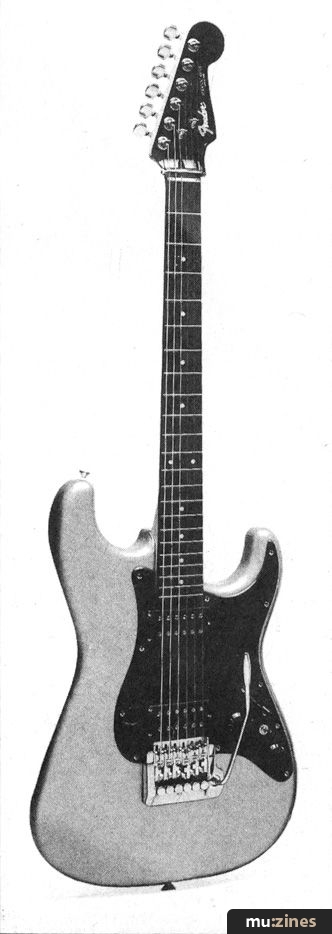
FENDER CONTEMPORARY STRAT DELUXE: £718
BUT you reviewed it last month, they cry. Well, almost. Last month I had my perspiring paws around the neck of the 27-5700, the expensive but beezer Strat with a humbucker by the bridge. This guitar what I have here, the 27-5800, has yer two humbuckers, and nothing else.
Horrors! This means a habit to unlearn — no more the merry jamming of the three-way pickup selector between settings for that picky Fendery out-of-phase sound, as there's no middle pickup. Perhaps Fender should have opted for a different switch, as I found it annoyingly easy to keep trying for that missing sound. But then I'm stupid.
This guitar is virtually identical to the 27-5700. The same black-topped headstock, new design string guides, the 22 fret 12in radius neck with fine-grained rosewood fingerboard sitting on matt varnished maple. It's also blessed with the System III tremolo with its so-simple-it's-brilliant open locking nut, adjustable zero fret, and the so-brilliant-it's-incredibly complicated tremolo unit itself. For those who didn't catch the deathless prose of last month's review, the System III allows you to adjust bridge through at least five dimensions, or even lock the whole unit solid if you so require without putting the wires out of tune.
What makes this guitar worthy of our attention so soon after the 27-5700 is of course the electrics. A Strat with two humbuckers, even if there is a coil tap, is a previously unheard invention.
The obvious first question is why bother? If you want a guitar with two humbuckers, why not design a completely new model? Apart from the fact that they have (see the Katana), it must be made clear that adding dual coil pickups to a Fender doth not a Gibson make. Plugging the Strat in and winding it up (tech-speak for making loud) soon reassures the troubled ear that Fender haven't moved into the Les Paul Copy market.
Even if the out-of-phase position is absent (I never liked Knopflerism, anyway), the resonant properties of that large chunk of wood (ash, I believe) are sufficiently characterful to give the 27-5800 the unique Strat tone.
Only it's not the unique Strat tone. It's fatter, rounder, louder, and has elements of brashness that single-coil Strats lack. There's a touch more sustain, a slight edge that makes this Strat seem easier to play. While it doesn't lie in your hands and play itself like some Gibsons will (meet my Les Paul), you don't have to work quite as hard as you expect to with older Fenders.
Single volume and tone knobs make this guitar easy to control, and even the coil tap falls comfortably to hand (only in the weedier single-coil position do you begin to notice the lack of out-of-phase, as the forcefulness of the full humbuckers makes you forget the relative lack of tonal variation). It's a conspicuously well-designed machine, efficient and precise — like a Strat, only more so. But...
But the three-way pickup selector was dodgy, crackling and cutting in and out (dock two weeks pay for Mr Squiggly Japanese ideogram, who claimed to have checked it). And one of the bridge saddle pieces was badly adjusted, with an Allen bolt protruding from its upper surface — rock the tremolo back and wow, instant sitar as the bolt got close to the string. Ho hum.
That aside, another expensive but beezer Strat from Fender Japan.
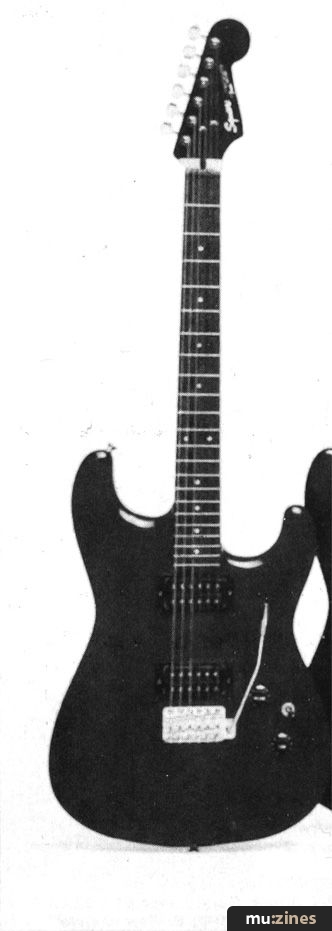
SQUIER CONTEMPORARY STRAT: £287
THERE'S A TRICK to guessing what these new Fenders are all about: Deluxe means "fitted with the System III tremolo", while Contemporary refers to the fact that they've buggered about with the pickup arrangement. Squier still means (even though most all Fenders are coming from Japan at the moment) "cheap".
Here comes a cheap Strat with two humbuckers and one of those cruddy old Vintage Style (as Fender prefer to call them) tremolos. Old-fashioned string guides, no locking device, though there is a graphite nut as a nod to modernity.
Twenty-two of the new fat frets fit neatly on to a 24¾in scale rosewood fingerboard (the big Fender boasts 25½in, but then wouldn't we all), which in turn is married to a shinily varnished maple neck. The fingerboard is coarse grained.
A four-bolt joint attaches the neck to the single colour (red or black) scratchplateless body. The Vintage tremolo requires a plate to cover its springs, and in the true spirit of cheapness, this is not recessed into the back of the body, though strangely the panel that covers the wiring is.
Back round the front of the guitar we find a three-way toggle pickup selector (à la Gibson), and two knobs for overall tone and volume. And two uncovered humbuckers. And the bridge. No messing about with fancy coil taps or pretty contrasting plastic on this guitar. No nonsense at all.
I loved it. While the Fender Contemporary etc etc is obviously a serious tool for sensible intelligent guitarists, the Squier is A Guitar. Its slimmer neck profile and thinner fingerboard give it a feeling of comparative youth, of spritely immaturity which makes it more fun to play.
The absence of clever-clever metalwork makes the Squier lighter, with a corresponding added feeling of liveliness. It's much less polite than its more expensive relative (rich uncle?), which by comparison seems a very stately, almost staid instrument.
The tone of the Squier is a tad harsher than the Deluxe, perhaps by virtue of its cheaper pickups, perhaps through the absence of that long-sustaining bridge unit; it does hold on to notes, though not as well. The sound retains that Stratty middle without the richness of response.
Another fine Squier they've gotten me into: smaller and jollier than the more sophisticated alternative, and without the niggling faults that annoyed me in the Deluxe. If money was no object, the choice would be a matter of personal taste; but it is, so it isn't. Strong recommendation here. JL
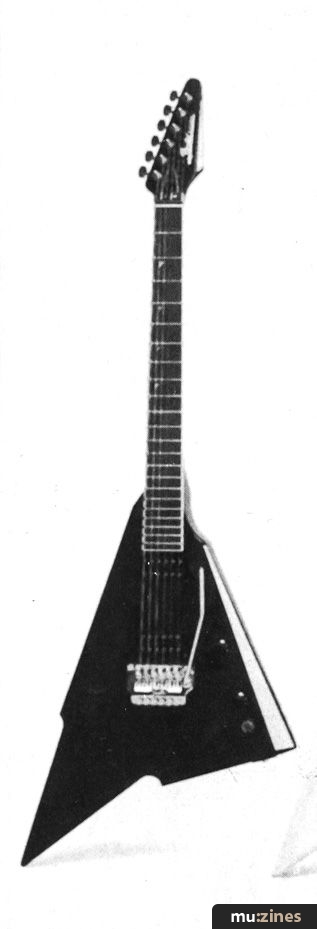
FENDER KATANA GUITAR £550
JUST ROOM for a quick run-down on the new Fender Funny Shape, as it's quickly become known round here. A triangular lump of body sets the theme, with tacky plastic silver stuff stuck on here and there.
Perhaps the question that loomed for Fender was, are we Fender, inventor of all this gear, or are we just another bulk Japanese guitar maker? On the evidence here, the latter.
All in all it's a workmanlike if plain instrument, uninspiring, and undoubtedly aimed at the heavier, stand-up guitarist.
A Gibsony fingerboard with 22 flattish frets sits on the neck, which is bonded to the triangle. The tone's pretty much the same all over, and a daft consequence of the triangular theme is the tiny fingerboard markers, quite easy to lose sight of under the bottom E-string — they're that tiny. It's worse where you need them most, too, up the top.
Two humbucking pickups are wound with messy tape, and there'll be no angle adjustments thanks to only two screws. The overall feel of the pickups is loose and wobbly. The bridge is somewhere between those of the two Strats elsewhere on this page — fine-tuners, single grooved saddles and a rocking trem action.
Top and warmish bottom are in evidence from the Gibsony set-up — the two humbuckers, plus single volume and tone and three-way selector — but as noted, the result is characterless. The tone is detented at 5, seemingly giving bass one side and treble the other, in effect. It's an attacky guitar at times, but lacking in the sustain department — a little more forthcoming, though, when you're stabbing chords into the flat fingerboard.
It's much like all the other oddballs-for-oddballs-sake you care to ram into your overdrive channel, in that there's no intention to stretch horizons or help you to play sitting down.
Apparently the guitar shares its curious name with a Suzuki motorcycle. Presumably, then, a good one for running flat out down country roads to scare Sunday drivers. TB
CONTACT: Fender UK, c/o (Contact Details).
Also featuring gear in this article
Publisher: One Two Testing - IPC Magazines Ltd, Northern & Shell Ltd.
The current copyright owner/s of this content may differ from the originally published copyright notice.
More details on copyright ownership...

One Two Testing - Dec 1985
Donated by: Neil Scrivin
Review by Jon Lewin, Tony Bacon
Previous article in this issue:
Next article in this issue:
Help Support The Things You Love
mu:zines is the result of thousands of hours of effort, and will require many thousands more going forward to reach our goals of getting all this content online.
If you value this resource, you can support this project - it really helps!
Donations for June 2026
Issues donated this month: 0
New issues that have been donated or scanned for us this month.
Funds donated this month: £0.00
All donations and support are gratefully appreciated - thank you.
Magazines Needed - Can You Help?
Do you have any of these magazine issues?
If so, and you can donate, lend or scan them to help complete our archive, please get in touch via the Contribute page - thanks!
Please Contribute to mu:zines by supplying magazines, scanning or donating funds. Thanks!
Monetary donations go towards site running costs, and the occasional coffee for me if there's anything left over!

 @mu_zines
 RSS Feed
 Blog
Blog